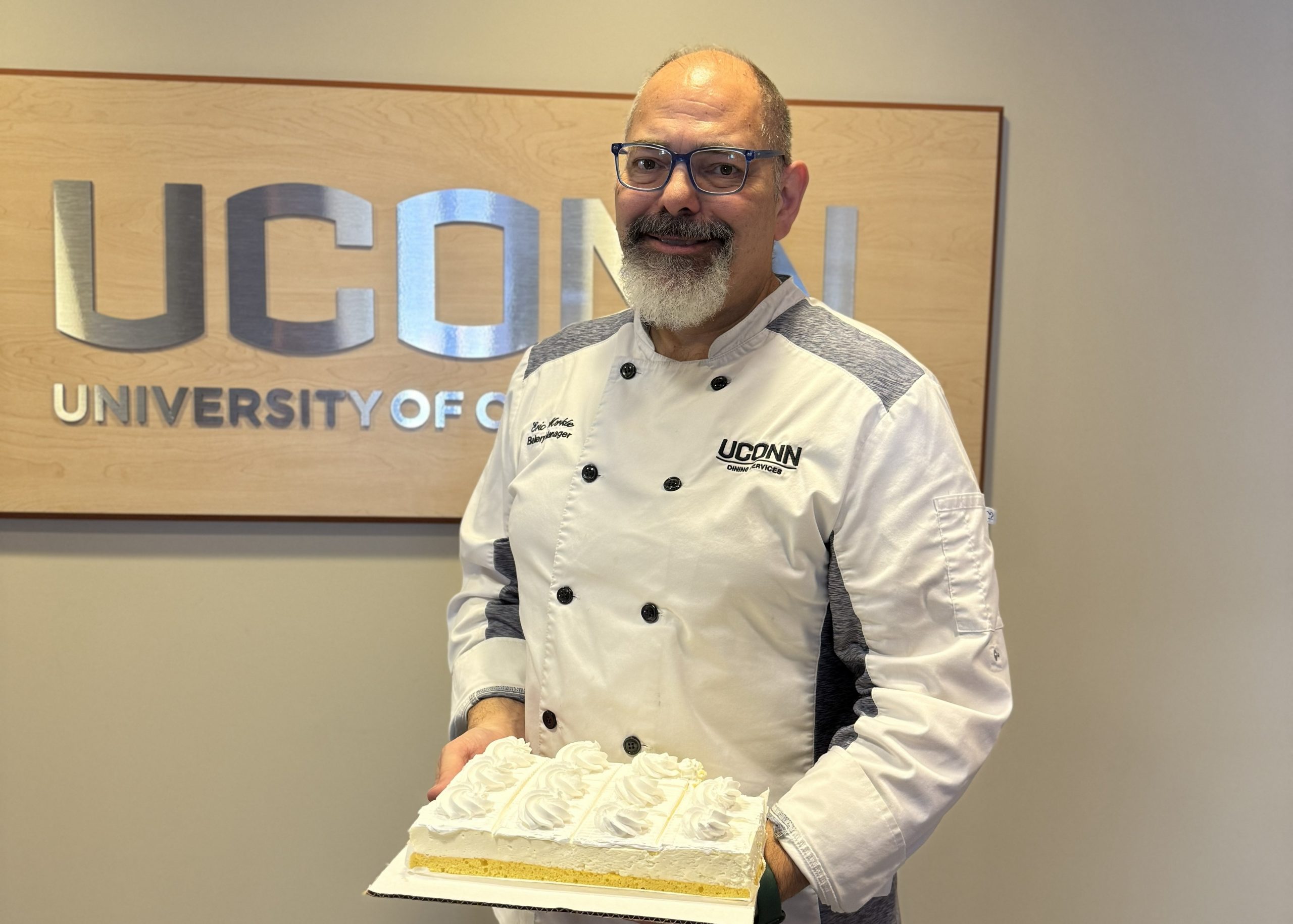
Eric Merkle is the long-time Bakery Manager for UConn Dining Services and oversees a staff of over 20 full-time bakers and student workers. The UConn Bakery produces thousands of muffins, cookies, and baked goods each week. The bakery starts each day at 3:30 a.m. – long before the rest of campus is awake. Eric studied bakery and pastry at the world-famous Culinary Institute of America. Each year, the bakery holds a pie sale for Thanksgiving, where members of the public can leave their Thanksgiving baking up to Eric and his staff! Everyone can get a taste of UConn by ordering from the online bakery. Eric’s cupcakes were also featured prominently in the recent UConn holiday video! Eric brought sample of a lemon chiffon cake (see the photo) and we all gave it a try!
Listen to Episode 155 on Podbean
Mike: Hello everyone. Welcome to an episode of the UConn 360 Podcast. It’s Mike Enright from University Communications, along with Izzy Harris from University Communications — and Izzy, happy spring semester.
Izzy: Thank you. Thank you.
Mike: This is the first week of classes for the spring semester at UConn. It doesn’t quite feel like spring, but I always think the spring semester goes by pretty quick.
Izzy: Yeah, it definitely does go by quicker than the fall semester.
Mike: Something about it — with the spring break in the middle. Sometimes when both basketball teams do well, all of a sudden it gets to the Final Four and all of a sudden, it’s like mid‑April and commencement is in three weeks.
Izzy: Exactly. Time flies.
Mike: Time does fly. Time does fly. Well, we have a great guest with us today. He’s the bakery manager of UConn Dining Services. His name is Eric Merckle. Eric’s been here for about 13 years at UConn. He oversees a staff of about 20 people — full‑time bakers and student workers — and the UConn Bakery produces thousands of muffins, cookies, and baked goods each week, and it’s my understanding we have some of those thousands of baked goods right here with us for a sample later.
Izzy: I’m super excited for this podcast, but I’m also super excited looking at this big white box of goodies right in front of me.
Mike: It can only mean one thing. Like I said, Eric’s a busy guy. He is going to tell us a little bit about what happens at the UConn Bakery and later on we’ll talk about the great Thanksgiving pie sale they have every year, which is always my contribution to Thanksgiving dinner. That’s my effort in baking — picking up pies from the UConn Bakery. Eric, thanks for joining us today.
Eric: Yeah, very happy to be here. Thank you.
Mike: So, tell us a little bit about your background and how you established your career as a baker and how you wound up here at UConn.
Eric: It’s actually kind of funny — Connecticut made me a baker. I went into the Navy right after high school and went out to the Gulf War. I was stationed right here in Groton on submarines. I specifically wanted that because I grew up on Long Island and I could take the ferry back and forth and easily get home. And I was a cook in the Navy. And when you’re a cook on a submarine, it’s only you. You have to cook for everybody — for about 110 to 120 people. So, after the Navy, I went to culinary school upstate New York, the Culinary Institute of America. I graduated, I believe it was ’96, and I moved to Aspen, Colorado to work for the Ritz‑Carlton. That was a very cool job. A fun job, a lot of celebrities, and a relatively small hotel — we got to do a lot of cool things. I left Colorado and I came here to Connecticut to be closer to my family on Long Island, and I got a job at Mohegan Sun. I was there a good 14 years as the pastry sous chef, dealing with mainly catering and stuff like that. At the time we had close to 50 people in the bakery at Mohegan Sun. I started up here, like I said, around 2012. It’s funny — I got the job, or I should say, I heard about the job from your health inspector. A lot of students and people probably don’t even know that you have your own health inspector here on campus. One of the health inspectors from Mohegan Sun would come up to campus and help her out every now and again. She clued me in that they were looking for a bakery manager. So, I applied and I got the job. And I love it. It’s been wonderful. Thirteen years. It really has.
Izzy: What an interesting background — starting from cooking on a submarine. That sounds extremely interesting to me, just like literally being underwater and cooking.
Eric: Yeah. Yeah, very much. We were certainly active with the Gulf War. It was very interesting, and the only limitations to a submarine is how much food it can carry. It can stay underwater indefinitely. It has enough power because it has a nuclear reactor. So yeah — the only limitation is food.
Mike: So how often — how long were you underwater for? For how many days at a time?
Eric: The longest was a month and a half.
Mike: Okay. Yeah. So, you would load all the food on.
Eric: Correct. Matter of fact, we put so much food on board, we walk on it. So, it goes in the hallways and there are thin pieces of plywood that we put on top of it, and we actually walk on the food.
Mike: Wow.
Eric: All cans and stuff like that.
Mike: Sure.
Izzy: Can you tell us a little bit about what your typical day is like in the UConn Bakery? I hear it starts at 3:30 in the morning.
Eric: Yeah.
Izzy: Tell us what you do each day and where the products go on campus.
Eric: Yep. It goes all over the place. We start — actually on Fridays we start at two o’clock in the morning, because on Fridays we have to get all the food out for the weekends because we don’t work weekends. It goes to every dining hall on campus. It goes to Catering on campus. It also goes to all the coffee shops. We provide product to Avery Point, the Law School, the Hartford campus, and even Stamford and Waterbury will order custom‑logoed items from us. Sometimes they’ll pick them up, sometimes we’ll mail them. The public can order cakes from us all the time. They can order pies and things like that. We’re a one‑stop shop. It’s not just pastries — we also make granola. We make ungodly amounts of pizza dough. But yeah, it starts at around 3:30 in the morning. The bread starts going in the ovens — muffins and things like that. We got to get them all panned and put in the orders and get the cabinets delivered by about 6, 6:30 in the morning. And then we actually start working on the next day.
Izzy: How have students’ tastes changed over the years since you first came to UConn? I know there’s so many trends and things to keep up on. It must be quite different.
Eric: It is very different. At Mohegan Sun, when I was there, our main clientele were actually seniors, so we catered to the seniors. Our main clientele here is 18‑, 19‑year‑olds, and they have a want and need to understand some things a little bit better. Why do we use the chocolate that we use, or why do we use the whipped cream or the topping that we use? And you have to explain some of those things.
Some of the dining halls have our desserts out at room temperature, and you can have them at room temperature. Cookies, pies—that’s not a problem. They don’t always have refrigeration, so I can’t put mousses and stuff out there that we can’t refrigerate. We also have our gluten‑free bakery on campus. I believe we’re the only campus that has a gluten‑free bakery. I am in charge of that. There’s only one pastry chef up there. She produces roughly 3,000–3,500 pieces a week in her 40‑hour work week. It’s in the original—the only original dorm kitchen left on campus. It’s across the street from Towers. And back in the day, all the dorms had their own little kitchens, and that kitchen cooked for the dorm. There’s only one left, and that’s now the gluten‑free bakery.
Mike: When I was going to UConn in good old Shakespeare Hall during the eighties, we had our own kitchen.
Eric: I’ve heard it.
Mike: Yeah. You’ve heard that story numerous times. She’s heard all my UConn glory stories. She’s sick of them, but that’s okay.
Izzy: I’m not sick of them. I think it’s cool to hear about it. And I actually asked my mom, and she also remembered having the same dormitory kitchen.
Mike: Yeah. You got to know the chef and the assistant chef. They became part of the family, part of the fabric of the place.
Eric: Yeah, exactly. I hear a lot of fond memories from—yeah—stories back then.
Mike: So, tell us—obviously the students and the university are your main clients, but you do the Thanksgiving pie sale every year. Talk about the general public and what their access to purchasing your goods is.
Eric: That’s a good segue. I mean, the pie sale is open to the general public. We also generally sell pies and cakes and birthday cakes and cookies like that to the general public all the time. More specifically, students’ parents will call up or order a birthday cookie—like a 10‑inch cookie cake—and get that picked up at the C‑Store, or they can actually come to the bakery and pick it up. The pie sale is probably our biggest sale throughout the year. And it’s very interesting—it isn’t really the pie sale that’s so much work, although it’s a fair amount. We do roughly 500 or 600 orders. It’s the timing of it. That week campus is closed. It’s Thanksgiving break. We in the bakery have to have a lot of product pulled together or prepped for the holiday parties before the Thanksgiving break because when we come back from break, there’s usually only one week of classes and a week of finals. And the dining halls want to get in their holiday parties in that last week. So, we can’t make it all then. We have to actually prep it a day or two or three beforehand—and that’s during the week of the sale.
But it’s very cool. We have a lot of customers—repeat customers. They like coming into the bakery and seeing what we do, how we do it. They like seeing the big racks that we have and how they go in the ovens and stuff like that. Nobody has things like that at home. We’ll often get requests for a cookie recipe or a cake recipe, and it’s really tough because I tell homeowners: they simply don’t have the equipment we have.
For instance, our ovens have a button that can inject steam into them. You have to have steam if you’re baking bread. We use very industrial mixers that are designed to mix bread at around 400 pounds a batch—like when we’re making pizza dough. You don’t have that at home. Your little KitchenAid can’t do that, unfortunately. So, the recipe isn’t going to turn out right.
Mike: So, tell us — get people’s appetite and mouths watering a little bit. Tell us about some of the desserts that are the most popular in dining halls. Yes, and you know, even though people are always health conscious, there’s always room for dessert.
Eric: Yes, there is. And it’s funny, talking a little bit earlier about the students and the trends. This time of year, or coming back from winter break, nobody eats. Everyone’s worrying about spring break, and the desserts and the amount of food that goes out goes way down. I brought you guys a sample of our lemon chiffon cake.
Mike: Ooh.
Eric: Yeah. It’s very nice. It’s a new product that’s going to be hitting the dining halls. I believe it first goes out a week and a half from now.
Mike: So, we get the preview.
Eric: Yes.
Izzy: I’ve been waiting very patiently and I’m ready to dig into—
Mike: Are you ready to check it out?
Izzy: I think so, yeah.
Mike: Should we open the box?
Izzy: I think we should. Wow. That looks good. That looks—can you tell us like what’s in it?
Eric: Yeah, of course. So, we start out with our sponge layer on the bottom. We use the sponge layer in quite a lot of different recipes. We make it completely from scratch. It happens to be what we call a three‑pound sponge. So, it ends up being the base layer for a bunch of different cakes. There is a cream‑cheese‑based mousse. So, you take a little cream cheese, you thin it down with a little bit of sugar — because when sugar hits cream cheese, it turns to liquid. We take a little gelatin, put a little lemon juice in there, bloom it, and then add it to the cream cheese and fold in some whipped cream and you have a lemon mousse. When it gets a little bit closer to the summer, I’ll probably add some blueberries to this.
Izzy: Oh, that sounds good.
Eric: Yeah. Yeah. It’s a rock‑solid dessert. We make it by the sheet pan, so that means you get 70 portions out of a sheet pan. And we actually have a machine in the bakery that cuts the sheet pans into the portions. So, it’ll cut everything from mousse cakes to brownies to cheesecake.
Mike: Oh, wow.
Eric: Yeah. It’s a really cool machine. It allows us to be accurate and get the exact portions out of the product that we’re looking for.
Izzy: Again, not something that would fit in my kitchen probably.
Mike: Yeah. This isn’t something you can make at home.
Eric: Not really. You’re right. No, I mean, you really need the bigger numbers — or I should say the bigger mixers and the professional stuff like that. It just doesn’t really work for home.
Izzy: All right. As I mentioned, I was getting a little bit impatient, so we took a quick break.
Mike: Not you.
Izzy: Never me. Never me. I’m the most patient person ever.
Mike: I concur.
Izzy: Say that a couple of times. “I concur.” “Patient person.” “Concur.” So, with that being said, we went ahead and divvied up a slice of this delicious lemon cake, and I think that it’s finally time to give it a try.
Mike: And this is called — what is it called again? Lemon…
Eric: Lemon chiffon.
Mike: Lemon chiffon.
Izzy: Lemon chiffon. Thank you. Because that’s a much fancier word. The cake gave—
Mike: Let’s give this a try.
Eric: Yes. It’s a very nice and light cake. Oh, it’s not overpowering.
Mike: It’s very good.
Izzy: Really good. Thank you. It’s kind of exactly like you said — it’s not quite as rich as cheesecake.
Eric: Exactly.
Izzy: But it also — I can taste the whipped cream in it.
Eric: Yep. Like you said.
Izzy: And the lemon.
Eric: Yep.
Mike: Yeah. It’s very good.
Eric: And the lemon.
Izzy: Yes, of course.
Eric: Yeah. It’s a super nice cake. It’s very versatile. I’ve even used this cake actually at the casino before. I’ve been making this particular recipe for at least 30 years.
Mike: Kinda has a hint of spring in it, like spring’s coming.
Izzy: I love the whipped‑cream layer on top. That really does it for me.
Eric: Yeah. It helps out a little bit. We actually run three different menus. We do a menu for the dining halls. There’s a menu for catering, and there’s also a menu for retail outlets. They don’t really mix, so we’re basically taking care of—I think I’m upwards of 25 or 28 units that order from the bakery.
Mike: Oh, wow. You were talking a little bit during our break about how long it takes to kind of fully implement and develop a dessert like this.
Eric: Yeah.
Mike: So almost a year?
Eric: Yeah, exactly. This lemon chiffon cake—we started working on it about a year ago. It takes quite some time to develop the recipe to meet our standards so that we can produce it. Meaning—how much cream do I need to make 45 sheets of this? Or how much milk? And I got to go back to my providers like Mountain Dairy and make sure that they can handle that much cream when we weren’t maybe ordering it before. I got to make sure my dry suppliers can make sure they get enough flour and sugar and stuff in so that I can produce this cake.
We can’t just put orders in without telling the suppliers that we need the product and we’re going to go through that product. It also goes through a couple of taste testings. Mike White, our director, will taste it. And of course, Rob Landolfi—
Mike: He’s been on—he’s been a podcast guest.
Eric: So not only can the bakery produce it—meaning this cake actually takes three days for us to produce. We get the sheet pans and everything set up one day. We pour all the mousse and everything, get it all pretty the next day, and then it goes through a cutting machine. Not only do we have to get that all prepped and it’s got to taste good, it’s also got to sit in the refrigerator for two days perhaps, and make sure it still gets to a dining hall and tastes good and looks good.
So, we have very specific things that maybe other bakeries don’t have to worry about. And that’s one of the things that takes so long to get things in motion. And I was working on this again for a spring menu—it’s nice and light and airy and a little more…
Mike: It’s a little more delicious. It’s delicious. So, tell me—when you’re at home, and it’s either the weekend or you’ve got some free time, what do you like to bake and cook on your own? What kind of food do you like?
Eric: Believe it or not, I like almost everything. I really do. I’m loving a lot of some of this fusion with Mexican and Vietnam and stuff like that. One of my favorite desserts to make is actually a Sachertorte. Unfortunately, we can’t make that here. A Sachertorte is hazelnut flour. And the bakery doesn’t use nuts.
Mike: Okay.
Eric: But it’s just a really nice chocolate and apricot dessert that pretty much goes back a good 300 years in Austria.
Mike: Oh, wow.
Eric: Yeah. Pretty interesting.
Mike: Wow.
Izzy: Well, I can say firsthand, this cake is delicious. So, anyone who has the opportunity to swing by any of our dining halls or the bakery, I highly recommend—
Mike: Pick it up. You’ll see a picture of it, and we’ll put the Dining Services website where you can buy various items on there in the description.
Izzy: I keep sneaking back for more bites and normally if we have some sort of extra food, sometimes we put it out for the rest of our lovely colleagues in Lakeside. But unfortunately—
Mike: You going to keep this one?
Izzy: I think this one might be coming home with me.
Mike: Sounds good. Sounds good.
Mike: Eric, thanks so much for joining us today here on the podcast. And thank you for everything you do for the students at UConn. It’s a team effort here. And students—if they’re happy with their culinary choices, they’re happy students.
Eric: Yes, they are. Yeah. We want to keep the students happy, and as they do—yeah.
Mike: Sounds great.
Izzy: A quick note before we sign off: Thank you so much again for all of your help with the holiday video.
Eric: Oh, my pleasure.
Izzy: Eric helped produce these wonderful cupcakes that were featured in Holiday U.
Mike: Oh, that’s right! I remember seeing that. That was you. Oh great. Great. Thank you for doing that.
Izzy: They were amazing. When you just think of the most beautiful cupcakes that you could ever imagine — I asked Eric to help me create a UConn Winter Wonderland cupcake theme, and he literally brought my vision to life.
Mike: You know what? Even though the holiday’s over, we’ll put that link in the description too.
Izzy: Yeah, why not?
Mike: So, people can see it. So, thanks everybody for listening. Stay warm and we’ll catch you next time on the UConn 360 Podcast.