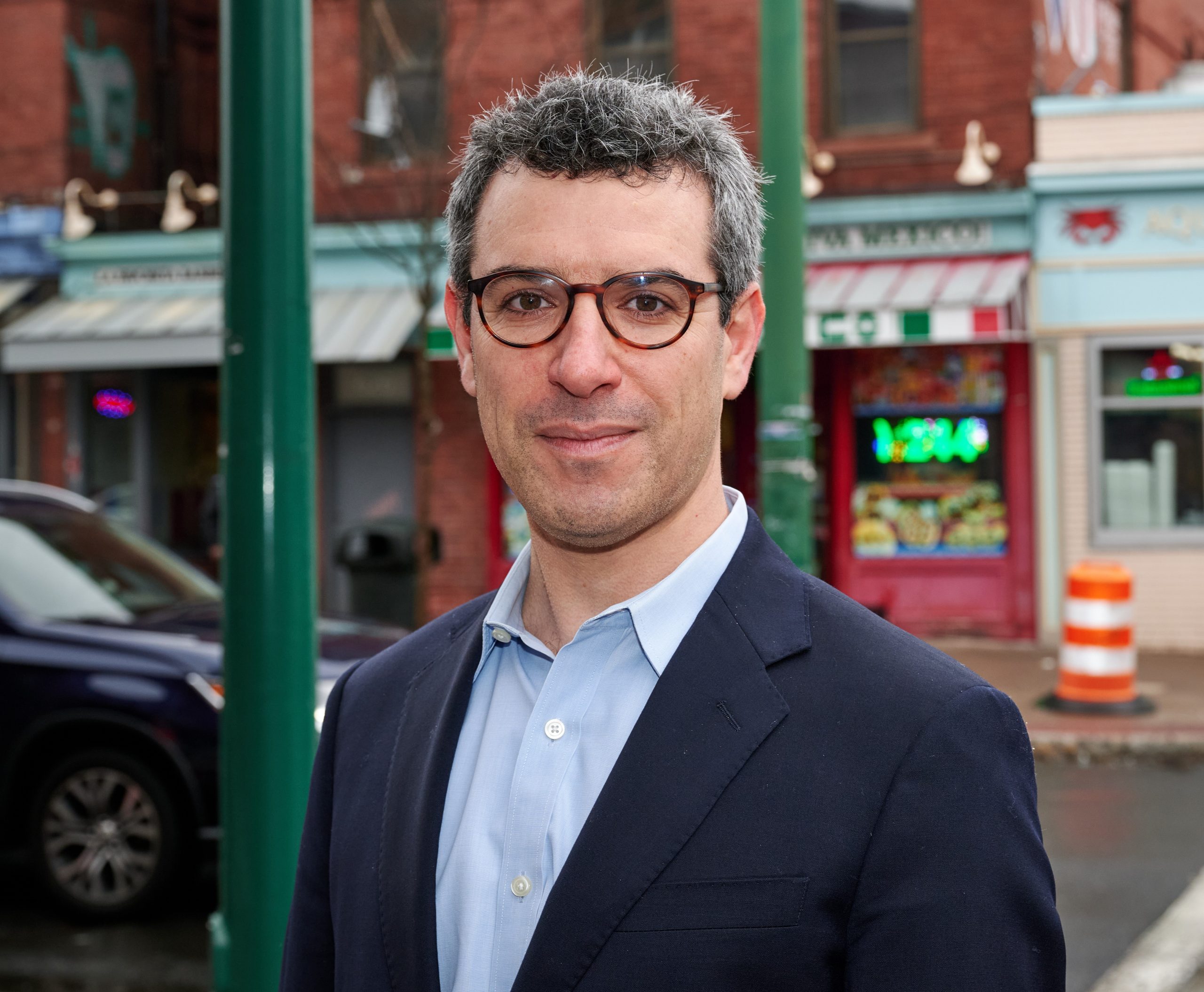
Andy Horowtiz is our guest on this episode of the UConn 360 podcast. He is an associate professor of history at UConn and also serves as the Connecticut State Historian. Andy discusses with us the recent America 250 celebration and a series of historical signs he designed that describe Connecticut’s various roles in the Revolutionary War. He also writes a column in the publication Connecticut Explorer, which brings Connecticut’s past into the present and gives us some tips of interesting places to visit. At UConn’s Hartford campus, he teaches modern U.S. history, as well as a new course called “Connecticut: A History of the World Around Us.” It’s also our first try at doing the podcast as a remote broadcast, so please forgive us if some of the audio sounds a little off!
Listen to Episode 167 on Podbean
Mike: Hello, everybody. Welcome to another episode of the UConn 360 Podcast. It’s Mike Enright from University Communications, along with Izzy Harris from University Communications. Izzy, the Fourth of July is behind us. Did you have a good holiday?
Izzy: I did. It was super hot, but also super fun.
Mike: Good, good. Beach and fireworks, and of course, this was America 250, and it’s a little bit about what we’re talking about today. Our guest is Andy Horowitz. He’s an associate professor of history here at UConn and also the state historian. As a native of New Haven, he was raised there, and he began his career as the founding director of the New Haven Oral History Project at Yale University, where he got his education.
His first book, Katrina: A History, 1915–2015, was written while he was teaching down at Tulane and won the Bancroft Prize for the best book on American history. He’s published essays in Rolling Stone, which is super cool, The New York Times, and Connecticut Insider. He’s been featured on NPR, the BBC, and Where We Live.
The Organization of American Historians has designated him a Distinguished Lecturer, and in this upcoming academic year, he’ll offer a nationwide series of lectures as a Phi Beta Kappa Visiting Scholar. At UConn’s Hartford campus, he teaches modern U.S. history, as well as a new course, Connecticut: A History of the World Around Us. Andy, welcome to the UConn 360 Podcast. Thanks for joining us.
Andy: Thanks so much for having me.
Mike: So, we went through your history there a little bit. We know you’re a New Haven native and went to Yale. How did you become interested in history, and specifically the history of Connecticut?
Andy: Well, I had two, two really interesting grandmothers, and I think I kind of grew up, you know, listening to their stories. But, and that made me just sort of inclined toward history. But the way I got hooked on Connecticut in particular is I had a summer job three summers in a row in high school and college working for the City of New Haven Department of Weights and Measures.
And I realize that’s a really weird place to start a story about becoming a historian, so, so bear with me here. But this is a consumer protection agency where I went around to every small store in New Haven that sold things by weight, like a deli or a, you know, produce counter or whatever, and made sure their scales were weighing accurately, you know, that they weren’t accidentally charging people for a pound of cheese if they only put three-quarters of a pound on the scale.
What this meant was that for three summers, I was in every neighborhood of New Haven, and it just gave me the sense, this maybe sounds a little parochial, but it gave me the sense that the whole world was in New Haven and certainly gave me the idea that the more I knew about this place, the more interesting it was. And that was just a really, you know, sort of profound experience for me when I was a teenager.
Then I went to college, and I had a really important teacher named Glenda Gilmore, who taught me about something called oral history, which basically means interviewing people about, you know, their memories and their experiences in the past. And as we worked together, that developed into us starting this thing you mentioned called the New Haven Oral History Project, where I was working to interview people about New Haven history, and that was sort of my beginning.
That sort of formalized the stuff I’d been doing at Weights and Measures, traveling around and talking to people, but also formalized my role as a professional historian and, I guess, set me on the path that lands me here with you today.
Izzy: Yeah, I really liked your sentiments about New Haven. It really is such a cool city. I hadn’t spent too much time there, and one of my friends recently moved down there, and it’s been so fun to poke around and learn about the history. But speaking of history, can you tell me a little bit about your role as the state historian? How did you get it, and what are your responsibilities?
Andy: It’s a unique job. I mean, truly, it’s a unique job in that I’m the, I’m the only one. There’s only one Connecticut state historian, and many states don’t have a state historian. The state legislature created this position around 90 years ago, around the 300th anniversary of Connecticut’s colonial founding, and it’s sort of taken various forms over the years.
But for the past decades, by state statute, it’s a position appointed by UConn’s History Department. So, they get to decide who the state historian is. And there are a number of responsibilities that are provided by state law, and a lot of that has to do with committee work. I’m on a number of public boards and commissions, like the State Historic Preservation Council.
I’m on the board of Connecticut Humanities, various organizations that are sort of charged with caring about history and the humanities in the state. But I also have kind of a broader mandate to support the work of history in the state. Sometimes I say that I’m meant to be a hype man for Connecticut history.
When I’m trying to be more formal or erudite, I say that I support communities in Connecticut as they engage in acts of collective autobiography. But my interest is in trying to help people tell stories about Connecticut that feel relevant, feel interesting, that are accurate and informative, and try to support a sense of place for us here in the state.
Mike: So, as everybody knows, we just had America 250 and the Fourth of July. Now, I doubt you two were around for the bicentennial, America 200, back in 1976, but I was a young boy back then. And it seems like the mentality of the country was maybe just different back in 1976. Although, me being a young boy, maybe that was just me being naive because there were events in 1976 that were seemingly as polarizing as 2026, like the end of the Vietnam War and issues like that.
But Andy, tell us a little bit about, you know, what you think the mindset of Americans is as we celebrated 250. And I don’t know if you’ve done any research or had thoughts back to 1976 and the mindset then.
Andy: Well, no doubt, you know, this is a complicated time that we’re in here in 2026. Everybody has a sense of how fraught our politics are, how polarized we are. And you’re right, Mike, that, you know, viewed through a child’s eyes, July Fourth is all fireworks and hot dogs, and I bet that was the experience for children, you know, this past July Fourth, too. But as you said, in 1976, it was quite a polarized time with the end of the Vietnam War and Watergate, and I think many people tried to use the bicentennial as an opportunity to tell a kind of patriotic story that could bring Americans together and try to have some kind of repair of a fractured politics.
And I don’t know that people were quite that ambitious this time, thinking that, you know, an important weekend could repair all that is broken in our politics. But I do think it presented an opportunity for people to reflect on what America is, what the United States of America is meant to be for, and to try to revisit some of the stories of our national origins.
You know, my family has not been in Connecticut. My family moved to Connecticut just before I was born. Most of us can’t trace our families back to 1776. But nonetheless, the stories of the 1770s are our collective inheritance as Connecticut. They give us a sense of who we are, who we want to be. So, the chance to revisit some familiar stories and tell new stories about the American Revolution, I think, gave us all a chance and gives us all a chance to reflect on, you know, trying to find a way out of what I think we can frankly call a kind of morass of our contemporary politics.
Izzy: So, Andy, I know we just worked together on telling the story of the Charter Oak, and I know that was just one of the series of historical markers around the state that you were trying to highlight in Connecticut around America 250. Can you tell us a little bit more about some of those stories?
Andy: Yeah, I had this great opportunity. This is one of the cool things, you know, that you don’t expect, but it’s hard to know what to expect when you’re the state historian of Connecticut. The Department of Transportation called and said that they were interested in commemorating the 250th with a series of new historical markers, and could I help?
And this gave me an opportunity to really think about the kind of stories that it would be interesting and productive to share. So, I ended up creating 38 new markers in collaboration with the DOT. These are up at the train stations, bus stations, and service plazas across the state. And each sign, I hope people start noticing these as they stop and look for them, uses a specific object, often from a Connecticut museum or historical society.
So, there’s a big picture of the object on the sign, and then it tells a story about the person who made it or held it. So just to give one example, and I should say even before I say anything else about these signs, that when you notice them, I hope people find them quite visually beautiful and interesting.
And that’s to the great credit of some MFA students at UConn working at the Design Center Studio who actually designed them. And one of their great ideas, the students’ ideas, was to cast them in the colors of Connecticut’s flag. So, when you see these brightly colored signs, that’s a product of great UConn student work.
But one that’s particularly meaningful to me, there are so many. We have Nathan Hale, a picture of Nathan Hale’s diary with some of the last words that he wrote down about seeing a lightning storm. We have a red coat worn by a Loyalist officer who was from Fairfield County. We have powder horns that were carried by Connecticut soldiers.
We have a watch that a man from New Milford carried with him as he walked across the Delaware River with George Washington. So, there are a bunch of amazing stories, but the one that stands out for me maybe the most is a sermon written by a man named Lemuel Haynes, who was from what was then called the Western District of Hartford.
Today, it’s part of West Hartford. He was born and was very quickly, as an infant, given over to a family to be raised as an indentured servant. And after he finished the terms of his indenture, he turned 21, he joined the militia, served for a couple of years for the Patriot cause, finished his military service in 1776, and went to study theology.
And he went on to become the first ordained Black Protestant or Congregational minister in the United States. His first pulpit was in Torrington. But before he did that, he wrote a sermon, and I think he wrote the sermon right after hearing the Declaration of Independence.
And I know that, and people will see this on the sign, because when he wrote the sermon, he also transcribed the preamble to the Declaration, “We hold these truths to be self-evident,” on the front page of the sermon. And then he wrote down what he thought about it, including the idea that the Declaration should mean equality and the abolition of slavery.
He wrote that what is precious to one man is precious to another, and what’s intolerable to one man is intolerable to another, and therefore, we must conclude that liberty is equally as precious to a Black man as it is to a white one. He called the sermon Liberty Further Extended, and I was so proud to share that story, along with, you know, dozens of others across the state, in these signs, in collaboration with these UConn students and the Department of Transportation.
Mike: So, Andy, talking about people getting out in the state and seeing different things, as a state historian, if somebody had a free Sunday afternoon with their family and said to you, “What, you know, where is an interesting and maybe even quirky place we can visit that’s uniquely Connecticut?” I think people would enjoy hearing about where, you know, what are some out-of-the-way places, unknown places, that people should visit in Connecticut?
Andy: Well, I don’t know about unknown, but one place that I’ve been going to a lot this summer, one of the things I do as state historian is I write a quarterly column in Connecticut Explored magazine.
And if listeners don’t know about Connecticut Explored, anyone who’s interested in Connecticut history, finding new stories to know about our state or new places to visit, Connecticut Explored is just a fantastic resource. I highly recommend it. I’ve got a column in every issue called “Making History,” where I interview people who are bringing, I think I describe it as people who are bringing Connecticut’s past into the present.
A couple years ago, I had the opportunity to interview a guy named Don Tuller, and I’ve been thinking about him recently. I’ve been thinking about him because he recently passed away. He was a farmer in West Simsbury. I forget how many generations, forgive me, but maybe six or seven generations, maybe even eight generations, his family has run the same farm in West Simsbury.
They opened it in 1768, and it’s still in the family. And the reason that I’ve been going there so much this summer with my family is that, well, hold on. Before I say what I’m about to say, I just want to give this disclaimer. As state historian, I work really hard to be kind of nonpartisan and neutral, and I’m very aware, in a sort of public role, that there are responsibilities about what is appropriate for me to say when I’m speaking as state historian.
But I’m just going to throw caution to the wind here and say that this farm, Tulmeadow Farm in West Simsbury, makes the best ice cream in the state of Connecticut. It has a lot of competition. There’s a lot of great ice cream in Connecticut, and Tulmeadow Farm is better.
And so, it’s so cool to go to this place that’s been in the same family since 1768 and to see it not as an antique, but as a place that’s managed to adapt to the times in the 1700s, 1800s, 1900s, and to today, and manages also to make just such a beautiful toasted almond crunch, a beautiful red raspberry chocolate chip.
Don Tuller’s daughter now runs the ice cream stand, and she’s experimenting with all kinds of, like, rose pistachio baklava, all kinds of crazy flavors. So, if you want to go see an 18th-century farm that is bringing Connecticut agriculture into the 21st century, you could do a lot worse than going over to Tulmeadow Farm in West Simsbury and getting, getting some ice cream.
And then going to walk the trail through the open space that the family’s preserved in a land trust, so that you can get a sense of what that farm has looked like over the centuries. It will never be developed because of the family’s hard work.
Izzy: While I’m sure the ice cream is really good, it’s going to be tough competition for the Dairy Bar.
Andy: I know, I know what I did. That’s why I gave that disclaimer. The Dairy Bar makes incredible ice cream, and, you know, maybe with 250 years of practice, they’ll get as good as Tulmeadow Farm. But there’s something to be said for doing it since 1768.
Izzy: Fair enough. Can you talk to us a little bit about the exhibit Connecticut’s Revolution that you’ve been involved with, with the Museum of Connecticut History that’s located at the State Library?
Andy: Yeah, Connecticut has a state museum at the State Library. And I’ve been really proud to work with the expert staff there, including some, some UConn alums. We should give a shout-out to the curators there who are proud UConn history alums.
But to make what I regard as really a major exhibit about the American Revolution in Connecticut, we brought together, the state museum is connected with the State Library and the State Archives, so they just have totally unparalleled collections.
Every, you know, important piece of paper that’s been created by the Colony of Connecticut or the State of Connecticut is there. And we put together a major exhibit that brings together more than 100 objects and artifacts from the Revolutionary era that have never been put together before to try to tell the story of what the Revolution was like for all kinds of people, Patriots, Loyalists, free and enslaved, Black, white, and Indigenous, men and women, people from Connecticut cities, people from Connecticut’s rural areas.
All had a very different relationship to this conflict, and we try to explore what the Revolution meant to them. And so, there are all kinds of sort of interesting stories about individuals and big stories about the meaning of liberty, and, just to my mind, extraordinary artifacts to encounter in person.
So, I’ll just advertise one. When you walk into the exhibit, one of the first things that you will see at the state museum is a copy of the Declaration of Independence, and it’s Connecticut’s official copy. It was printed in January 1777.
And what’s amazing about this particular copy of the Declaration, along with being the first printed copy to list the names of the signers, it was printed by a woman named Mary Katharine Goddard, who was born in New London, and she then later moved to Baltimore, which is where she printed this, this copy.
But as printer, she printed her own name on the bottom of the page. So, this is the only copy of the Declaration of Independence that has a woman’s name on it. And so, it’s extraordinary as a sort of, as Connecticut’s official copy, as a copy printed by a Connecticut person, as a copy printed by a woman, as a copy with a woman’s name on it.
And then when you remember that the signers, the people who affixed their names to the Declaration, were very publicly outing themselves as what the British would regard as traitors. They were essentially signing their own death warrants. And so, we get a sense of Mary Katharine Goddard as somebody who really was willing to put her life on the line to promote the cause of independence.
And that’s just, like I say, one of 100 similarly amazing artifacts that are on display. So, it’s really been a privilege to work at the museum and to work with these collections, and I think to tell what people will find to be a pretty extraordinary story. The exhibit’s going to be open for a year, so people have time, I hope, to get over there and check it out.
And it’s, it’s, it’s free. This is, this is our public museum, so I hope that people will go.
Mike: Andy, at your core, you’re a teacher, you’re a professor. Tell us about this new history class you have about Connecticut that you’re going to be doing, I think, this fall at the UConn Hartford location.
Andy: One of the real privileges of teaching at UConn Hartford is that most of my students are from Connecticut, and that’s just a really interesting thing, so that we all have Connecticut in common.
But other than that, we’re as different, you know, as different could be. Last semester, just for example, sitting next to each other were one kid whose family was, like, a ninth-generation agricultural family from Durham, and another kid whose family had just moved from Colombia. So, newcomers and people who have very long lineages in Connecticut.
And I wanted to tell students, you know, this interesting and diverse group of Connecticut people, I wanted to tell them a story about the place we all share. And so, I called the class Connecticut: A History of the World Around Us. ‘Cause just like I started by saying about, you know, traveling around New Haven and coming to see that the whole world was there, I really think that Connecticut is about a small place that really has the whole world in it.
You know? There are so many different backgrounds and sort of national histories that have come here to mix together, every possible profession and interest. And to me, it’s just such a productive challenge. I think it’s really the challenge of my career to try to tell a story about Connecticut that we can all see ourselves in, that feels true and meaningful and relevant, and also, I hope, is just interesting and maybe even fun.
And so that’s the project for the fall, and I can’t wait to have, you know, 40 Connecticut students at Hartford to try to come along on this journey with me and see what we can learn about this place that we all share.
Mike: Andy, I’m going to go off script on you here for a second. I’m a proud, lived in Connecticut most of my life, although I’ve lived in Indiana and Massachusetts, and I think one of the things, it’s probably one of my pet peeves about Connecticut, but makes Connecticut unique, is that we’re almost this, we have 169 towns, and they’re so independent, and people relate sometimes more to what town they’re from than what state they’re from in Connecticut.
Didn’t know if you had any thoughts about that, that kind of municipality attitude that exists maybe here in Connecticut and not other places.
Andy: It is a really interesting fact that I think people don’t really have a sense of what Connecticut is. They might know what West Simsbury is, or Enfield, or Storrs, or New Haven, or Bridgeport, or Bridgewater, like all those places.
Those places seem to have more meaning to people, as you’re saying, Mike, than maybe Connecticut does as a container. And, you know, I think you’re right to look to a kind of history of independent governance and local governance that I think is quite good. You know, I think it, on balance, is good for people to feel really connected to their local communities.
It, for me, a state historian, creates a real opportunity to try to figure out what this thing called Connecticut is. It gives me a kind of great title page for the story that I try to tell.
Mike: Well, yeah, I appreciate your input on that because I do think it’s, you know, we drive from town to town, and it seems like every couple miles you’re going into a new town in Connecticut, which is just different from how other states are set up.
Andy: I like that about Connecticut, though. You know, I think if the “we” that we talk about when we talk about Connecticut was one homogeneous group, my job would be pretty boring. But the fact that, you know, there are tens of thousands of people from Jamaica, and tens of thousands of people from Guatemala, and tens of thousands of people who can trace their family back to colonial times, and on and on, independent Indigenous nations and all of that, all kind of crowded together in a very small area, each sort of practicing their own, you know, pursuing their own idea of happiness, to use the Declaration’s phrase, but also sharing the space in common and trying to live together.
This is the great promise of American democracy and, you know, good on us for trying to make it work, and the fact that it gives all of us an opportunity to explore and learn from each other and kind of revel in, you know, in that diversity, I think, is just a great thing about the state.
Mike: Well, Andy, thank you for joining us today on the UConn 360 Podcast, and thanks for all the work you do for us here at UConn and also for the entire state. Really appreciate you joining us today.
Andy: Thanks so much for having me. I love UConn 360. I’m a UConn partisan, so it’s great to be here.
Mike: Izzy, we’ll talk to you next time on the podcast.