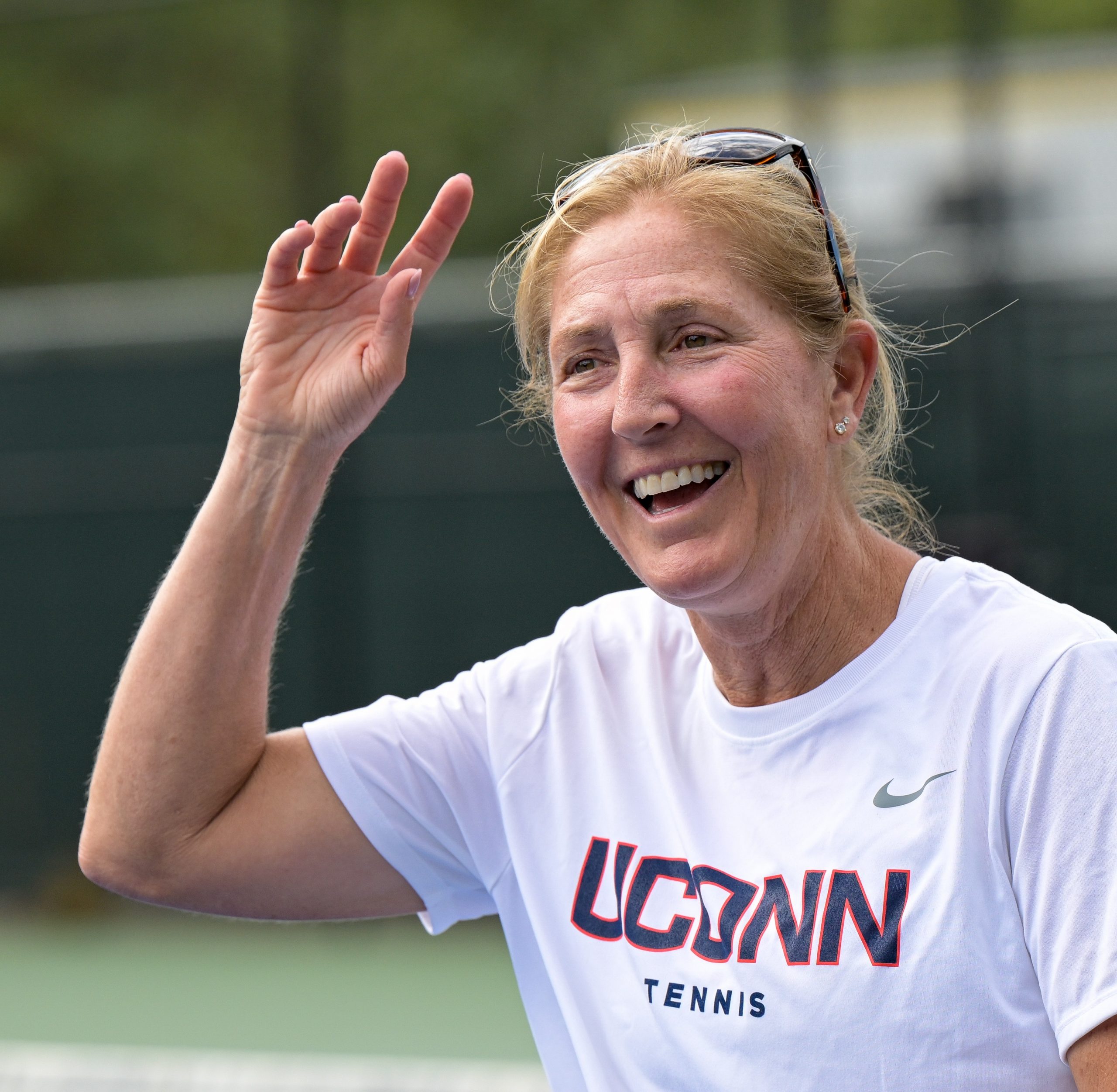
Laura Glitz is entering her second season as the women’s tennis coach at UConn and joins us on the podcast right after the conclusion of the U.S. Open. She knows all about that event as she played in all four Grand Slam events as a professional player. Laura was ranked among the top 300 singles players in the world and the top 90 in doubles. Following her pro career, she took up college coaching and came to UConn from Purdue, where she spent 18 season and was the winningest coach in school history. Laura led UConn to the Big East semifinals in her first year. Keep listening as Izzy and Laura get into an involved pickleball conversation toward the end!
Listen to Episode 171 on Podbean
Mike: Hello, everybody. Welcome to another episode of the UConn 360 Podcast. It’s Mike Enright from University Communications, along with Izzy Harris from University Communications. Hi, Izzy.
Izzy: Hey, Mike.
Mike: I’m very excited today.
Izzy: Me too.
Mike: I’ve met a lot of people in sports, due to my sports background. I’ve met a lot of people who have done a lot of great things, but I’ve never met anybody who played at Wimbledon or the US Open.
Izzy: Ooh, I don’t think I have either.
Mike: And that just changed.
Izzy: I know. What a lucky day.
Mike: Exactly. So, our guest is Laura Glitz. She’s entering her second year as our women’s tennis coach here at UConn. She came from a really successful career at Purdue, where she spent 18 seasons and became the winningest coach in school history. In her first season at UConn, she led UConn to the Big East semifinals. She’s also been the head coach at Cornell. Like we said, she had a very, to me, a very impressive professional playing career.
She played in all four Grand Slam events, the French Open, Australian Open, US Open, and Wimbledon. Did you know those four?
Izzy: I didn’t.
Mike: Oh, okay. See? That’s incredible.
Izzy: I don’t think I was familiar with the French Open.
Mike: That’s the one before Wimbledon. It probably doesn’t get as much attention as some of the others.
Izzy: Okay. But yeah, well, you learn something new every day.
Mike: You learn something new. She was an All-American player at Arizona State. Laura, welcome to UConn and welcome to the UConn 360 Podcast.
Laura: Yeah, thank you so much. I’m happy to be here.
Mike: So, we got to kick off with what I just talked about. You played in all four majors. You had an amazing professional career. Tell us about that experience and maybe what people, you know, we watch on TV, we watched Alexander Zverev and Elena Rybakina win the championships this year, but tell us, what’s it like to play in those events?
Laura: I mean, it’s incredible. It’s like the pinnacle for a tennis player. So, for me, I had a little bit of an interesting, I guess, way to get there, how I climbed up to the top. But, so, I was playing on the tour for about two years, and I was playing in Brazil and almost actually quit tennis, to be quite honest, at that tournament.
And then my partner and I got to the finals of the doubles, and from then, we kind of, like, soared, and we became top 50 in doubles, and then my singles jumped up.
And then once you get to the Grand Slam tournaments, like, you don’t want to leave those tournaments. The experience, the travel, everything. I mean, it’s just a phenomenal way to see the world and, like, play great tennis and be a part of something huge. So, for me, that was, like, it. It was the best.
My parents owned a tennis club at the time, so when I played the US Open, this was before the badges actually showed, like, you had to take a picture, so they brought in, like, our entire club into the player lounge. So, it was quite amazing.
Mike: Of the four Grand Slam tournaments, was one more your favorite than the others?
Laura: Well, I mean, you got to go with the US Open, right? But I would say, as far as player-friendly, the Australian Open is what most of the players say is the most player-friendly, and they are the most accommodating. And then, obviously, Wimbledon has the prestige. I mean, they haven’t, I don’t even think they’ve done much to the venue, you know, because it’s what they, it’s just, you know, Wimbledon, so.
Izzy: So, we know that you attended a qualifying day of the tournament this year. What was your reaction to this year’s events and the winners, and what about some of those start and end times? I mean, we were all over the place.
Laura: Yeah, so we went to the qualifying, and it was, I want to say it was, like, the first round of qualifying. So, its basically players ranked from 100 to 200 in the world. And, I mean, for us, it was really interesting because I took three of our athletes, and we were watching, and I was showing them the level, like the footwork and the intensity. And probably the difference between the qualifying and the main draw is just a little bit of, like, the errors are fewer. You know, they’re more proficient in the game. But as far as, like, if you would watch them practice, you would say, “Oh, these people are the same.” But then, when you get into the match situation and the pressure, like, that’s where you can see the difference.
Mike: I was going to say, for the professionals, I’m sure, you know, most of us, when we watch tennis on TV, we’re watching the top 10 players, the top 15 players, the top 20 players. But if you’re in that 100 to 200 range, is it a hard life in some ways?
Laura: Oh, it’s a very hard life. I mean, you’re living out of a suitcase. You’re going from week to week. Obviously, the top players are flying in private jets, so for them, it’s, you know, glamorous. But look, I mean, you’re doing something that you love every day, and, you know, how can you beat that?
Izzy: So, when you were done with your playing career, how did you end up at UConn?
Laura: Well, so when I got done playing, I actually, so I was a finance major in college at Arizona State, and I always thought I was going to be a financial analyst. That’s kind of what my focus was. And then I got out of playing, and I just jumped into teaching at the club that my parents owned, and I just really loved it. And I did it for about four or five years, but I was like, “I really want to get back into college tennis,” because I love teaching student-athletes.
And so, my first job was at Princeton, where I was there for four years as an assistant coach. And it wasn’t that far from Pennsylvania, where I lived, so I was like, “If I don’t like it, I can come back easily.” But I loved it. And then, from there, obviously, I was the head coach at Cornell.
And then, to be honest, when I moved out to Purdue, in my head, I was thinking I’ll be there, like, five years. And then I just really fell in love with the athletes, the atmosphere there, and, you know, 18 years later, I’m still there. I’m super excited to be at UConn.
I’m from the East Coast. I grew up in Maine, actually, until I was 15, so I’m from New England. So, for me, this is, like, kind of coming back home. My dad lives in Pennsylvania, and my mom actually moved here to Connecticut. So, yeah, for me, like, I’m just around more family, and that’s kind of really what I wanted. You know, in my last 10 years of coaching, I wanted to be, you know, I just felt a little isolated out in Indiana. I didn’t have any family there.
Mike: So, you talked about it a little bit. When you heard the UConn job was open, certainly the appeal to come home was part of it. What else did you know about the program, and what else did you know about the school in general?
Laura: Well, obviously, UConn has a huge name in athletics. I knew that. And I just looked through different things in the history, and I was like, “This program has a lot of potential.” You know? And to be honest, everywhere I went, so when I went to Cornell, they hadn’t won an Ivy League match in three years before I went there. And then I went to Purdue, and the same thing, they lost a lot of players, and we started at the bottom.
So, not that we’re at the bottom here, but I really like coming in and developing the program and taking it to the next level. I think we did really well in the first year with the roster that we had, and I think we’ve added four good players, so I think we’re going to be even better this year.
Mike: For people who don’t know a lot about college tennis, tell us a little bit about it. It’s kind of an all-season sport. Tell us about what you do in the fall, what you do in the winter, and how it culminates in the spring.
Laura: Yeah, so right now, basically, this part of the season is more individual. The individual NCAAs for singles and doubles are right before Thanksgiving. So, all these tournaments are basically geared toward making the individual tournament. It counts toward your individual ranking in singles and doubles. Then, once we get to January, it’s all team, and the NCAAs for the team are in May. So, it’s kind of broken up into an individual season and then a team season.
Mike: And you have the Big EAst Tournament, and it’s like other sports where the winner of the BIG EAST Championship gets an automatic bid to the NCAAs.
Laura: Correct. Yeah.
Mike: Gotcha. Gotcha.
Laura: The first tournament that we’re hosting here at UConn is like a team format, so you’re still kind of playing as a team. You know, you’re working together as a team every day, and that’s kind of what we’ve been focusing on, just being a collective group and being all in every day on what we want to do and what we want to achieve. So even though it’s individual, we’re still focusing on the team.
Izzy: Your roster has an international component to it. Is that typical of college tennis, and what’s the process of recruiting internationally?
Laura: I would say yes. International players are pretty prevalent in college tennis these days. I would say with golf and tennis, and even more so in all sports, to be honest, international players are becoming a greater presence. But yeah, the recruiting process, I actually haven’t been to all these countries. It would be quite fun to go and visit them in these countries, but basically, how the recruiting process works is, you know, you use recruiters, and they kind of send you recruits, and you look at them.
But with tennis, there’s so much live streaming that you can actually watch them play tournaments live. You don’t really need to be there, which has made international recruiting quite a bit easier and a lot more efficient. But our roster, I would say, is probably half and half right now.
Mike: So, this isn’t news, but the weather in Storrs, Connecticut, for some of the year is not conducive to tennis. Of course, it’s probably the same way at Purdue and Cornell. How do you deal with the cold weather? And I assume there’s some indoor play.
Laura: Yeah, I mean, I think most of these places have indoor facilities these days, so being indoors or outdoors is not that big of a factor. But yeah, I mean.
Mike: Where does the UConn team go for indoor practice and play?
Laura: Yeah, so right now, we play our matches and practice in the wintertime at Magic Lincer Tennis Club in Manchester.
Mike: Great. Do you play tennis?
Izzy: Oh, no.
Laura: Oh, okay. Okay.
Izzy: But we’re segueing into a topic that is going to make Mike upset.
Mike: I’m not upset.
Laura: What?
Izzy: I love pickleball. How do you feel about pickleball?
Laura: So, look, I love playing pickleball. I mean, do I like it better than tennis? No. But yeah, for me, it’s something different. Obviously, I’ve played tennis since I was 12, so for many years. So, I love playing pickleball, and I’m going to try padel as well.
Izzy: Ooh.
Laura: That’s the new one that’s kind of maybe taking over pickleball.
Izzy: Oh, wow.
Mike: I don’t know what that is. What is it?
Laura: You don’t know what that is?
Mike: No, I don’t.
Laura: So basically, it’s an enclosed court, maybe kind of the size of a racquetball court. You can hit off the walls, but it’s played with a small paddle, and I’m pretty sure it’s a tennis ball.
Mike: Hmm.
Laura: And it’s a small net. It’s kind of like racquetball, tennis, and pickleball, with that size of court. Yeah, so it’s a little bit of everything combined.
Mike: You’ll have to give that a try, Izzy, and get back to us.
Izzy: I mean, three years later, I’m just starting to get decent at pickleball.
Mike: Always a new challenge.
Izzy: I don’t know. It definitely is a challenge when you face ex-tennis players, though.
Laura: Mm-hmm.
Izzy: Because they have an enormous amount of skill and talent.
Laura: Well, I will say, when I play pickleball, they know I play tennis.
Izzy: Absolutely.
Laura: They can tell right away, so whether I’m doing it right or wrong, they can tell its tennis.
Izzy: People ask me if I play tennis, and I haven’t picked up a tennis racket since, like, oh my gosh, probably when we had to play in elementary school or something. Or I think my parents might have put me through lessons. But anyway, I’ll take it as a compliment, and now we’ll shift back to tennis. So, give us an outlook on this year’s season.
Laura: No, I think, so we’ve only had about one week of practice. We started last Monday. We started on Labor Day, so the girls didn’t get a day off.
We had a practice and then actually a barbecue at my house, so it was a full week. I think everybody’s looking great, to be quite honest. I think, from last year to this year, I feel like we have tremendous depth. And, you know, I don’t want to jinx it, but I really feel like we have the team to win the BIG EAST.
Mike: Give us a few names of players that fans can kind of keep an eye on this year as they follow the team.
Laura: Sure. Well, some of the returners, Chloe Lomans, she’s from the Netherlands. She actually qualified for the All-American tournament, so she’s actually not going to be competing with us next weekend. She’ll be in North Carolina competing at the All-Americans with my assistant.
And then we have another girl, Ela Platenikova. She played number one for us last year, and she’s from Slovakia. And then some of the new ones, we have a girl from England. Actually, she lives very close to Wimbledon. Her name’s Tamara Kuti. I don’t know if I’m saying the last name right. It could be right or wrong.
Then we have a girl from Singapore. Her name is Abigail Elham. And then, actually, we have a local girl from Magic Lincers, the people that own the club, their daughter is joining us from Connecticut here.
Mike: Oh, great.
Laura: Her name’s Karolina Lincer.
Mike: We seem to ask all the coaches that come through here the same question, too. And, you know, these are obviously crazy times in college athletics. Tell us about your sport and how the transfer portal and NIL and all that good stuff affect your team and affect your sport.
Laura: Well, I think the transfer portal is affecting everybody’s sport, for sure. Actually, to be honest, the first two years of recruiting, I haven’t gotten any transfers. They’re all freshmen. So, this year, the ones coming in, and then next year, the ones we have committed, are all freshmen.
But in general, even when I was at Purdue, we looked at the transfer portal quite heavily. NIL, I mean, it’s not really that big in tennis right now for us. That’s more of the revenue sports, probably, here. But yeah, it is affecting our sport at the top level, though.
Mike: That makes sense. Yeah, that makes sense.
Izzy: What do you like to do outside of coaching?
Laura: Well, I do like to play pickleball. But yeah, I mean, I pretty much like anything outdoors, like hiking, biking. I even like, you know, it’s kind of weird, but I like to garden and, you know…
Izzy: It’s not weird. I like to garden. I like pickleball. It sounds like we would be good friends.
Laura: And do everything outside, you know? So, yeah.
Izzy: Have you seen the new courts over by North, the pickleball courts?
Laura: I haven’t.
Izzy: They’re really nice.
Laura: Okay.
Izzy: Maybe one of these days…
Laura: We should play pickleball.
Izzy: We can play.
Mike: We’ll have a UConn 360 challenge.
Izzy: I know.
Laura: Yeah. Oh, there we go.
Mike: There we go.
Izzy: Talk about it there. We can use the video, too.
Mike: Absolutely.
Laura: Yeah, absolutely. And hopefully, you know, padel will be one of my things that I’m going to do in my free time.
Mike: Well, Laura, thanks for joining us on the podcast today. We, again, welcome you to UConn. You’re entering your second year, and we wish you and the team lots of luck and encourage everybody to follow UConn Women’s Tennis. Thanks for joining us today.
Laura: Thank you very much.
Mike: Izzy, we’ll catch you next time on the podcast.