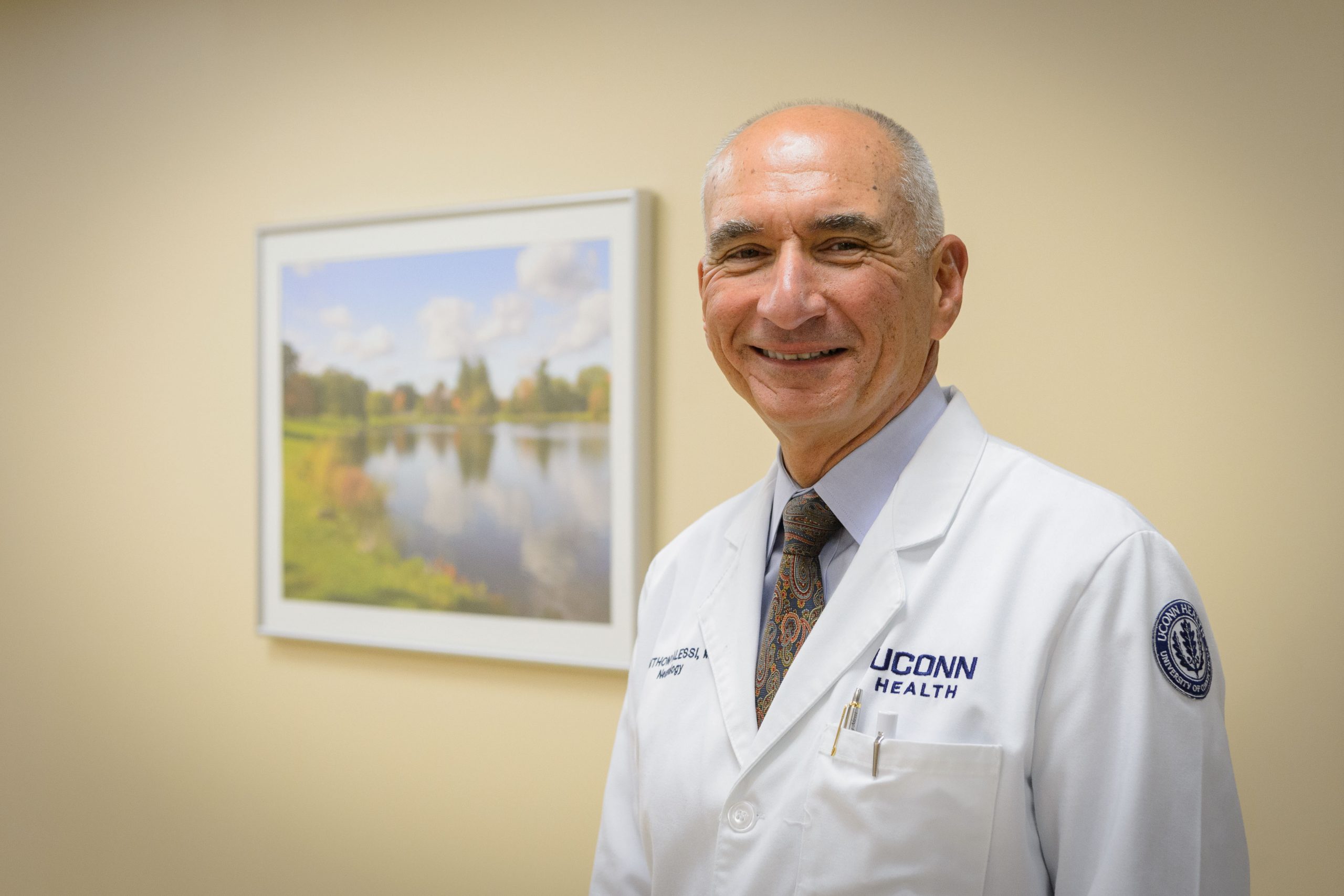
Our guest on the final UConn 360 podcast of the year is a familiar one to listeners of the Healthy Rounds radio show. Dr. Anthony Alessi of UConn Health is a neurologist specializing in general neurology, neuromuscular diseases, EMG and sports neurology and the long-time host of the show. It is moving to a podcast format in January and listeners can reach out to Dr. Alessi with questions at info@alessimd.com . Dr. Alessi also talks about his experience working in athletics with UConn teams, the New York Yankees, boxers, and Professional Bull Riding. In addition, co-host Izzy Harris shares how she and her University Communications co-workers finished in first place the annual UConn Gingerbread House Decorating Contest. Happy Holidays to all from UConn 360!
Listen to Episode 153 on Podbean
Mike: Hello everybody. Welcome to another episode of the UConn 360 Podcast. It’s Mike Enright from University Communications, along with Izzy Harris from University Communications. Hi Izzy. How are you?
Izzy: I’m good, Mike. How are you?
Mike: It’s our last podcast of 2025.
Izzy: That’s hard to believe. It is.
Mike: Hard to believe. Another year is going by so quickly, and we have a fellow UConn podcaster as our guest today.
Izzy: Is today our first fellow podcaster guest?
Mike: I believe so. There aren’t many of them here at UConn. It’s probably a familiar voice to a lot of people, especially if you listen to radio.
Our guest is Dr. Anthony Alessi from UConn Health. He’s a clinical professor of neurology and orthopedics, and for a long, long time you’ve heard him on WTIC radio. He is a board-certified Connecticut neurologist specializing in general neurology, neuromuscular diseases, EMG, and sports neurology.
His show on WTIC was called Healthy Rounds, and it’s now moving to the podcast format. He’s involved in a million different things—does great work at UConn Health, works spring training with the New York Yankees, has been involved in boxing, and even rodeo.
He’s going to tell us a lot of different things and a little bit about the new format of Healthy Rounds. Tony, great to have you with us here today.
Tony: Great to be here, Mike and Izzy.
Mike: So, tell us a little bit about your background. Where did you grow up? How’d you get interested in medicine? And then we’ll talk a little bit about how you became a media superstar.
Tony: I don’t know about the media superstar—you know, I’m just trying to catch up to UConn 360, which you guys do a great job with. But yeah, I was born and raised in the Bronx and lived there until I went to medical school.
I went to Mount St. Michael Academy in the Bronx, Manhattan College, then off to the University of Rome for medical school. I spent five years in Rome and then ended up at the University of Michigan doing my neurology residency and fellowship. After completing that, I went into private practice in Norwich, joining a group called Neurology Associates.
I was there for 14 years, then went into solo private practice, and eventually came to UConn Health. That’s kind of an overall sketch, but so much of that happened by accident. It’s one of those things that just happens, and I think my life really explains that.
For example, coming to UConn Health was basically because I was covering football. Jeff Anderson got me involved here, and on the sideline one day, Gus Mazzocca said, “Do you ever think of coming to work with us in orthopedics?” Since I had developed a sports medicine practice, I really hadn’t thought of it. Slept on it and told my wife, “Hey, what are we doing here? Our kids are all up in that area. Maybe it’s time.” And suddenly, here I am.
So, it was interesting from that standpoint, but many of the events—ending up in Rome and at the University of Michigan—are all those things that happened just by accident and saying yes to people, including my media career.
Izzy: That’s quite the background—from Rome to Michigan to Storrs.
Tony: So yeah, I finished up at Manhattan College, and I’m not good at standardized tests—never have been. I think I passed that on to my children, unfortunately. So, I didn’t get into an American school, and people had told me about going to Italy.
Now, although my family’s Italian, no one had been there since my grandparents got off the much-maligned boat back in the twenties. But I went to the consulate, and before you knew it, I had to take a test in Italian. And here I was at the University of Rome. I made some of my best friends there, including many Americans who were going to school there at the time.
So it was, again, one of those things that happened by accident. Actually, going to the University of Michigan was another accident. I was doing an internship in New York and thought I was going to be an ophthalmologist—I thought I was going to be an eye doctor.
And a nurse just told me one day, “Did you ever think of going into neurology? You’re so good with these stroke patients. I’ve been watching you.” And I said, “You know, I always liked neurology.” So, I called a bunch of programs. This was May, and programs typically start in July.
I called the University of Michigan because one of our doctors trained there. The woman said, “Well, we’re full until next year.” Then she said, “It’s too bad you couldn’t be here this year.” I said, “What do you mean?” She said, “Well, somebody just dropped out.” And I said, “I’ll be there.”
She said, “Wait—you’ll be here in six weeks?” I said, “Yep.” And before you know it, there I was at the University of Michigan.
Izzy: Well, I love what you said about always saying yes, and it’s very obvious you have a great medical background and career. When did you decide to take a turn for radio?
Tony: Yeah, so I started—and Mike and I share common roots in Norwich, Connecticut, starting out at the Norwich Bulletin. Basically, Backus Hospital asked me to write a column every five weeks for the Norwich Bulletin about health. I was doing that, and it evolved into a sports column called Healthy Sports every week in the Norwich Bulletin.
A radio show called Sports Talk with Bill and Mike invited me on a Saturday to talk about my column that week. So, I started doing that. Then another show, The Lee Elci Show, asked me to do it on Wednesdays. And then one day Lee said, “Hey, I’m going away. Why don’t you take over the show for a morning?”
That led to me bringing in guests and the station manager offering me my own show. That eventually ended—voluntarily—because I wanted to take the summer off. Then WTIC picked up the show, where I’ve been for the past 16 years.
So, I didn’t intend this to happen again, but it’s been so much fun. Having a kind of media presence—it’s more like a hobby than anything. And I really enjoy it because it keeps me up to speed and lets me talk to interesting patients—and not only patients, but physicians and people like you guys.
Mike: So, tell us about the new version of Healthy Rounds. It’s now in the podcast format. How will it be different, and how will it be the same as what listeners are used to on WTIC?
Tony: Well, one of the things I’ve found recently is that I’d like to keep in touch with my listeners. So, I have an email—info@alessimd.com—and they send me questions. For most of the show, I didn’t take live questions because they wouldn’t be pertinent. I only had an hour show.
Many of the people who were getting in touch with me by email would say, “Oh, I didn’t listen to this week’s show, but I always get it on the podcast.” And that started evolving.
To be honest with you, after 16 years, I was a little selfish. I was giving up every Saturday to do this show at 11 o’clock, and I was missing my grandchildren’s flag football and basketball games. So, I thought it would be interesting to do it as a podcast.
Already, they would take the show and repurpose it as a podcast, but it was never done in a strictly podcast format. So, I went to the folks at UConn Health and said, “Would you be interested as I’m winding down?” The Healthy Rounds show will be winding down at the end of this year.
We’re doing a podcast where we talk about health, talk to a variety of people, and continue to answer questions. I really wanted to keep that community together. So, we’re still using that email for people.
And just think about it—it interests me that more people don’t take advantage of it. You can email a doctor for free, ask any question for free, and either get a referral to a qualified doctor or an answer to your question on the air. I was always shocked that I didn’t get hundreds of emails. Proportionately, I get relatively few, and I thought that was interesting.
Mike: Well, maybe in this new format that can increase, and we’ll put that email for listeners in the description on the homepage of the UConn 360 Podcast.
Izzy: It’s a really interesting format to have listeners email you these questions and then answer them on the air. I mean, I’m probably going to ask you some questions—so if you see izzy.harris@uconn.edu pop up, know that’s coming from me.
Tony: Happy to do it.
Izzy: Awesome. Well, you have a great interest and wide experience in athletics—boxing, basketball, UConn sports. How did all that develop?
Tony: Again, in high school, due to my lack of football talent, after a couple of years of playing, I became an athletic trainer. Back then, it was nothing like an athletic trainer today—it was a correspondence course.
I loved sports and loved medicine, and it was a perfect balance. So, I did that in high school, and in college I moonlighted and made some extra money doing it. Then I went and did neurology, and I had this big gap.
But in 1995, the New York Yankees moved their AA team to Norwich—the Norwich Navigators. I had a lot of experience with the Yankees because in 1968 and 1969 I sold peanuts at Yankee Stadium living in the Bronx. So, I often tell people I’ve been with the organization since 1968, which always floors them.
When they came in 1995, they started asking me—I don’t even know how it started—for advice or help with players. Then they said, “Did you ever think of coming to spring training? We’ve never had a neurologist work with us.”
Now, you have to understand, this was before the big concussion discussion. Everybody’s worried about that now, but it didn’t happen in 1995. The Yankees had some idea about this, so they invited me to spring training, and I just became part of the organization for the past 30 years. Obviously, my role has grown since concussion and head injury have become a big part of things.
Tony: Around the same time, we had our new casinos in the mid-90s, and we started doing boxing. Now, I’m not a boxing fan—I don’t know anything about boxing. They were asking me to be there, so I said I’d go. They said, “Do you like what we do?”
And I basically said, “Well, do I get to end the fight?” And they said, “Yes.” I said, “Well, then I’m your guy.” Because I feel that I am an advocate for the fighter—that’s my only job. And you’d be surprised how few advocates they have because everybody’s got a different agenda, including their corner people.
So, I got involved in boxing and then subsequently mixed martial arts.
Izzy: Neuroscience, athletic training, radio host—is there anything that you don’t do?
Tony: Yeah, there are a lot of things I don’t do. It’s kind of interesting—I just develop a lot of different interests. But yeah, I’m open to anything, and that’s probably been the key to it all.
More recently, professional bull riding has become a big part of my career. I got involved with them about 15 years ago. UConn has taken a big lead, and we are now nationally renowned because they fly their athletes here to Storrs.
We developed a program in 2018. In 2017, we had a catastrophe—we had a young bull rider who I saw and instructed to never ride again. He insisted on doing it again and two years later died by suicide.
Mike: Wow.
Tony: So, at that point, PBR said, “We need to start doing something about these head injuries.” So now we have a program where they fly riders here to Storrs from anywhere in the country. It’s all paid for through a foundation of theirs.
We put them through three days of testing—they’ll see me here in Storrs, then have neuropsychometric testing, MRI, physical therapy, and then we come up with an answer for them as to what they should be doing.
What’s interesting is the original riders who came thought, “This guy’s going to end my career.” And the first two people who came had problems unrelated to hitting your head. One fellow had an attention deficit disorder that never got treated, and the other had migraine headaches. We fixed both problems, and both rose to being in the top 10 in the world.
So, it’s become more of a brain health program through the university. And it’s just interesting because—I mean, I’m from the Bronx.
Mike: Not a lot of bull riders in the Bronx, probably.
Tony: No. So, you can understand that I came from a whole different planet to bull riding, but I have really enjoyed those athletes. They are tough, kind—I find them to be just really genuine folks.
Izzy: Mike, were you aware of this bull riding program that we have here in Storrs?
Mike: I was not aware of this bull riding program. This sounds like a whole new subject we need to explore.
Izzy: I know. Now I have a ton of other questions, but we’ll have to save those for another time—another episode—because we just have so much to cover here.
Mike: That’s right. One of the things I wanted to ask you was—you know, we talk about staying in touch with listeners, and we always try to provide here at UConn 360 a little “news you can use.” What’s your advice to weekend warrior athletes to avoid injuries—neurological injuries? And what about parents with young kids? You have grandkids—you said they’re nervous about their children or grandchildren playing contact sports. What’s your advice to them?
Tony: Well, the first and most important thing I tell parents is: go talk to the coach. Okay? And make sure he or she is not a knucklehead—for lack of a better term. The whole thing of “get tough and work through it”—you have to understand the coach’s philosophy before you let them take care of your kid.
The second thing is I ask people at the youth sports level: everybody needs to be an observer. And when it comes to head injury, what you want to look for is a player not getting up quickly, getting up and staggering, or needing assistance to get up. Immediately, that player needs to come off the field—whether it’s a concussion or not.
Sometimes a coach doesn’t see it, or a ref doesn’t see it, so a parent may see it and bring it to somebody’s attention. So, I ask everybody to be an observer.
The other thing for weekend warriors—and it’s kind of a pet peeve of mine—is wearing a helmet when you’re bicycling. Here, it seems that older people don’t think they need a helmet.
I like to cycle, especially on the Farmington Trail or one of the trails, and invariably it’s always older people who won’t wear a helmet. And they actually need it more than young people because you have a little more space between your brain and your skull as we get older. So, when they hit the ground, there’s more contact between their brain and the skull, and they bleed.
So, the point is: no matter what your age is, wear a helmet. It’s easy enough to do. And Mike, you and I probably remember when people would ski with no helmets, bike with no helmet, no seat belts when you’re driving.
Mike: Right. Exactly.
Tony: So, there are these little things that you really need to do to avoid a catastrophic injury.
Izzy: I’m just laughing, thinking about all the times that I have hit my head playing sports. I play volleyball and have gotten whacked in the head countless times. Pickleball—hit in the face—even though that’s not as much of a contact sport as volleyball.
Tony: Eye injuries are the other big thing. The number one cause of eye injuries in sports now is pickleball.
Izzy: I have been hit in the eye—many times—and it’s scary because my eye has swelled up. I’ve gotten hit in the lip, and everyone’s like, “Oh, it’s not that hard.” I can show you pictures afterwards—it looks like I got hit in the face with a fist, not a wiffle ball.
Mike: It’s a blood sport.
Izzy: I know! People need to take it for what it is.
Mike: That’s why I stick to the golf course.
Izzy: Good idea.
Tony: That’s right.
Mike: One of the things I wanted to ask you was—you know, we talk about staying in touch with listeners, and we always try to provide here at UConn 360 a little “news you can use.” What’s your advice to weekend warrior athletes to avoid injuries—neurological injuries? And what about parents with young kids? You have grandkids—you said they’re nervous about their children or grandchildren playing contact sports. What’s your advice to them?
Tony: Well, the first and most important thing I tell parents is: go talk to the coach. Okay? And make sure he or she is not a knucklehead—for lack of a better term. The whole thing of “get tough and work through it”—you have to understand the coach’s philosophy before you let them take care of your kid.
The second thing is I ask people at the youth sports level: everybody needs to be an observer. And when it comes to head injury, what you want to look for is a player not getting up quickly, getting up and staggering, or needing assistance to get up. Immediately, that player needs to come off the field—whether it’s a concussion or not.
Sometimes a coach doesn’t see it, or a ref doesn’t see it, so a parent may see it and bring it to somebody’s attention. So, I ask everybody to be an observer.
The other thing for weekend warriors—and it’s kind of a pet peeve of mine—is wearing a helmet when you’re bicycling. Here, it seems that older people don’t think they need a helmet.
I like to cycle, especially on the Farmington Trail or one of the trails, and invariably it’s always older people who won’t wear a helmet. And they actually need it more than young people because you have a little more space between your brain and your skull as we get older. So, when they hit the ground, there’s more contact between their brain and the skull, and they bleed.
So, the point is: no matter what your age is, wear a helmet. It’s easy enough to do. And Mike, you and I probably remember when people would ski with no helmets, bike with no helmet, no seat belts when you’re driving.
Mike: Right. Exactly.
Tony: So, there are these little things that you really need to do to avoid a catastrophic injury.
Izzy: I’m just laughing, thinking about all the times that I have hit my head playing sports. I play volleyball and have gotten whacked in the head countless times. Pickleball—hit in the face—even though that’s not as much of a contact sport as volleyball.
Tony: Eye injuries are the other big thing. The number one cause of eye injuries in sports now is pickleball.
Izzy: I have been hit in the eye—many times—and it’s scary because my eye has swelled up. I’ve gotten hit in the lip, and everyone’s like, “Oh, it’s not that hard.” I can show you pictures afterwards—it looks like I got hit in the face with a fist, not a wiffle ball.
Mike: It’s a blood sport.
Izzy: I know! People need to take it for what it is.
Mike: That’s why I stick to the golf course.
Izzy: Good idea.
Tony: That’s right.
Izzy: So, both of your daughters have followed in your career path and become neurologists. That must make you very proud. What is it like to work with them?
Tony: It’s great, actually. It really is great. I think that’s one of the things that keeps me going in this. I mean, I’m 71 years old now and still enjoying it. Getting to work with them brings a whole new dimension to practice because, quite honestly, they’re up on things that were not part of my training—specifically genetics and genetic testing.
So, I can always run things by them, and they can always look to me based on my experience. So, it’s great. Catherine is with me here at UConn in Farmington, and Stephanie is at Hartford Hospital, where she’s director of the Sports Neurology Program.
Now, my older daughter took a different path. She didn’t want anything to do with medicine and became an attorney. But fortunately, she does malpractice defense.
Izzy: That was going to be my guess.
Tony: Yeah, no, no. We told her, “Listen, the day you sue a doctor, you’re out of the will.” That was the deal. It’s always good to have an attorney in the family. So, it’s become a family affair that I’m thoroughly enjoying.
Mike: In addition to radio and being a doctor, you’re also an author. You’ve written two books. I’ve got one here in my hand, and it’s got a beautiful picture and looks like a beautiful story. It’s called Lift Up Your Hearts: Healing Haiti, the Land of Hardship, which was published shortly after the earthquake in Haiti in 2010. Unfortunately, Haiti seems to have so many natural disasters. Tell us a little bit about this book and your work in Haiti.
Tony: Yeah. So again, things happened by accident. My daughter Stephanie came to me when she was thinking of applying to medical school and said, “Dad, I think it’ll look good on my application if I did some charity work. I’m thinking of going to Haiti.”
Well, being a dutiful father from an Italian family, I couldn’t let her go to Haiti alone. So, I said, “I’ll go with you.” I have a friend, Dr. Jeremiah Lowney, who was on the Board of Regents here at UConn and runs the Haitian Health Foundation. We arranged to go under his auspices in a group with him, and that was in 2008.
I made three trips with that group. Catherine came with me one time. Stephanie actually got a master’s in public health by living there and doing a public health project in Haiti. But in 2010, about three weeks after I had just been there, the earthquake hit.
Dr. Lowney hooked me up with a fellow named Father Rick Frechette—a Catholic priest from West Hartford who’s been living in Haiti since 1987. He actually went to medical school and was running a pediatric hospital that he built in Tabarre. That began my journey there, which continued until COVID and civil unrest kept me from returning since 2020.
The book is actually the result of articles I wrote for Jim Conrad in the Norwich Bulletin. They asked me to write about the experience of being in Haiti during an earthquake. We repurposed those articles into a book, and all the money went to the St. Luke Foundation, which worked out great.
Izzy: Okay, so to wrap things up here—and I apologize if I’m missing something—so you’re a neurologist, an honorary Yankees team member, involved with bull riding, an author, radio and podcast host. Are there any fun facts that you’d like our audience to know that we haven’t covered so far?
Tony: No, I think that’s about it. I think much of all these things come from my joy of being around people—different people—and hearing their stories. And I think that’s what drew me to media: just listening to physicians, listening to people, and hearing them out. So, I think that’s the one fun fact that I’ve enjoyed throughout my life that got me to do all these things.
Mike: Well, the Healthy Rounds podcast begins after the first of the year. Sounds like you’ve taped a few already. Dr. Andy is your first guest or one of your first guests?
Tony: Dr. Andy will be the first guest. It first drops on January 13th and will continue every two weeks. So, we’ll have a new one every two weeks. But what we’re also doing is we’re going to have bonus episodes. You know how they always tell you in podcasts you have bonus episodes if you sign up? Well, we’re not requesting anybody to sign up or make a donation.
So, we’re going to have separate bonus episodes where we answer everyone’s questions. It’ll be an episode of just me answering questions that have come to our email at info@alessimd.com. So, we’re going to have some fun with this, and I really thank the folks at UConn Health for indulging me in doing this.
Mike: Well, like I said, we’ll put that email and the link to this podcast in the description, and we really encourage people to check out the new Healthy Rounds podcast. But don’t forget about UConn 360—you’ve got plenty of time. You can listen to both. So, thanks so much for joining us today, Tony.
Tony: Thank you, guys for having me.
Mike: So, this is it for calendar year 2025 for the UConn 360 Podcast. We hope everybody has a happy and healthy holiday season and enjoys it with your friends and family. And I’ve waited until the end here because I want to give props to Izzy—she won a big competition along with some of her coworkers. So, Izzy, wrap up 2025 by telling us the good news.
Izzy: University Communications won the 2025 Gingerbread Decorating Contest, which is huge news. Have you heard about this contest, Tony?
Tony: I have not, but there are several out there. I mean, there are different leagues. Which league were you in?
Izzy: Well, this is just for the university.
Mike: This is big time. This is for UConn.
Tony: This sounds like this is for all of UConn.
Mike: Yes.
Izzy: Yes. I believe there were 21 teams—two were no-shows—so we won out of 19 teams, and this was our first-ever win.
The theme was “A Time Machine: Decorate Your Decades,” and we decided to do “The Land Before UConn” and made our gingerbread house based on the fossil rocks that are on campus.
Tony: Really?
Izzy: So fun fact—if you didn’t know—there are rocks with dinosaur footprints in them, or fossil footprints. I don’t know the correct terminology; I should probably know this. So, it’s based on a real artifact on campus, and we made dinosaurs out of Rice Krispies treats and turned our gingerbread house into a volcano.
So, we chopped it up, constructed this volcano, did a rock with the dinosaur footprints on it, and President Radenka chose us as the winner.
Mike: The president was the judge. So, this was no joke.
Tony: Really?
Mike: Yes. And give a shout-out to your fellow University Communications employees and team members who were part of this momentous occasion.
Izzy: Oh my goodness, yes. We cannot leave them out. A big thank you to Christine Vasington, Kim Phillips, Craig Burdick, Jacie Severance, and Janet Vamos, who was the creator of the idea but was sadly away in Austria while we competed this year. But it was her idea.
Mike: If you can’t be at the UConn gingerbread competition, Austria’s not a bad second place.
Izzy: No, it’s not. And she said she thought of us the whole time because there was gingerbread everywhere.
Mike: Excellent.
Izzy: It was a winter wonderland.
Mike: Excellent. Well, again, everybody, we really appreciate when you listen to the UConn 360 Podcast, and we’ll see you all in the new year.