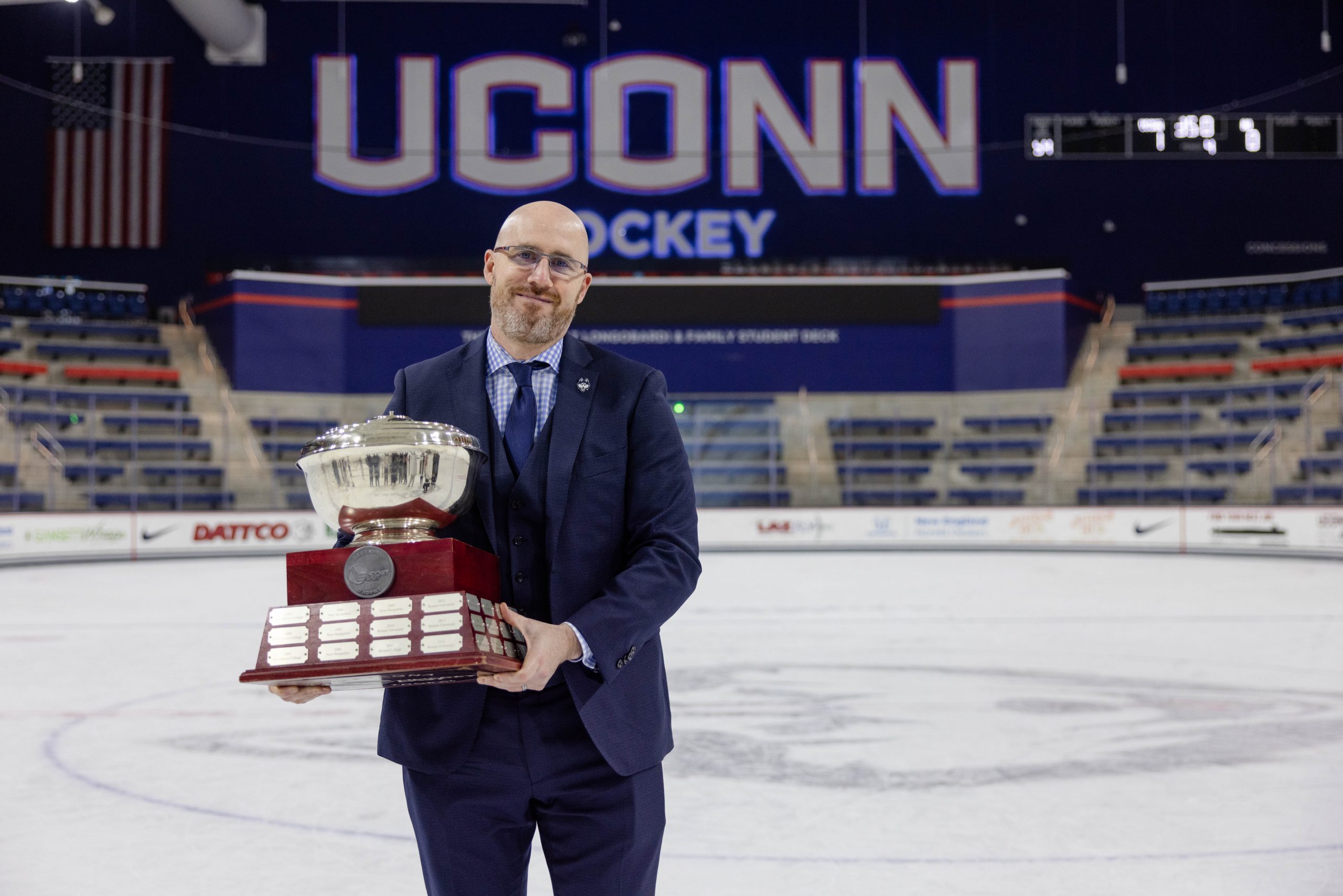
Happy New Year to all of our UConn 360 Podcast listeners. Women’s ice hockey coach Chris MacKenzie is our guest on this episode and his team is currently ranked fifth in the country. He is in his 13th year in charge of the Huskies and has led UConn to the Hockey East regular season championship in each of the past two years. Chris was the national coach of the year in 2024 as he led UConn to its first-ever NCAA tournament appearance. He talks about this year’s team, what he looks for when recruiting a student-athlete, and how the new Toscano Family Ice Forum has changed the program. Chris also gives us an Olympic preview and a look into his family life. Check out a UConn game this season!
Listen to Episode 154 on Podbean
Mike: Hello everybody. Welcome to another episode of the UConn 360 Podcast. And not just a regular episode, but our first episode of 2026. So happy New Year to all our listeners. This is, uh, Mike Enright from University Communications, and my frequent guest co-host Jacie Severance is here. So, Jacie, thanks for joining us and happy new year.
Jacie: Happy New Year to you too, Mike. Always great to have you here. And we have a, uh, real special guest today. He’s our head women’s ice hockey coach, Chris MacKenzie, whose team is off to a fantastic start to the season. They’re really more in the middle of the season—they’re 15-3-2 and ranked fifth in the country, one of four athletic teams on campus ranked in the top 10 right now. It’s an exciting time. And in the description for the podcast, we’ll put the team schedule so you can check them out at an upcoming home game and a link to tickets. Chris is in his 13th season here at UConn—hard to believe. He has led UConn to the Hockey East regular season championship in each of the past two seasons. In 2023–24, UConn played in the NCAA tournament for the first time, and Chris was the national coach of the year. Before coming to UConn, he was an assistant coach at Ohio State and head coach at Niagara University, his alma mater. He coached on the men’s side for eight seasons at UMass Lowell and was a student-athlete at Niagara, where he was a team captain and led the Purple Eagles to an appearance in the NCAA quarterfinals. So, Chris, thanks so much for joining us today on the UConn 360 Podcast.
Chris: Thanks a lot. Happy to be here, Jacie and Mike.
Mike: So, to get started a little bit, we talked a little bit—the team’s off to a great start this year, like I said, middle of the season or so, ranked in the top 10. Give us your impressions of the season and the hopes for the rest of the year.
Chris: We are a very focused group. Special teams and goaltending are our strengths right now. At the beginning of the year, I wasn’t sure if we’d look this way. I’m very happy that we do. And I feel right now our team is very focused, and we only have 14 games left, and they are in a good place, so we just have to keep going.
Jacie: You have built a nationally competitive program here at UConn. How did you do that?
Chris: It wasn’t just me. We’ve had a lot of support from our administration. We did build a new hockey arena two years ago—that helped. We were a ranked team about four or five years ago playing out of the old rink. But with the new rink coming on board, that’s really jumpstarted our recruiting to another level. We had a longtime assistant coach, Casey Handrahan, who’s been with me for the full 13 years, and I think the two of us and our other coaches and our support staff have just had a lot of continuity. That’s helped us just continue to build and go in the right direction. So, when they say you’ve built it, it’s not really me—it’s everyone and us taking advantage of the things that we have support-wise.
Mike: Talk a little bit about what you look for when you’re recruiting a student-athlete, and what are your recruiting areas? I assume it’s some international—yeah, some Canadian—but it’s also local as well.
Chris: Yeah. I think anyone can pick out the talented players. It’s just more or less getting to know them and their families and seeing, okay, are they a good fit for UConn and that campus? And then really where we’re recruiting is quite a bit in Canada. Both myself and longtime assistant Casey are from Ontario—that’s the Minnesota of Canada. And we sprinkle in New England players; we sprinkle in Western Canada. We’ve had players from California, Wisconsin. If they like us, we’re going to have some interaction, and if we like them, we’re going to have some interaction. And UConn is a place you can recruit pretty much anywhere.
Jacie: We have had other coaches on the UConn 360 Podcast, and we’ve asked them the same question. College athletics is changing so much. How do NIL and the transfer portal affect your program and your sport?
Chris: I think what you see affect football and basketball almost immediately—within a five-year window—will affect us. So it’s not going to be overnight with women’s hockey. There have been changes; we’ve made some changes to what we give our student-athletes. We’re pretty standard across the board—every player’s kind of getting the same package, which I think lends itself to trust, respect, all that. We’re not going to get into the comparison world with each other, and at least I’m trying to hold off from doing that right now, but it seems to be working. That transparency—like, everyone’s on the same package here. Let’s not get into the “What are you getting? What are you getting?” And that’s a distraction I don’t think anyone wants. So yes, there’s been changes. We’re holding off as much as we can before we have to dive into those as much as possible. So, we’ll see how it goes.
Mike: So, Chris, how has the building of the Toscano Family Ice Forum affected your program? And talk about what it’s like to see a game there for the fan, and the advantages it brings to your team.
Chris: Recruiting-wise—I’ll give you an example. Penn State built a $100 million rink in 2013. If we were going up against them with a recruit, we had a big disadvantage. Now, with Toscano Family Ice Forum being built, it’s more apples to apples. And so, facility-wise, we can match against pretty much anyone in the country. What’s the environment like? Saturday night we had 850 people—it felt, for a women’s hockey game, it felt full. And we’ve had upwards of 2,200 this year. I think we’re in the top five for attendance, which is great. Our marketing team does a great job. The in-game entertainment’s good. And obviously we’re trying to be good on the ice. Honestly, my wife tells me what it’s like. I don’t—even—hear the music. I’m so focused on what’s going on, so my wife says it’s good. So that’s all I really should give you. But everyone’s telling me I would’ve heard if it’s bad by now, is what I guess I would tell you.
Jacie: Got to listen to the wife.
Chris: Yeah. No, yeah.
Mike: Good advice.
Jacie: For people who are not familiar with women’s ice hockey, can you talk to us about the emergence of the sport? There’s now a thriving professional league and it seems to be more and more popular in venues like the Olympics. Talk a little bit about how the sport’s growing.
Chris: You know, there were maybe 15 teams in the late 1990s. Now there’s 40. So, you’ve seen this exponential growth. Every four years, the Olympics come—this is a boost year where you’ll see enrollment next September go up again because of the Olympics. “Hey, you know, Mom, Dad, I want to play hockey,” especially female players. I can tell you, just having a sister that played when I grew up, she had to play with the boys till she was maybe 13, 14. Now there are opportunities everywhere for women’s-only teams, and that’s just—I think it’s just the growth. Is it the quickest-growing sport in North America? I don’t know the research, but I’ve seen the growth just in my time, the 15 years I’ve been coaching women’s hockey, that it’s going nowhere but upward. The professional league’s great. We have alumni of our program playing in that, and I’m hearing there’s another expansion coming—at least two, maybe four more teams. So, it’s encouraging. It’s certainly giving our current players something to strive for, which is great. They stay focused. The more, the better is, I guess, what I would leave you with.
Mike: Put you on the spot here a little bit, though. The Winter Olympics are coming up in Italy in February. Give us your international scouting report and maybe how the USA may do this year.
Chris: They would be the heavy favorite right now—still. I’m a dual citizen, so we do—and it’ll probably end up being Canada and the U.S. in the final, but I would tell you the U.S. is a heavy favorite right now, given the last matches that they’ve had; the U.S. has dominated. Now, that can all change, and it has in the past. So really, it’s just going to come down to one game—the gold medal game.
Jacie: So dual citizenship. You grew up in Ontario, on the Canadian side of the falls—Niagara Falls. What’s it like to be raised in one of the most famous tourist towns in the world?
Chris: Pretty neat. I look back at it now—what a fun place to grow up. It’s the type of place where in the winter it’s 70,000 people; in the summer, it’s upwards of five to six hundred thousand, and all from people from all over the world. I look at it now—it was a lot of fun. I was a Buffalo Bills fan. It’s very exciting to see how they’re doing now. But going through four Super Bowls and the way that happened—that was crushing. So, but I’m in there for the long haul. It’s a neat spot. I can say I’m from Niagara Falls, not Toronto or near Toronto. People understand what it is. And it’s funny—we’ll even run into people; there’ll be employees on campus here that travel, and they’ll go visit there. So, I kind of give ’em tips on where to go and what to do.
Mike: Did you—you obviously played hockey growing up, but did you play any other sports growing up?
Chris: Soccer. Soccer was the sport. And then trying to do a little bit of it. The only other sport I’m playing right now is squash.
Mike: Playing squash? Really?
Chris: Squash, yeah. Really tough. It’s a grueling sport.
Mike: I’m always amazed—you’ve got a top-10 team going here on campus. When you think of successful coaches, sometimes you might think of fiery personalities, and you seem to be really level-headed. Is that the way you’ve always been? Or are we not seeing that side of you all the time? Talk about your personality a little bit.
Chris: I’m pretty competitive. I don’t have a problem getting into it with people when it’s—I think coaches, people that end up coaching, are usually quite competitive in most aspects of their life. I am fairly easygoing. I save a lot of my energy for my practices, and I think when I’m quiet and calm, my team’s actually better. So, I’m really trying to focus on that. And we just actually lost our assistant coach—she got a new head coaching job. So, I’m going to be in charge of the forwards. That’s going to help me just focus on the forwards and not yell at referees. And I do think that’s actually going to help my team. They probably won’t say it to my face, but I think that’s going to help them be in a better place, honestly.
Jacie: Thirteen seasons here at UConn—you’re a native, now a local—you’re a Husky. What do you do when you’re not on campus, when you’re not, you know, playing squash? What do you like to do in your free time?
Chris: Travel. Spend time with the family. So, there’s basically two seasons in hockey. You have about 16 to 18 games in the first half, then you have three weeks off, then you have another 16 games or so. So, this year we went to the Dominican Republic, and that was a good time. I’ve never been there before. So, we got to do that. In the summer we’ll do something—maybe go up to Canada, travel there. We might do a family vacation somewhere. My sister lives in Europe. She was a hockey player; she ended up staying in Europe, playing over there. And she’s married with a family. We’ll go over there and visit. So, it’s a lot of travel because our kids—we literally live beside the school. This is our little bubble. We kind of want to make sure we’re getting out and our kids are getting out and seeing the world so they’re not just living within a half-mile radius of a university town.
Mike: So, we’ll start to wrap up here. Finish this sentence: The UConn women’s ice hockey team will have a successful end to the season if—
Chris: We continue to play to the high standards that we have.
Mike: Excellent. Excellent. Chris, thanks so much for joining us today here on the UConn 360 Podcast. Jacie, do you have any closing words?
Jacie: Well, you know, Mike, you might not know this about me, but I thought about a hockey career once.
Mike: You did?
Jacie: I did, but I just couldn’t stick with it.
Mike: Jacie always has the great puns to end our podcast. So, Chris, thanks—thanks for joining us here today. Jacie, thanks for sitting in. Like I said, for the fans that want to go see a game, check out the schedule—there’ll be a link in the podcast description. And thank you for listening, and we’ll catch you on the next episode of the UConn 360 Podcast.