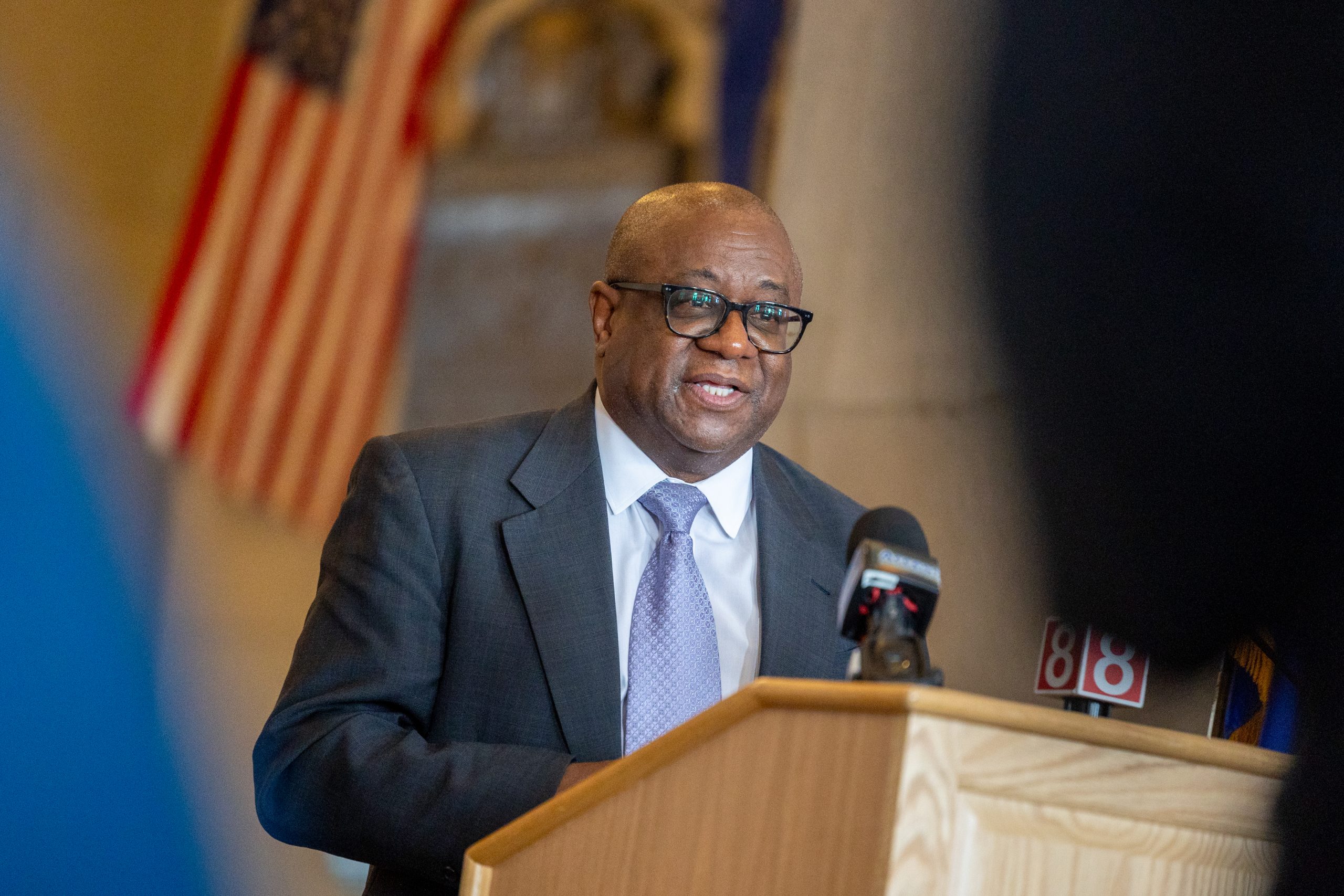
Our guest on this episode is Dr. Jeffrey Hines, who leads the Office for Inclusion and Civil Rights for both UConn and UConn Health. The office ensures the University’s commitment and responsibility to foster equitable and inclusive working and learning environments. Jeff has an amazing background as he earned his undergraduate degree and medical degree from Brown University. He then did his residency in obstetrics and gynecology and served as a battalion surgeon during Operation Desert Shield and Operation Desert Storm. In January, he was the keynote speaker at the Connecticut Martin Luther King, Jr. Holiday Commission Commemoration. In the podcast, he reflects on King, Black History Month, and the recent passing of the Rev. Jesse Jackson.
Listen to Episode 157 on Podbean
Mike: Hello everybody. Welcome to the UConn 360 Podcast. It’s Mike Enright from University Communications, along with Izzy Harris from University Communications. Hello there, Izzy.
Izzy: Good morning.
Mike: Oftentimes when we do this UConn 360 podcast, we get great guests on who have done so many things in their life, and I say to myself, I’ve accomplished nothing, and I think our guest today is another person that fits into that category.
Izzy: I completely agree with that.
Mike: So, our guest is Dr. Jeffrey Hines. He leads UConn’s Office for Inclusion and Civil Rights for both UConn and UConn Health. He was named to this position last October when the office was created through a merger of, two other programs. The office ensures the University’s commitment and responsibility to foster equitable and inclusive working and learning environments. So, he first came to the UConn family in 2022 when he was named the first ever Chief Diversity Officer for UConn Health. He’s got an amazing background. He earned his undergraduate degree and medical degrees from Brown University. He completed his residency at the Fitzsimons Army Medical Center in 1990 and then was a battalion surgeon during Operation Desert Storm and Operation Desert Shield. He’s got an amazing background and we’re really happy to have him here on the, on the podcast today. So, Jeff, welcome.
Jeff: Hey, thank you, Izzy. Thank you, Mike. And remember, we’re all the heroes of our own story.
Mike: Well, I appreciate that. Yes, because I read your background and I’m like, this is amazing. You’ve done so many, so many different things and want to talk to you a little bit about each part of your life. Thank you. But tell us about the overall mission of the Office for Inclusion and Civil Rights at UConn. And it sounds like, and I believe it is, that it includes every single member of the University population, no matter the job that individual has or, or who that individual is.
Jeff: Yeah. And thank you for framing it that way, Mike. We’re very excited to represent students, faculty, and staff in this work that we do. And this work is around several domains. We are involved in education and training. We are involved in building a sense of belonging. We are involved in advocacy. We are involved in compliance, and because of the work that we do at the health center, we’re involved in health equity. So, we do touch not only faculty, staff, students, but because of the work that we do at the health center, we touch patients and communities that we serve.
Izzy: It looks like there’s a lot of education and training that your office does, and not all of the work is punitive. What are some of the training programs your office conducts?
Jeff: So, thank you for framing it that way as well too, because we want to go in through looking at things through a, a model of strength as opposed to a deficit model. So how do we build upon what we all aspire to as an institution? So, I’ll lean in first to that whole aspect of belonging. We know that belonging is a big predictor of success, not just of the learners or the students, but also for our faculty and staff. So. What are the trainings that we can deploy and put in front of faculty and staff in addition to our students so that they have a sense of belonging?
We also do work around microaggressions and bias, do trainings in education, and we try to nuance that to the particular unit that we have been asked to, to work with because a session on implicit bias, for instance, that we do for the Department of Surgery may be different than something that we put together for the Department of Anthropology, for instance. So, we work with the leaders of a particular unit before we go in to really try to nuance it. The other thing that we do is we really try to give a little bit of background information. We leverage Academic Impressions a lot and ask individual units to do a little bit of a pre-read on their own, in addition to informing us what they need so that we can really craft a training or an education session that is meaningful to them. So, it’s really bidirectional. In the work that we do, we really try to partner with the education packets, the education that we put together for different units throughout the University.
Mike: So, Jeff, as I mentioned earlier, you have quite an impressive background with your work as an obstetrician and a surgeon in the military. Maybe tell us a little bit about your background, where you grew up, your work in, both those fields. Ooh.
Jeff: It’s dangerous to ask me an open-ended question like that. So, I grew up right across the Sound. I grew up in Bay Shore, Long Island and I’m proud of the Long Island. Went to a public high school in Bay Shore, Long Island. Went to Brown University, both undergrad and med school. Then did a residency in the Army to help pay for my medical school. I took a scholarship through the Army and did a four-year residency in obstetrics and gynecology at Fitzsimons Army Medical Center. And then met my wife as an undergrad at Brown and together we trained at Fitz and she’s a pediatrician by training. And then we were driving to our first duty assignment after finishing our residencies, and we were driving to Fort Hood, Texas, one of the biggest armor posts in the country. It was then Fort Hood. It’s been renamed since, and I don’t remember the new name, and we kept hearing these things about Southwest Asia and Saddam Hussein, and it didn’t mean much to me until I arrived at the hospital and within two weeks of arriving to the hospital, I was pulled into the hospital commander’s office of several of the physicians, and we were told—you know, it was all men. Gentlemen, it’s a matter of when, not if and for how long? And three weeks after that, I was on a plane over to Southwest Asia. Most of the, the work that I did as a battalion surgeon was mostly on enemy prisoners of war. Because we had air superiority, most of the coalition troops flew over us. And most of the people that I treated for the seven months that I was deployed were enemy prisoners of war. And then coming back after that I went on and did a fellowship in gynecologic oncology. So, my background training is I treat women with ovarian cancer, uterine cancer, cervical cancer. That was an additional three years of training and have been doing that since. While I was deployed to Desert Shield/Desert Storm, it was the first time a significant number of women had been deployed, and the military wasn’t prepared for that many women. And so, we took an opportunity to inventory and catalog the services that were available to women in theater. And the other thing that we—a group of us—decided to do was to look at whether some of the illnesses we were seeing among U.S. troops who would come in for sick call—if there were any disparities. And that really got my interest into this whole work of health equity and disparities because we would look, say for instance, at soldiers who were active duty versus reservists who were coming in, and we saw some clear differences in outcomes of healthcare that, that they were having. And that really sparked my interest into the work in health equity and disparities.
Izzy: That’s a great segue into our next question because that background is extremely different than what you’re doing right now. Different but the same. There are some similarities, like you said, health equity has kind of led you into the position that you are now. So, I have a couple of questions for you. How did you make that switch and. Do you still work in medicine? Do you miss it? What are your thoughts on that?
Jeff: Oh, thank you for that, Izzy. So, when I took this role at UConn almost four years ago now, I decided that I wouldn’t clinically practice medicine. So, I don’t see patients anymore. I don’t operate anymore, still have my faculty roles and still very proudly teach medical students, dental students, and, and residents.
So, there is still some work around taking care of patients. In terms of what are some of the diagnoses that they have and how do they differ based on where they live? How do these diagnoses and outcomes differ based on their race, ethnicity, their sexual orientation? So, the combination of the work and equity and disparity still align with the clinical work, and that’s the whole work of health equity is.
Based on a particular population, what might be differences in outcomes that we’re seeing based on a particular metric, their gender, their gender identity, their race, their ethnicity. And then based on that, what can you deploy to make a difference? You got to measure it. And then did your intervention make a difference to improve outcomes for patients?
Mike: So, this is, this is amazing. You kind of glanced over it, but I have to ask you, what was it like doing surgery on enemy POWs?
Jeff: So, to be clear and to clarify, I was in what’s called a maneuver battalion, so I worked out of a tracked armored vehicle. So, we would stabilize those.
Enemy, prisoners of war that were injured and provide medical care to them, those that required surgery, we referred them out in the military. That level of a physician is still called a battalion surgeon, even though I didn’t operate on those people,
Mike: But still an amazing job and an amazing experience. I would think.
Jeff: it was completely different than my training as an OB GYN doctor. Sure. You know, during Operations, Desert Shield and Desert Storm, when you’re going to deploy 500,000 coalition troops, you have to have a sufficient number of physician assets over there. And you know, the military is like, you’re a physician, so you will do the role that we need you in.
Yes, we know you can operate, but we need you providing this level of care. And so, Captain Hines, that’s what you’re going to be doing.
Mike: And so that’s what you do.
Jeff: And that’s what I did.
Mike: That’s what you do. So, we’re in February. Hard to believe. We’re almost, well we are halfway through February and it’s, Black History Month.
So, tell me a little bit about what. February and Black History Month means to you personally and, what it means to UConn.
Jeff: So personally to me, it has a lot of significance this year because I was asked to be the keynote speaker for the Martin Luther King celebration at the state capitol, and truly meaningful for me because my family was there and particularly three of my five grandsons were there, and part of what I spoke about, spoke to them, and spoke to not just my children, but to our children, because the next generation, we owe it to them to make it better., so that was a wonderful kickoff for me to Black History Month—the celebration, the MLK convocation that the Office for Inclusion and Civil Rights did on January 30th where we celebrated the accomplishments of faculty, undergraduate, graduate students, and community members in the work that they’re doing that benefit the entire University, not just a segment of the University.
And that’s part of MLK’s message—was that whole aspect of the beloved community that he talked about—and that has rolled nicely into a variety of events that are on all of our campuses throughout the month of February that certainly highlight and celebrate the contributions of Black and African Americans. But it resonates with all of us in terms of that message of resilience and strength and accomplishment. So, particularly, that’s what’s especially important to me about Black History Month—is the stories resonate with so many and not just a particular group.
Mike: I’ll put you in a spot here a little bit. We kind of—breaking news today. We taped this on Tuesday. Dr. Jesse Jackson just passed away. Yes. Tell me a little bit about some reflections on, on his life.
Jeff: So, I do have a personal reflection.
Mike: Oh, good.
Jeff: When I was in medical school in 1984 in Providence, during his first presidential campaign in 1984, he came to Providence and I had a chance to crowd into a church in Providence and hear him speak and, you know, just his cadence just resonated. And I think for me, what I would wonder is: have we really made some progress from his runs in ’84 and ’88 and the legacy of work that he did with PUSH in Chicago and the work that he did nationally? It still is apparent to me and to many that there’s still work to be done. And I think we owe it to his ongoing legacy to continue in that work.
Izzy: Well, Jeff, UConn is certainly so lucky to have someone that works to make it such an inclusive environment for everyone. And thank you for spreading kindness, love, and education. I know that so many people will love to hear all of the amazing stories that you had to share with us today. What did you tell me before at the beginning of the podcast? Remind me the quote that you said about us being all our own heroes.
Jeff: Yes. We all are the heroes of our own story.
Izzy: Okay, so speaking of your story, I was wondering what are some of your outside interests and what do you do with the little to no spare time that you probably have?
Jeff: I make the best of that time because it’s important and I lean into my family. First of all, three of my five grandsons live in New Haven, so I see them every weekend, if not a little longer. My wife and I, part of our self-care, are aspects of exercising and physical activity together. The spiritual reality that’s important to the two of us. And again, as mentioned, being with family—you may not be able to see it from me, but I love distance running. I’ve run seven marathons in my career. I’m trying to see if I have another one left inside of me and I enjoy collecting visual art. My wife and I collect art made by African American artists, and that’s a big part of who we are and what we like to share in terms of the richness of the diaspora of the Black experience—is the visual arts.
Mike: Amazing. Amazing. And, and I concur with Izzy. We are so lucky to have you here at UConn, Jeff, and we were lucky to have you on the UConn 360 podcast today.
Jeff: I appreciate the offer and hopefully, we’ll be invited back in the future.
Mike: There is no question. I was thinking the same thing myself. So, Izzy, have a great day and we’ll, catch everybody in the next UConn 360 podcast.