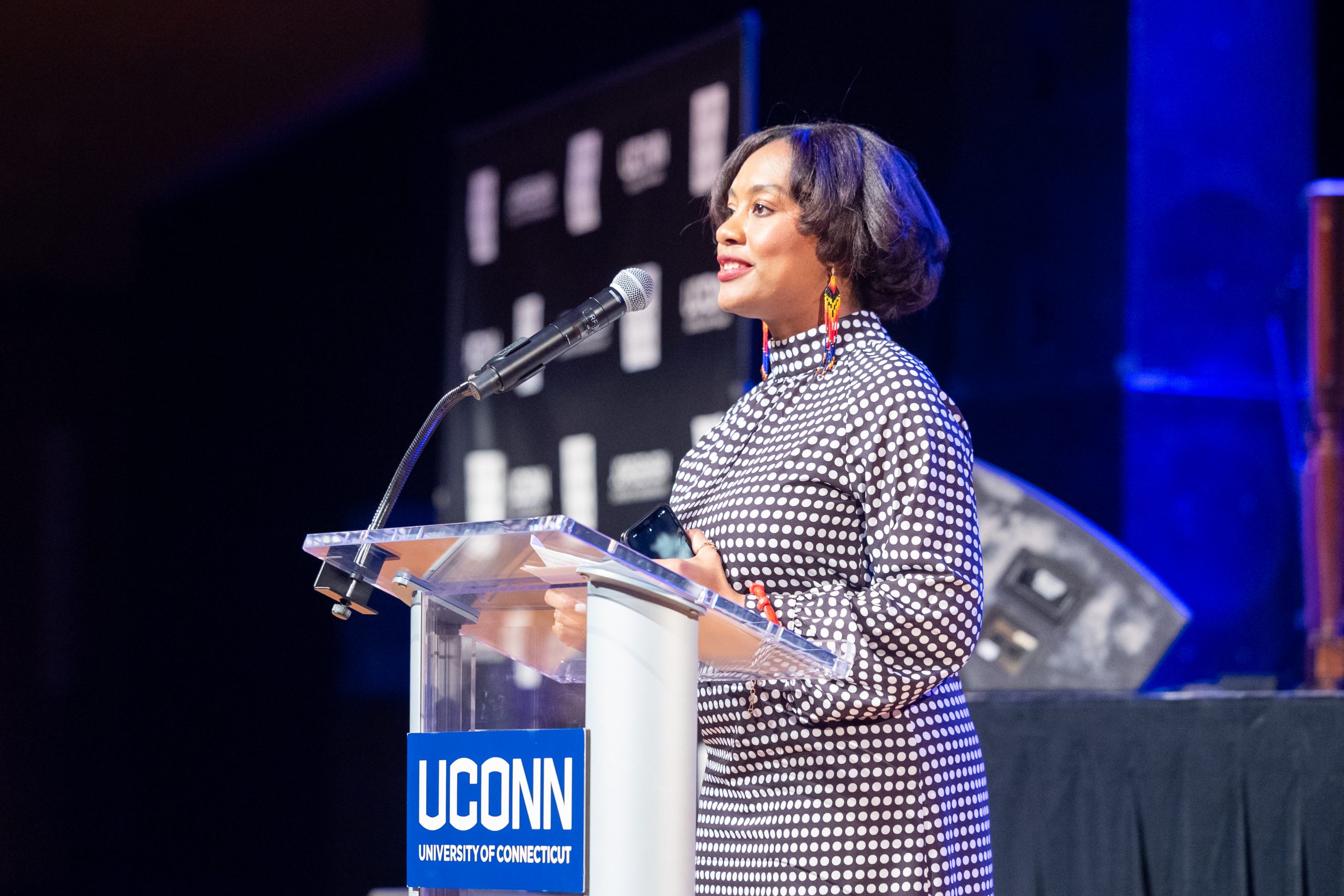
Jonelle Reynolds is the Director of Diversity and Inclusion Initiatives here at UConn and brings a positive outlook to us on this episode of the podcast. She has been at UConn for over a decade and currently develops, manages, and supports culture, engagement, and inclusion strategies across the university. Jonelle’s work blends strategy and operations, identifying gaps in resources and training and partnering with faculty, staff, and students to design programs, streamline processes, and strengthen community. She also has a background in marriage and family therapy and gives us some good ideas on how to make those relationships successful in our lives. A native of Guyana, she earned her doctorate degree from UConn, her undergraduate from Baruch College in New York City and has a master’s from Oklahoma State.
Listen to Episode 158 on Podbean
Mike: Hello everybody. Welcome to the UConn 360 Podcast. It’s Mike Enright from University Communications, once again joined by Izzy Harris from University Communications. Izzy, spring is here.
Izzy: Spring is here, but yet I almost fell on my way to work this morning.
Mike: Well, we’re glad that didn’t happen.
Izzy: I know, it was a close call. I mean, who would’ve filled in for me?
Mike: I would’ve been solo.
Izzy: I know.
Mike: That wouldn’t have been fun.
Izzy: No, not at all.
Mike: And an early reminder for our podcast listeners — this is spring ahead weekend coming up.
Time change.
Oh yeah. See, so once again, UConn 360 — plenty of public service we do here.
Izzy: Oh yeah.
Mike: So anyway, I like Daylight Savings Time.
Izzy: I do too. And it’s obvious that Phil the groundhog was right.
Mike: Phil the groundhog was right. Is he the one in Pennsylvania?
Izzy: Yes.
Mike: Because there’s one in Manchester, Connecticut too.
Izzy: Oh, at the Lutz Children’s Museum, right?
Mike: Yeah, yeah, yeah.
Izzy: Either way, Phil — he is not on good terms with me right now.
Mike: I don’t think he’s got many friends.
Izzy: Yeah, I don’t think so either. So hopefully he has a better prediction for next year, and it looks like the weather is warming up and sunny days are coming, so that’s something to look forward to.
Mike: Let’s hope. Let’s hope. Well, speaking of friends, we have a good friend here with us today. Jonelle Reynolds is the Director of Diversity and Inclusion Initiatives here at UConn. Jonelle’s been here for over a decade at UConn, and she currently develops, manages, and supports culture, engagement, and inclusive strategies across UConn.
Her work blends strategy and operations, identifies gaps in resources and training, and partners with faculty, staff, and students to design programs, streamline processes, and strengthen community. She’s also a certified facilitator in cultural intelligence and managing unconscious bias. She’s also a certified grant writer.
She earned her undergraduate degree from Baruch College in New York City, and then must have done quite a cultural change — she went to Oklahoma State for her master’s. So, I’m not sure New York City and Stillwater, Oklahoma will ever be confused. And that’s no offense to our friends in Stillwater.
And then she got a doctorate from here at UConn. She’s involved in some other things, which we can talk about later. But Jonelle, welcome to the podcast.
Jonelle: Thanks for having me.
Mike: So, tell us — I gave a pretty good background, but tell us a little bit more about your job at UConn and the role that you play.
Jonelle: So, in addition to all of that, I love my job because I get to spend so much time with the people in the UConn community really understanding their lived experience while at work and in the classroom. And because of that, I am then able to add context to the data that we have in terms of trends in higher ed and some of the gaps in resources and the places where policy does not necessarily lead to good practice.
And so, with that overall knowledge, it helps me to then create programs and initiatives, etc., that can help fill some of those gaps and help our folks feel like they belong.
Izzy: Can you share with us a little bit about your background and how you got interested in this type of work?
Jonelle: It’s a long journey, but for the sake of time, I’ll just say that my clinical practice, the research that I was doing, and then my own experience as an international student for over 14 years, working in the community providing wraparound services for folks — really that was the bedrock of me working with disadvantaged populations. And then the latter part of my grad degree, working in the Writing Center, Professor Tom Deans said, “You should be doing diversity and inclusion work.”
And I said, “What is that?”
And so began the journey of finding my way into this role. But it really wasn’t— that was not an aspiration because I didn’t know the space existed.
Izzy: You had mentioned you were an international student for 14 years.
Jonelle: Mm-hmm.
Izzy: Where was home to you at the time?
Jonelle: Guyana — so born and raised Guyana, South America. Came here as a student and just stayed.
Izzy: Oh, amazing.
Mike: Well, that’s good. You must like it here.
Jonelle: Yes.
Mike: So, we talked weather already. I assume the climate in Storrs, in Stillwater, and in New York City is a little different than the climate in Guyana.
Jonelle: Yes. In Guyana it’s rain and sunshine. If it rains too much, you’re like, “Ah, should we go to work?” Not so much here.
Izzy: I wish.
Jonelle: Yeah, not so much here. The one thing about the weather that I’m like — I’m glad I don’t have to shovel snow. I have to clear the car, but I don’t have to shovel.
Mike: Shoveling snow can be a lot.
Jonelle: Yes. The first time I did it, I felt like I was going to have a heart attack because I was a little bit too excited.
Mike: Well, we don’t want that to happen.
Izzy: None of that.
Mike: So, we recently, here on campus — and you were very involved in it — hosted the Dr. Martin Luther King, Jr. Living Legacy Convocation and Awards. It was held late in January. So tell us a little bit about that event and who was honored at it.
Jonelle: So, it’s our signature annual event, and this year we really wanted to focus on UConn and local Connecticut state talent. And we wanted to make sure that the presenters and the performers really just tapped into celebrating Dr. King’s legacy and his life.
We also had — I think this is our third year of having the MLK Legacy Awards, where that’s an intentional opportunity for us to identify folks, whether it’s students, faculty, staff, alumni, community members, or organizations who are doing this work.
And oftentimes the people that are doing this work are not doing it because of accolades — they’re doing it because it’s something they’re committed to and passionate about.
And we felt it was important to celebrate, to make sure that they’re aware that we see them, they matter, their work is important, and to keep going.
So that’s a good summary of the event — but it’s really joyous, celebratory.
Mike: And it’s an annual event, so people can come to it next year.
Jonelle: Yes.
Mike: So, is it typically the end of January?
Jonelle: Yes. Last Friday in January.
Mike: So, get your calendars out. Jorgensen Auditorium, right?
Jonelle: Yes, yes. Jorgensen is a good partner of ours.
Izzy: DEI initiatives are so important to our community, and I’m sure that your work comes with challenges, but also a lot of rewards. Can you share a little bit about both with us?
Jonelle: I’ll start with the challenges so I could end on a high. I would say one challenge in particular is, as someone who is very people oriented, folks bring issues and things that they’re dealing with, whether it’s individually or as a department or a unit, and sometimes there’s just no concrete or quick solution to the issues. It’s complex and layered and sometimes requires patience, systemic changes, policy changes. And so, I want to be able to help folks in the moment right away. And sometimes it’s the process, the delay, that could be very frustrating for folks. And I would say the other piece is that there’s just not enough of us to go around, right? We want folks to feel committed, like we see them, we care about them, and that their issues matter. But there’s not enough of us to do all of that. But the more important thing is that we will keep trying to the best of our ability.
Mike: That’s a great attitude.
Mike: It should be my motto.
Izzy: It should be.
Mike: Keep trying to. That’s terrific. So, you have a doctorate in Human Development and Family Sciences.
Mike: You’ve done research in marriage and family therapy, which is probably a side issue, but also related to the work you do here at UConn. So, tell us, what do you think the biggest challenges are that families and children and married people face today here in 2026?
Jonelle: Well, you know, family issues don’t stop at your home. You come into work, and it plays out. I would say given our current climate; families are struggling financially. And that’s manifesting in food insecurity, housing insecurity. For families that have temporary or precarious immigration statuses, they’re dealing with the forced removal of family members. So, all of that is disruptive. Folks are dealing with mental health issues. You know, post COVID, the stigma attached to mental health issues was decreased, but it still lingers. And access to healthcare. So those are like broad. And then more specifically for children, parents are having to sort of balance allowing their kids to use digital devices and having access to the internet because they’re using it in school, but also trying to protect them from predators and being exposed to or inundated with information that’s not necessarily developmentally appropriate. Right? So how do I protect my child while also exposing them to technology?
Mike: If somebody said, what are three things somebody can do to be a better family member? What would you say? Three things.
Jonelle: One, you need to figure out what are your family patterns, right? What are the things that you learned growing up that you’re bringing into your family? Are you prioritizing learning new skills and strategies so that you can communicate better and not replicate what you’ve learned? And I would say, have you built a community so that the pressure is not just on you to parent, right? That you have a community of folks who have different skill sets, who can mentor and help shepherd your kids in the direction you want them to go.
Mike: Good answer.
Izzy: Yeah, all of those are great pieces of advice to take with us and move forward. But speaking of moving forward. It can be challenging for college students as they navigate this new chapter of their life, often alone with some of these patterns that have followed them into college.
Jonelle: Mm-hmm.
Izzy: How would you suggest college students go about, particularly at UConn and any resources available to them, kind of breaking that pattern and starting a new life for themselves?
Jonelle: Yeah. I would really encourage first year students to take the First Year Experience course because that is really a structured way to build community. One, you are taking the same, you know, each week you’re with the same group of people. You have access to not just the adult or faculty mentor, but you also have a peer mentor who is just a few years above you and that’s where you’re learning about all the resources. So that’s a safe environment to start. I also think it’s important that you find one friend. You don’t need five, you don’t need 10. You don’t need an entire community in your first year, but you need at least one or two people who you can talk to when you’re struggling, that you can go to, you know, student activities and be brave together and find an adult, if not your FYE instructor, a professor or someone that you know has come to the class where you can sort of go to them and say, I’m struggling with this issue. Can you help me find the resources? So FYE, find a friend, and then find an adult so that you have three areas in which folks can at least be aware. They can notice if you’re absent or skipping things and they can advocate for you.
Mike: So, in addition to everything else you do here at UConn, you’re involved in the community.
Jonelle: Mm-hmm.
Mike: You’re the vice chair of the Connecticut Land Conservation Council, and you volunteer as a court‑appointed special advocate, looking out for the best interest of children in foster care. Mm-hmm. Tell us a little bit about those two parts of your life.
Jonelle: Yeah, not that my life is not busy enough, but because I grew up watching a father who was very involved in the community, I felt I was very involved in Oklahoma because of the work that I was doing. And I felt like it was time for me to reconnect—well, not reconnect, to build connections beyond UConn, but also not just replicating what I already do. I think it’s important for humans to have an environment that they can, you know, not just have good relationships, but have land and good quality air. So that’s kind of like the work that I do with CLCC. And then my research was heavily focused on foster families, and so it’s really no surprise that I’m finding time to be an advocate for the foster family that I’m assigned to. So, it’s pretty fulfilling and different parts of the brain. I feel rounded in terms of my overall involvement.
Mike: So, when you finally get to relax, what do you like to do?
Jonelle: I love British murder mysteries. European murder mysteries. You know, I love a good murder mystery, and it has to be good quality. And I also love Murder, She Wrote, so I’m old school that way.
Izzy: A crime junkie.
Jonelle: Wow. But not true crime because, you know, I deal with the realities of the world all the time, so I need fiction.
Mike: You need to relax.
Jonelle: Yes.
Mike: You need to relax by reading about murder.
Jonelle: You know. And I have a puppy, Barnaby. So, you know, lots of opportunities to do things with family and friends and my faith community. But when I’m not with people, I’m watching my shows and cuddling with my puppy.
Mike: Well, Jonelle, thank you very much for joining us today. You were a great guest here on the UConn 360 Podcast, and you do great work here at UConn.
Jonelle: Thanks for having me.
Mike: Izzy. Spring ahead.
Izzy: Spring ahead. Hopefully no more falls.
Mike: Hopefully no more falls, and we’ll talk to everybody next time on the UConn 360 Podcast.