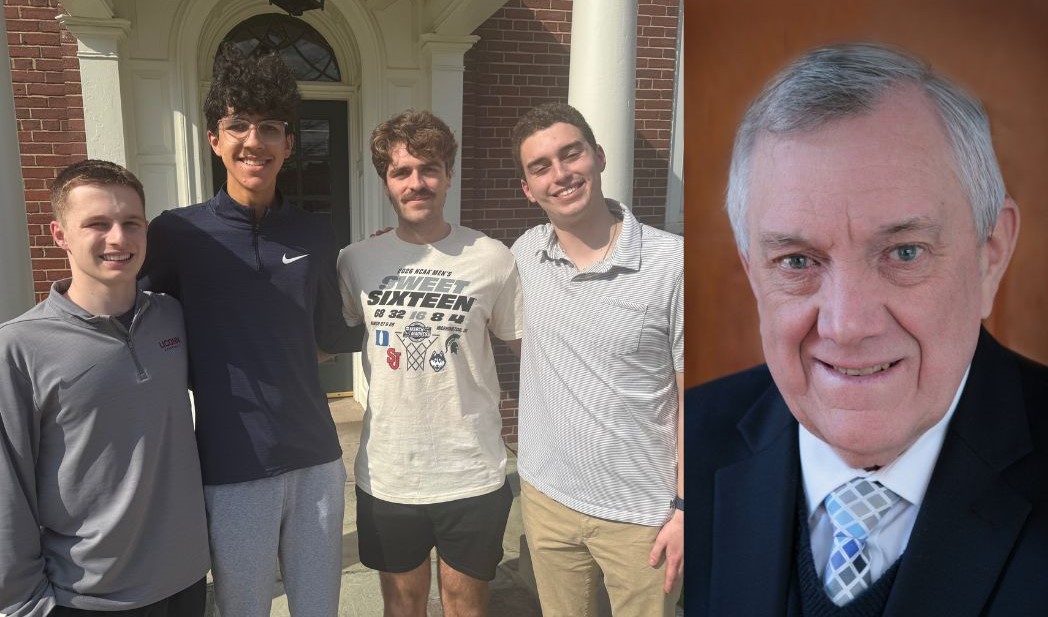
The UConn men’s and women’s basketball teams are the talk of the sports world this week as both teams are head to the NCAA Final Four. This podcast is a media roundtable taking a look at the upcoming games in Indianapolis and Phoenix. We start with the long-time color announcer on the UConn Radio Network Wayne Norman and then we talked to four student journalists – Sam Calhoun and Matt Dimech, who cover the men’s team for The Daily Campus; and Jake McCreven of the Daily Campus and Kaden Knapp of WHUS-91.7 FM radio, who cover the women’s team. The student journalists talk about what it is like to cover a team while still in college and what their future plans are. And we have predictions…Go Huskies!
Listen to Episode 160 on Podbean
Mike: Hello everybody. Welcome to another episode of the UConn 360 Podcast. It’s Mike Enright from University Communications working solo. This week as my usual co-host, Izzy Harris is getting ready, as all of our guests on today’s podcast, they’re getting ready to go to Indianapolis for the men’s Final Four.
Mike: We have a lot of people going to Phoenix for the women’s Final Four too. So, basketball had to be the subject this week of the podcast, and we’re going to have some UConn-related media people tell us a little bit about their careers, their experiences, and what they’re looking forward to this weekend.
Mike: We start with Wayne Norman. Wayne’s been the radio color analyst for UConn basketball and football since 1979. He’s been on the broadcast for all six of UConn’s men’s basketball national championships. He’s also, in his day job, the longest host of the longest continuously running morning radio show in Connecticut.
Mike: At WILI, which made its debut way back in 1971. He’s a member of the Connecticut Broadcasters Hall of Fame. He’s been named Connecticut Sportscaster of the Year. And in full disclosure, he’s a very good friend of mine. So, Wayne, thank you for joining us on the podcast today.
Wayne: You always remember your first. This is the first time I’ve done one of these actually in the studio.
Wayne: And man, this is high-tech stuff.
Mike: Well, it’s hard to believe, for your long radio career, you’ve never done a podcast, but we’re glad you’re here. So, you know, we’re going to talk about a few things today. You were courtside for Braylin Mullins’s shot. We’ve seen it. There are literally hundreds of camera angles you see on the internet now.
Mike: What was it like to be there?
Wayne: Mike, I’ve been courtside for all these big shots, the Kemba shot and others; they’ve all been talked about during the week, and I could do a whole show with you just on those alone. This one probably stunned me the most, even more than Tate George’s shot from Scott Burrell in 1990. I honestly did not see it coming the way Duke turned it over, and then Mullins launched that long 35-foot shot, and I think for about three seconds or so.
Wayne: I was processing it. What have I just seen? It was stunning. And the way they came back from 19 points down — nineteen’s a big number, by the way. ‘Cause when Tate hit the shot, you kind of blown a 19-point lead. This year in the Sweet 16 game against Michigan State, they had a 19-point lead disappear, and then against Duke in the next game, they came from 19 down to win on that improbable.
Wayne: Three-pointer by Braylin Mullins, who I think of all the buzzer beaters — I got a whole list here, which I won’t read off to you — of course Kemba Walker’s is on the list as well, but I think that may be the most significant shot in UConn history, bigger than Tate’s, even though that was the year that Calhoun got the team to the NCAAs for the first time, the dream season and so forth.
Wayne: But of all these shots — Rip Hamilton, Ray Allen, they’re all on my list here — not many of them were in the NCAA where a team went on to win the national championship. Kemba Walker’s did. And I think without that Kemba Walker shot in 2011, they wouldn’t have won the national championship. And there was one that Shabazz Napier had at Gampel early in the season, not an NCAA game, a game-winning put-back, a second-chance basket against Florida.
Wayne: A team they would later go on to beat in the Final Four on the way to the national championship. But all these others are great.
Wayne: Buzzer beaters they’ve had — those teams didn’t win championships, and certainly none put them in the Final Four. That’s why I would put the Mullins three-pointer at the top of the list.
Mike: So, Mullins hits the shot. Everybody in every restaurant and bar and in the arena is going crazy. You still got a job to do. So, walk through a little bit about you and your partner Mike Crispino, how that — you know, this happens, it’s a seismic moment — how do you do your job?
Wayne: Mike, so many things happen in a short period of time.
Wayne: He had to describe them all, and he got the players’ names right. He got the length of the shot and so forth correctly. But at that point — now, by the way, I strongly feel the color man should keep his mouth shut when the play-by-play guy is calling a play like that, and I did, I always do. Bob Husler talks about the Tate George’s shot.
Wayne: His call became world famous. And I wasn’t yapping on top of it. I’m proud of that. He’s proud of that. But now that Mike’s call is finished, even though the game wasn’t quite over, they still had four-tenths of a second left. I’m recapping the play from the point of view, pointing out that Deery got the steal, and then Deery tapped it back to Mullins.
Wayne: Mullins got the ball in the forecourt to Karaban, who was covered by Boozer, and he kicked it back to Mullins for the long shot. Then it got into more of the big-picture thing. UConn missed 17 of its first 18 threes in the game, but then got back in the game and won the game by hitting four of the last five.
Wayne: Lots of things set that game-winning shot in motion. And that’s my job — to fill in those blanks after the ball has gone through the hoop.
Mike: And then once the game’s over — I was listening to the broadcast driving home from a friend’s house — what amazed me is the work just kind of started for you when the game was over.
Mike: How many different people did you interview after that game, and who were some of the people?
Wayne: I did about five. We had Silas Demery live courtside, and you could just tell he was oozing with excitement. That was really something special, as you know. But then I wandered out on the court and the people I got included Tarris Reed.
Wayne: I think Tarris’s performance in that game was highly underrated. Everyone’s talking about the Mullins shot and even the Deery steal, but look at the huge game that Reed had, like he’s had in like every game in this NCAA tournament. So, I got him. He was great. I only had time for one question, one answer from Karaban, but I got Alex, and of course it had to do with the game-winning shot.
Wayne: Mike got Braylin Mullins. I generally interview Coach Hurley after the game, but because we were running around the court doing different things, he had the access right there to Coach Hurley. So, he talked to Coach Hurley, and I talked to Luke Murray, the UConn assistant coach, whose birthday is April the first.
Wayne: ‘Cause he’s leaving, and he’s a big part of this success. I think a lot of the fan base doesn’t realize how important Luke Murray is to the success of what’s gone on. He’s a real analytical guy, a real digital guy. Dan Hurley’s not, but he relies on the knowledge and the ability to design this complex offense on Luke Murray.
Wayne: So, I talked to him, and I talked to Dan Hurley’s dad, Bob Hurley Sr., a Hall of Fame high school basketball coach. And in short, his answer to me and my question — he says, in all the games I’ve seen, I have never seen anything to match what I’ve just seen. So that was good. And then I think Mike got somebody else, and we had a lot of people in the post-game.
Wayne: It was a really good
Mike: post-game show. It was a great, it was a great post-game. So obviously this is an audio podcast and you can’t see the paperwork and the notes that Wayne brought to kind of show us how he prepares for a game, but talk about how you prepare for a regular season game and how the NCAA tournament’s different, and now even more so how the Final Four is different for radio guys.
Wayne: As you know, Mike, I’m a fifth-generation Californian, grew up in Hollywood, listened to Vin Scully growing up, and he’s sort of been my broadcast idol even though I was not a big Dodger fan. But he said at one point something which always stayed with me, and that’s that when you prepare for a broadcast, you overprepare.
Wayne: During the broadcast, you might only use 30% of what you prepared, but if something happens, you’re ready for it. And all these complex notes that I showed you, I would say maybe 50% of what I did got used, but things happened that I was able to drop in because I did all this preparation. I do more preparation for these NCAA games.
Wayne: There’s more information out there to get, but it’s not just a matter of how many points a game, how many rebounds a game. But I go back and look at trends. I go back, like I did talk about on the air quite a bit. Solo goes to the line in the final minute of the game, he’s made 14 straight free throws.
Wayne: Well, he just missed the first one, then he made the second one. But all those kinds of things — who’s hot, who’s not. The Tarris Reed Jr. numbers are incredible. Over the last month he’s been averaging about 16 points a game and 12 rebounds a game. He’s been the offense on this team when the three-point shots haven’t been there.
Wayne: From Solo, from Karaban, from Mullins, although along those lines, Karaban’s numbers in the NCAA tournament have been really good until the Duke game. So, I’ve got all that analytical stuff going on. I do talk to people. I talk to coaches. My job on the broadcast also includes interviewing someone from the opposing camp on the pregame show.
Wayne: Tom Izzo from Michigan State’s always been great, always been very cooperative. I did a great pregame interview with him before the Michigan State game. I’ve had great relationships with people like Jay Wright from Villanova, Mike Brey from Notre Dame, and others along the way. Greg McDermott from Creighton’s been great, although we’re losing him this year ’cause he retired.
Wayne: And then the post-game, my normal responsibility is to get Coach early. I wait outside the locker room, and I get three quickies with him, three quick questions and answers before he gets to the interview room, and that plays in our post-game show. And Dan has been really good and cooperative with that.
Mike: So, one way or another, this is the last weekend of basketball.
Mike: There’s no more games to play after Monday night. And hopefully we get there and hopefully we’re cutting down the nets. And then you have the summer and then it becomes football season. Talk a little bit — a basketball game’s two hours, a football game’s two hours.
Wayne: Not anymore. Two
Mike: hours. Well, no, that’s true.
Mike: And I used to say a football game’s three hours, but that’s not true anymore. What’s the difference? It might seem obvious, but what’s the difference between doing a football game — and you’ve done UConn football for a long, long time and there were some lean years and things have gone better.
Mike: Two straight bowl games and now a new head coach. You did the game at Notre Dame. You’ve done bowl games. What’s the difference between doing a football game and a basketball game?
Wayne: By the way, Notre Dame’s number one on my all-time list, the 2009 double overtime out there in South Bend. But one of the differences in preparing is that you’ve got a lot more names to prepare for.
Wayne: You see that I’ve got basically 15 players on my sheet here for each team in basketball. Well, there’s a lot more in football, so you’ve got a lot more information, a lot more stats to fill in. And you just say the game is longer. My football responsibility is different. I interview a player on Tuesday that runs in the pre-game show, post-game.
Wayne: Our sideline guy, Adam Giardino, does most of those interviews. But you know, my job still involves analyzing what happened. Mike’s job is to call the play, and my job is to explain why — what happened on the play, what made it work. One thing that I’ve trained myself to do over the years, especially in football, but sometimes in basketball.
Wayne: You don’t always watch the ball. Sometimes, for example, a tight end throws a key block and the running back cuts around the right corner and goes down the sideline for a 40-yard touchdown. I don’t have to watch the ball carrier. My job at that point, as the color analyst, is to see who threw the block, who did he take out.
Wayne: And then after Mike has called the highlight for the touchdown call, I can say, ‘And that play was made possible because of the block by the tight end’ — fill in the blank name — ‘and he took out the outside linebacker who was blitzing on the play.’ So, I can add color to what’s going on, to explain why a play worked.
Mike: So, in our next segment, we have some young UConn journalists coming in from both the Daily Campus and WHUS Radio. You’ve been in this game for a while. What’s your advice to a 20-, 21-, 22-year-old person getting into this business?
Wayne: A lot of different things. You know, my first partner with UConn for five years was the legendary Marty Glickman, big-time New York broadcaster.
Wayne: He could do a whole podcast on him, but one thing that he talked about was always read the rulebook. He knew every rule for basketball and for football. Know the sports you’re talking about. Don’t just say, well, Cameron Boozer pushed off on that play, which he did in a play that he was not called for a foul on in the.
Wayne: Elite Eight game the other night. But as far as getting into the business, that can be tough these days. I learned sportscasting early on at WHUS, where those guys started. I think there might’ve been more jobs back then. I got my teeth cut doing high school games both in Ansonia — the Valley with the great football — Ansonia, Shelton, Seymour, Derby, and then doing high school games at WILI for Windham High School.
Wayne: And that’s where you learn, not just watching a game on the field and what to say, but also learning chemistry, learning to listen to your partner. You might have some great stat, and you’re so focused on looking at that great stat you want to drop in — you didn’t notice that 30 seconds ago, he said the same thing.
Wayne: Maybe the listeners pick up on that, but I don’t want to repeat what he just said, so I’ll say something else. But I also feel strongly, as I mentioned earlier, that if you’re a color commentator — or just a broadcaster in general — don’t have two people talking at once. Let somebody finish a sentence and the other person jumps in.
Wayne: And certainly over big plays — may not be the game-winning play, may not be the Braylin Mullins shot — but on any play, the RBI double in baseball while the guys round the bases, the color guy should zip it and wait until the play’s over before he talks. And I hear this on the major league level, other levels as well, where the color guy talks over the play-by-play guy, and I really don’t like that
Mike: way.
Mike: No, great advice. And we have some of our friends from the Daily Campus and WHUS Radio joining us next and have a safe trip and come back with a championship net.
Wayne: Well, I’ve got some experience in that. I’ve done it six other times.
Mike: Well, let’s make this a seventh.
Wayne: I’m into it.
Mike: Our first guest today was Wayne Norman.
Mike: We’ll start our next segment now.
Mike: Okay, UConn 360 Podcast listeners. We continue our media roundtable as we approach two Final Fours this weekend for UConn — the men in Indianapolis and the women in Phoenix. And I’m proud now to be joined by two people who will be in Indianapolis. And again, great experience. There are two UConn students who write for the Daily Campus, and I’m going to let each one of them quickly introduce themselves to our listening audience.
Mike: So Matt, why don’t you go first?
Matt: I’m Matt Dimech. I’m a junior at UConn studying journalism. This is my first year on the men’s basketball beat for the Daily Campus, and it has been just such a great ride. And
Mike: Matt, where did you grow up?
Matt: I grew up in Cheshire, Connecticut, about an hour from here.
Matt: Sure. Been there my whole life. Got my start in sports reporting there and, yeah. Excellent.
Sam: I’m Sam Calhoun. For those who don’t know me, I’m a senior journalism major here at UConn. And this is my second year on the men’s basketball beat for the Daily Campus.
Sam: Obviously this year blows last year’s out of the water, and I’ll be going to my seventh Final Four — my first as student media, well, as media as a whole. So, for full disclosure, Sam obviously has a familiar last name to UConn basketball fans. Sam is the grandson of UConn legend Jim Calhoun.
Mike: So, he’s got quite a history with the program. Yeah, I do. I mean, I was nine in 2004 when they won. The team won in San Antonio. I mean, I was there for the Final Four loss in Detroit. And then it’s crazy. I keep track, I keep track of all the.
Sam: Tournament games that I’ve been to, and I think it’s mostly accurate because I went to the Sweet 16 and Elite Eight in Phoenix in ’04. I think my record’s now 28 and 3 in NCAA tournament games attended for UConn basketball. Well, let’s hope it’s 30 and 3 after this weekend.
Sam: That’d be pretty good. I mean, that records like a one-seed worthy, so. Absolutely. Absolutely. So, I talked to Wayne a little bit about this earlier, but you guys were both in Washington for a moment that will not be forgotten anytime soon. Matt, we’ll start with you. What was your reaction when Braylin hit the.
Matt: I wish I had words to tell you — I just stood there with my mouth hanging open. I grabbed Sam, I was like, what is going on? And I just pulled out my phone, recorded my reaction. I got some of the crowd in there, and a couple seconds went by and it really settled in — it really settled in — like, this is going to be one of those generational UConn moments that gets talked about.
Matt: The Tate George shot, the Cardiac Kemba shot — and we were this close to that shot. It’s just crazy to think that we were part of such a historic moment in UConn basketball. How about you, Sam? Yeah, just for the record, to show where we were — our seats were literally on the sideline. Oh, great.
Sam: I can send you a picture. There is a picture. No, we’re all audio here at UConn. Yeah. Someday maybe we’ll do video. Yeah. But I have a picture and it’s literally right on the court. Oh, it’s great. It is right on the side that Braylin hit the shot.
Sam: So, we got like the best angle humanly possible. I didn’t record it at all because, I mean, my whole family — my mom did like the crossed fingers and all of that. I was kind of doing that too, covering my mouth. Just trying — and then when they got the steal, I totally expected a foul.
Sam: I totally expected a foul. Right. I think most people did. Right? I think I can speak for Matt when I say that. And then, yeah — Silas tips it and then Braylin gets, corrals the deflected pass, and then gets it to Alex. And then at that point when Alex got it back, I was like, okay, he’s got to shoot it.
Sam: And right, the moment it left his hands, I think both you and I were like, this is going in. Because I mean, it just felt like such a fairytale thing. Like it’s like something you’ve seen in the movies, like Hoosiers or Remember the Titans type of thing.
Sam: I mean, Braylin Mullins, for those who don’t know, is from Greenfield, Indiana, which is like 30 minutes outside Indianapolis, and the Final Four is in Indianapolis. I mean, it was just — I would’ve used that as my headline for my recap ’cause I had recapped that night. But Alex Karaban kind of took those words out of my mouth when he said it at the press conference.
Sam: So, I didn’t want to plagiarize that. But yeah, it just left his hands. And I was just like, oh my God. And then I saw 0.3 and I was like, there’s no way. And then they added a fourth tenth of a second — I had already texted my family group chat, we’re going to the Final Four. And I wasn’t way ahead of them, so I kind of spoiled the moment.
Sam: Oh no. Oh, but right on TV — but I did not care at that point. So, tell me, you guys both work for the Daily Campus, and for some of us that went to school at UConn a while ago, it’s obviously known for its print version, and it’s I think one of the oldest collegiate daily papers in the country.
Mike: But tell me what else — how has online and social media changed what the Daily Campus does? We’ll start with you, Matt. So, the digital stories are definitely most of our viewership traffic now. But for the record, I think it’s great that we still print five days a week, being like one of the last papers still doing so.
Matt: But the online stuff is really where we gain most of our traction. I know me and Sam — Sam has a massive Twitter following. Mine is still, growing, I guess we’ll use that. But that’s kind of the number one way that both of us promote our stories. We go through Instagram and stuff like that on our personal accounts, and then the Daily Campus’s social media presence is starting to grow.
Matt: I know that Bob and Maria Mariano came into the building and there was a whole social media campaign there, which was really cool for us. So, do you think, as you guys explore your further careers — we’ll start with Sam — are you looking at traditional print, or what do you look at, and what do other Daily Campus people look at for a career path?
Sam: I mean, obviously it’d be great to stay in this relative area. My family is all over New England, especially in Connecticut. And my grandparents, my parents are either on Nantucket or in Rhode Island. So definitely want to stick closer to home. And I mean, I love college basketball.
Sam: It’s been — I mean, I think it’s pretty clear that it has become my life ever since I was born. I mean, there are maybe pictures of me with a UConn Huskies basketball shirt. So, this has been in my blood for as long as I can remember. That’s something I want to do.
Sam: And I’ve fully invested in it. Matt sometimes gets annoyed with how much I talk about it. No, never. But yeah, I definitely want to stick in college basketball in some form. I mean, when we are taught by our professors — shout out to Mike Stan, and then the other ones — they tell us to kind of just have such an open mind when you’re looking at job opportunities.
Sam: I know I have an internship this summer with CBS Sports. Oh, great. Good for you. Thank you. Yeah. That’s excellent. Yeah. So, he’s already doing better than me. I got an internship last year, but I also had this amazing opportunity to cover the men’s team and I kind of took this time to one, just kind of relax, and two.
Sam: Just, maybe — when I first got into this, when I first knew I wanted to be a journalism major and all of that, I had a sports blog in high school, and I still do, I don’t really post on it anymore, but over the summer I would write about like the UConn summer league, or the TBT, the basketball tournament.
Sam: So, yeah. So, tell me, you guys are students too, you’re both journalism majors, right? Yes. How are you balancing missing class time for being on the road with the Huskies? Fortunately for me, I’m in mostly journalism classes right now, so the professors are very understanding that I’m going out into the real world to practice real journalism.
Matt: So as long as I’m keeping up with my work and staying in contact with them, they’ve been more than gracious with allowing me time to kind of stay on course. ‘Cause for us, ever since I think March 10th — we left for the Big East tournament before spring break — I think we’ve spent 15 days in a different city, and this is my fourth day on campus since that day.
Matt: So, yeah. Like a lot like the players, you need the academic support. It’s difficult, but the teachers and the professors, they make it much easier on us for sure. Okay. To wrap things up, we’ll go with prediction time. What’s going to happen Saturday? Well, UConn’s beaten them once already.
Matt: They beat Illinois once already this season at a neutral site, although Madison Square Garden, you know. So, I think they have the worst odds out of the four teams there, but I think UConn can get it done and make it to the national championship for sure. Sam, what happened Saturday, and who wins the other game?
Mike: Arizona. My bracket’s got Arizona. I mean, me and Sam are on the same page. You guys are on the same page? We both think Arizona has been the best team in the country all season. Yeah. So, I’m thinking of a UConn-Arizona national championship matchup. And this may be a silly question — who wins that game, Sam?
Sam: Well, to piggyback off of what Matt said, I do think it’s a UConn-Arizona rematch from that November game that Tarris and Braylin were both out for. And Tarris was like a last-minute, very late scratch. But I think it’s going to be a lot tougher to pick this game.
Sam: I do have UConn winning, but it’s going to be a lot tougher because this Illinois team is a lot different from the Illinois team you saw in MSG on Black Friday. I mean, that was November. Both teams have evolved so much since then. And Kyan Wagoner, who’s like their superstar freshman, going to be a top-10 pick in the NBA draft.
Sam: He only had 14 minutes in that game, and they ran their offense a lot different then — they ran a lot through Kalen Boswell, who I think played almost the entire game. Now it’s much more — I mean, now they’re the number-one offense in the country in terms of adjusted efficiency, and they use their centers a lot more, like Tovi.
Sam: And then they also have a real good freshman. I have loved Wagoner’s game, especially since he wasn’t really talked about preseason. I mean, he was a four-star, but I think he was on the lower end of the four-star. And he very well could be the best player on the floor on Saturday night.
Sam: I’m excited to watch both of these teams play. And I do think also that Brad Underwood wants to get revenge for that 30-point loss, probably. Yeah. Well, let’s hope Monday night we’ll cut down the nets. And Tuesday we’re playing in a parade. We’ll see. Yeah. So, Sam and Matt, thanks for joining us today on this Final Four media roundtable.
Mike: And now we’re going to bring in two student journalists, media people that cover the women’s team, and we’ll talk a little bit about what’s going to happen in Phoenix.
Mike: So now we have two student journalists who are off to sunny Phoenix to cover the women’s basketball team in the Final Four. We have Jake Reaven from the Daily Campus and Kaden Nat from WHUS Radio, 91.7 on your FM dial, which is commonly called W’s now, but I always call it WHUS. So, I’ll keep it W-H-U-S. So Jake, we’ll start with you for a few minutes. Tell us a little bit about yourself, what your major is, where you grew up, and how you got involved in this. Yeah, so I’m a sophomore journalism major, and I have minors in writing and history, so all about writing for the most part.
Jake: That’s good. We need writers. I’m the women’s basketball beat writer at the Daily Campus. So, I have the privilege of following this team around, you know, wherever they go. And it’s been just a blast this season. I mean, uncontested for the most part, but these next two games — hopefully they win the Final Four — but these next few games are going to be amazing ’cause it’s two of the three teams that are on their level.
Mike: Kaden, how about you? Yeah, I was born in Alaska. Wow. And then — wow, this is our first guest from Alaska on the 360 Podcast, I think. And then when I was five years old, I moved to Northwest Ohio where I grew up. And when I was in seventh grade, my high school asked me if I wanted to broadcast games because they had no one to do it.
Kaden: I said yes, I’m going to do this. And I did that all throughout high school and into this year, where I now broadcast games for WHUS. I’ve done men’s and women’s games, and I also intern for NBC Sports in their research department, and I’ll be working the World Cup for Fox this summer. Oh wow. Good for you.
Mike: Was that with NBC? Was that done in Stamford? Yes, down in Stamford — what kinds of work did you do down there? Yeah, so I more recently have been on their research desk, so I’ve gotten to sit in on the Olympic shows they’ve had, as well as their college basketball shows, and just help provide information for the on-air talent and fact-check information.
Mike: Great. Good for you. Good for you. That’s awesome. So, I mean, covering UConn women’s basketball — they’re a dominant team, a dominant force. How do you cover the games? Because sometimes the scores quite frankly aren’t that close — is it a challenge to cover the team from that standpoint?
Jake: Yeah. You know, it gets repetitive after a while. I learned that — this is my second year on the beat, I started around as a freshman. It gets repetitive. Every game is 25-plus, 30-plus, 35-plus. Even, you know, some of the ranked games that they play get a little out of hand. But I’ll go back to a moment in time before the start of this season. Dom Amore, the lead columnist at the Hartford Courant, who’s also been a guest on this podcast.
Jake: Really? When he did his Coach Calhoun. Yeah. Well, I’ll be sure to — Dom, I came on here, but he pulled me aside right before the start of a media availability over the summer and told me, listen, you got to get comfortable being a writer. You can’t just tell them the final score.
Jake: Everyone watched the game. Everyone saw how bad it was. You got to find an angle about this game that no one else has and kind of draw the reader in to keep reading what you have to say, because a million people are covering this team ’cause it’s the most popular team in the country. What do you have that other people don’t?
Jake: And that’s kind of the angle that I’ve gone with this year. What can I find every blowout that is different than the last blowout? And Kaden, how about you doing the broadcast — does it ever in the second half get a little tricky, or what’s your trick for making the broadcast interesting?
Kaden: Yeah, so I’ve had experience calling blowouts before. In high school I called a lot of different games that had a wide score. So going into broadcasts, especially if I have an idea that it’s not going to be close, I’ll usually write down a few stories that I want to talk about or things that I think would be great to add to the broadcast and keep the listener engaged.
Mike: So, tell me a little bit about working with Coach Auriemma and the student athletes on the women’s team. Is it tricky being a student media person? Do you have an advantage because you’re their age and you relate to them? What’s it like working with the team and the coaches?
Jake: Well, you were actually just talking about this when we were outside waiting. So, I mean, it is amazing. It is a one-of-one experience. You are not going to find this at any other university in the entire country. We are the only university that has sent both teams to the Final Four, and we’ve done it — what is this?
Jake: Six times? Yep. Six. Six times, right. Yeah. So, this is a very, very unique experience with first-ballot Hall of Fame coaches, future NBA and WNBA superstars. And you get to go up to them and talk to them and ask them questions, and they’re all nice. I don’t have any complaints about any player, any coach.
Jake: I’ve only had good experiences here. And again, it is the basketball capital of the world, and I just get to go and talk to Sarah Strong on a daily basis. It is amazing. Kaden, how about you? What’s it like to broadcast the games? It’s been just so fun. I mean, just jumping up to this high of a level has just been so rewarding.
Kaden: And to add to what Jake said, we get to sit in on press conferences afterwards with kind of the who’s who of sports media and just, you know, talk with them, see how they ask questions, and it’s just a huge learning experience. Tell me a little bit about what it’s like to go to Final Four.
Mike: How is that experience different than the NCAA tournament? How is that experience different than covering the regular season? It’s just the feel. I remember last year I got to Tampa. It was just, it felt different. There it is. It is indescribable, really. And the pressure and the privilege — it is not only for the teams, obviously, but as a member of the media, you’re expected to get your story out as soon as possible, and also have that unique lead.
Jake: And then as a member of the media, you need to cover the game on social media. You need to post all your clips, get everything out as soon as possible — ahead of the national, the international media that are all there. I asked the men’s basketball guys this, but you know, from the Daily Campus and from WHUS, I mean, I think a lot of us of a certain era think of the Daily Campus as a print publication and WHUS as a linear over-the-air radio station.
Mike: How have both entities embraced new-age media, and how has that helped you? Yeah, I would say that we’ve had a lot of collaboration, at least the three orgs if you add UCTV in, and that’s kind of helped make it so the org heads kind of bounce around ideas. And on top of that, I would say for the radio station specifically, we’ve tried to just find as many different ways as possible to engage with people on social media, post articles — both audio and written — and just give the students an all-around feel.
Kaden: Yeah. With WHUS, it’s still — it used to be called the Sound Alternative. I don’t know if it still is — when it’s sports, it’s sports — talk a little bit about the mission of the station. It’s not a typical radio station, right? Yeah. I would say that the mission for the radio station is to just connect with as many people as possible, connect with the students, and also give the students voices.
Kaden: I mean, as long as you are able to — which most people are — go through the training and get air clearance, you’re able to have a radio show, whether that be live or recorded. You can do a podcast, you can be talking on air, you can have music. It’s really just what you want to do. Excellent. Excellent. Okay. We did this with Matt and Sam.
Mike: It’s prediction time, Final Four weekend. We start with the women on Friday. We’re actually playing the early game this year, which makes it nice for people. UConn, South Carolina. What do you think? Yeah, we are also looking at the betting lines outside, so I think we kind of knew what questions you were asking beforehand.
Jake: The line’s at six and a half right now. Five and a half. Six and a half. Six and a half. Yeah. Six and a half for UConn. It’s hard to say that they won’t cover the spread. And obviously I’m not a big sports betting guy, but I use the spreads to kind of plan for the games. Sure. UConn and South Carolina is the rivalry now.
Mike: Yeah, and I think you throw the line out the window at that point. I just don’t think that there’s any way to predict what will happen with that game. Two of the best teams in the country. And then on the other side, I hope that Texas wins ’cause I would really want to see Sarah Strong versus Madison Booker in the championship.
Jake: South Carolina’s just going to be really, really tough to get past. Same feelings there. Yeah, I agree with Jake. I think that UConn will cover against South Carolina. I do think it will be close for a while. I think the Huskies will kind of pull away in the fourth quarter as they’ve done this season.
Kaden: And looking at the other side, Texas is the favorite to win. I do think UCLA will end up getting the victory, just because UCLA — they’ve been playing at just an incredible level of basketball as of late, and really all season long. And they’ve played so many different difficult teams this season, and I think that is really going to help them in this game.
Mike: Sunday predictions. Let’s say it’s a UConn-UCLA final — what do you think? I don’t, I don’t think I can pick against UConn. There you go. How about you? I second that. Alright, well that sounds good. And for folks, obviously we have great friends at ESPN, but 91.7 FM if you want to give a listen to the championship game or the semifinal game.
Mike: And what’s the website for the Daily Campus? DailyCampus.com. That’s easy enough. We want to thank everybody that joined us today. Four great UConn student journalists. We started with Wayne Norman of the UConn Radio Network. And happy Final Four weekend everybody. It’s a special time. You can’t take it for granted. And thank you for joining us, and we’ll catch you next time on the UConn 360 Podcast.