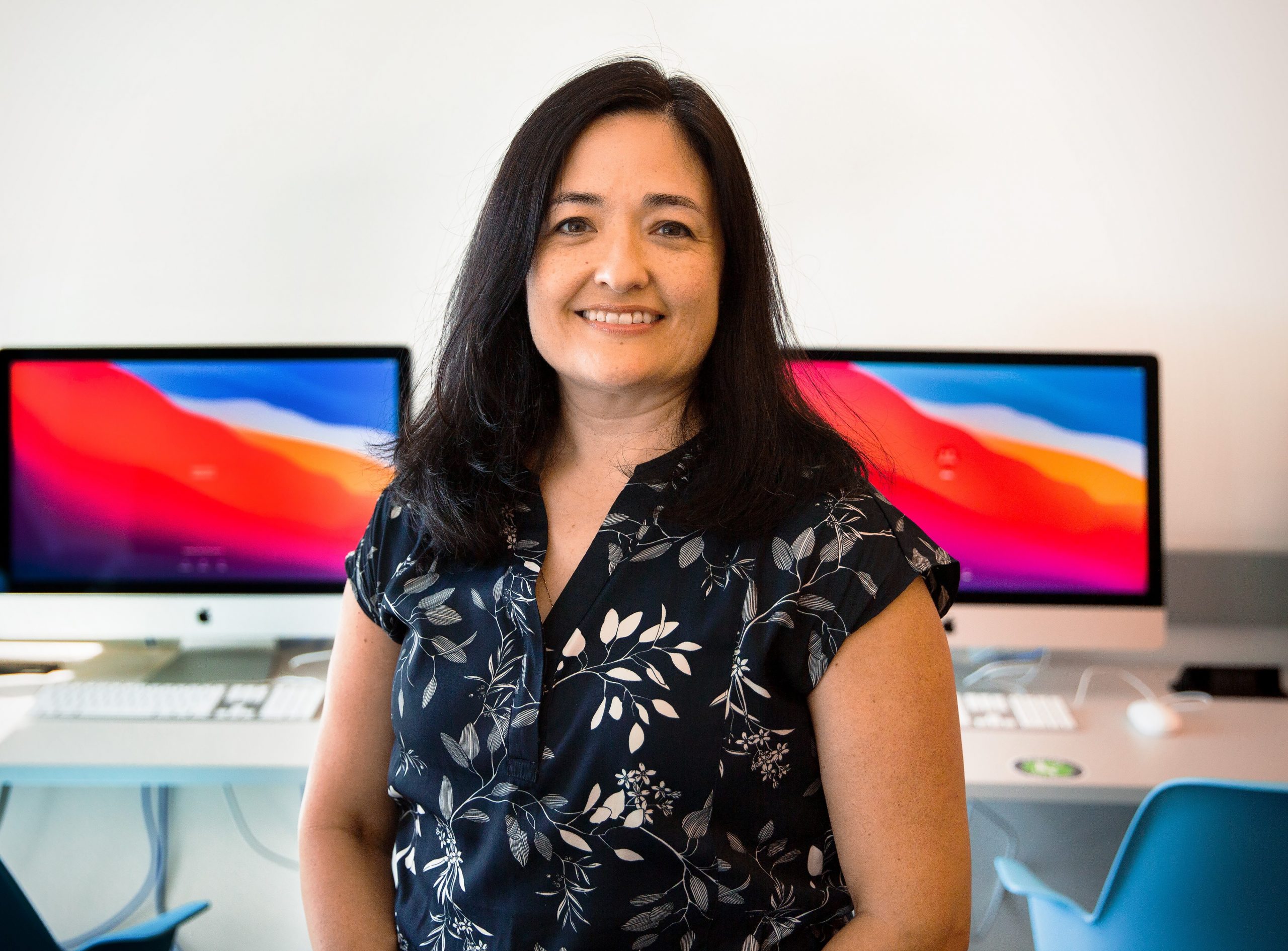
The Department of Journalism at UConn is the only nationally accredited journalism program in New England. Students learn to become intelligent, responsible, articulate journalists, and clear communicators in all forms of media through practical training and a liberal arts foundation. Marie Shanahan is the head of the department and is our guest on this episode. She began her career as a print reporter for the Hartford Courant and then moved to the digital news side and worked more than 20 years in the field. Marie gives an overview of the department and the types of classes that are offered. She also discusses how AI fits into the current world of journalism and how people can make sure they get accurate information in this day and age of fragmented reporting.
Listen to Episode 165 on Podbean
Mike: Well, hello everybody. Welcome to another episode of the UConn 360 Podcast. It’s Mike Enright from University Communications, along with Izzy Harris from University Communications. Hello, Izzy.
Izzy: Hey, Mike. Welcome back.
Mike: Thanks. I just came back from a great six-day trip in Ireland with my son Matthew, in the Galway area, so it was terrific.
Izzy: What was the high and low of the trip?
Mike: There was really no low. I mean, it’s a six- or seven-hour flight, which is no fun, but there were movies and games and things like that to watch. The highlight was going to an island called Inishmore off the coast of Galway, which is like going back in time hundreds of years, where people live a very simple life. It’s a little tourist-driven, but there’s a lot of agriculture, a lot of small business—just a very simple way of living.
Izzy: Love that. Well, I’m sure you’re feeling nice and refreshed—very refreshed—and ready for—
Mike: a new episode. Ready to go. I’m a little nervous about doing this one, though.
Izzy: I know because—
Mike: Because if I do a bad job, my degree might be revoked.
Izzy: I know. I’m in the same boat, but I didn’t go—well, now I can say I did go to UConn, because I graduated.
Mike: But I was a journalism major at UConn.
Izzy: Yeah, you might be in trouble.
Mike: So anyway, hopefully we do a good job here, because our guest is Marie Shanahan. She’s the department head and an associate professor in the Department of Journalism, and there are so many great topics to talk about with the media right now.
Marie actually began her career as a print reporter for The Hartford Courant. And look what I brought today—just, I know we’re audio, no video—but I brought a real newspaper.
Izzy: Wow, look at you.
Mike: Do you still read a real newspaper?
Izzy: I hate to say it, I really have never been a newspaper reader.
Mike: I still get The Courant delivered to my house, and I get three newspapers on Sunday delivered.
Izzy: All from The Courant?
Mike: I get The Courant, The Boston Globe, and The New York Post delivered to my house on Sundays.
Izzy: Oh wow. I subscribe to The Hartford Courant online.
Mike: Online—that’s probably how most people are doing it. But I thought just for symbolism I’d bring a real newspaper here and we’ll stick it in the middle.
Izzy: Very nice.
Mike: Today’s Courant. Marie worked in journalism for 20 years. She then moved over to academics, joined the UConn family in 2011, was named department head in 2021, and she’s very interested in trends in digital discourse, online news commenting, social media, news literacy, and local news engagement.
She helps students gain proficiency in digital news gathering and production. She is also a UConn undergraduate and got her master’s from Quinnipiac. So, Marie, thanks for joining us here on the UConn 360 Podcast.
Marie: Thank you. Thank you so much for having me.
Mike: So, give us a little bit, first of all, an overview of the Department of Journalism at UConn. I know it’s part of the College of Liberal Arts and Sciences. Talk about how many students you have, what kind of students, the classes offered. I assume the typewriters are gone. Tell us a little about the department.
Marie: Okay. Well, you know, for me, coming sort of full circle with UConn journalism—this is the program that I graduated from. I did have a career at The Hartford Courant. I started as a print newspaper reporter, so I do still have… I don’t read print anymore either, but I appreciate it.
So, coming back to UConn after all those years and being able to give back to the department where I came from has been really special. I never thought I would be department head—that wasn’t something I aspired to.
Mike: We hear that a lot from people.
Marie: But when my prior department head, Maureen Croteau, who led the Department of Journalism for about 35 years, finally decided to retire, I stepped up—it was about a year after COVID.
So, a lot of the things we think about—like the number of journalism majors at that point had slipped a little—but in the past five years since I’ve been department head, we’re back up again. We probably have about 200 majors, which is great.
Mike: Wow. Yeah, that’s a great number.
Marie: Yeah. And I think part of that is because of the news environment the way that it is nowadays. Because it’s so fragmented, because people are getting news from all different points of contact…
When we think about pathways to news, there’s social media, search, the internet—it’s coming from all different directions. And I do think students are a little bit worried about, “Where am I getting my information from?” and “How do I know this is real?”
So, one of the things I always ask students is, “Where do you get your news?” and “What kind of devices do you have?” I’ll poll them—what kind of phone do you use, how are you getting your information, what social media channels are you using?
It’s been really interesting to track that and to think about how we teach journalism in a way that actually engages these students. Because Mike, I appreciate that you subscribe to three newspapers—but I would say most college students don’t do that.
Mike: I’m on a short list of people.
Marie: A very short list, yes. And so, we have to think about how people are actually getting their news these days. How do they come across it, and how do we want them to engage with it?
It reminds me a lot of teaching. You have an audience—whether it’s students or readers—and you want to get their attention and get them engaged. But if you do it the same way we always did it, that doesn’t really work anymore.
So, because there are so many different ways people can use technology—and the way you get news is different from how I get news—we have to think about all those different models of storytelling and offer it to people in different ways.
And that’s hard to do if you’re one person or part of a small newsroom. So, these are all the things we talk about.
But the journalism curriculum here is interesting to students because it’s not just theoretical—we don’t just talk about it. It’s real. We make you go out and do it.
Mike: I remember that.
Marie: It’s very practical. We send students out. We have something called—well, it used to be called “sudden death,” now it’s “sudden deadline day.”
That’s in Newswriting 1, when you first learn how to be a reporter and write a news story. There’s a day during the semester—you don’t know when it’s coming—where you come into class, and your instructor tells you, “Go out, find a story, come back, write it in two hours, and file it.”
And the adrenaline kicks in—you’re scrambling to find something, reporting in real time—it’s very memorable.
Marie: And then we build on that experience. So, depending on what students are interested in, they can go out and cover different kinds of stories. If they’re interested in politics, they can cover political news. If they’re interested in sports—and we have a lot of students interested in sports—I would say we get a lot of journalism majors because it’s UConn and UConn has great sports.
So, students come in and say, “I want to be a sports reporter, I want to work at ESPN,” and we have courses where we can teach them how to do that, in addition to all the other types of journalism.
For example, right before I became department head, I taught a podcasting course. We teach broadcast journalism—we have a broadcast studio in the department. We teach documentary journalism. Two of our professors worked with students to create a documentary that was shown at film festivals and won awards.
So, we are really trying to offer all the different ways that you can potentially tell a story and teach students a little bit about each. And if they’re really interested, they can dive deeper and specialize.
Izzy: So, AI is obviously a really hot topic right now. How do you think that’s affecting the program and your teaching, and even how students are approaching journalism at UConn?
Marie: Well, we’ve actually been really lucky, because the College of Liberal Arts and Sciences decided they were going to build a cluster related to AI, and they wanted it to be interdisciplinary.
One of the clusters reached out to the journalism department and asked if we wanted to be involved, and of course we said yes. It focused on AI and the environment, and how people are getting information about climate change and related issues.
Through that, we were able to hire a faculty member, Brad Tuttle, who joined us a couple of years ago and focuses specifically on AI.
And one of the biggest ways we approach AI is through ethics. Journalism is different from something like English or communications because it is based in truth. You have to report accurately—you can’t make things up. So, there’s a lot of rigor in reporting and research, and then there’s the ethical side of it as well.
So, when we think about AI, we ask questions like: Is it ethical to have a machine write a story for you? What if the machine is making things up? Those are concerns not just in journalism but across academia.
At the same time, we also look at how AI can help journalists. Can it make you more efficient? Can it act as a kind of assistant or editor?
I was just reading about how AI is being used in larger newsrooms. Journalists still do what AI cannot do—talk to people, conduct interviews, go out into the field, gather documents, verify information. But then AI might help shape the story, ask follow‑up questions, or help identify gaps.
And then there’s the distribution side. Once you have a story, how do you share it across platforms? Can AI help you turn that story into social posts for Instagram, TikTok, YouTube, X, Facebook—all the different places where audiences are?
So rather than replacing journalists, we’re trying to think about how AI can extend what journalists are capable of doing.
Mike: Is there still a place for the student—and then the young professional—who just loves to write, is a good writer, loves to report, loves to interview? Can they succeed without having to be a video editor or a social media expert? Can you still get by just being a great writer?
Marie: Yes, I think you can. I think it depends on the organization that you’re working for. If you go to one that’s big enough that has people who handle those other roles, or if you have technology that can support you, then yes.
But the bread and butter of journalism is the reporting. That’s really the foundation.
It’s been interesting hearing from Professor Tuttle about his research and how AI is being used in smaller newsrooms—like local newsrooms—where there’s essentially an AI editor, but the reporters are still doing all the research.
So, if you really like being a reporter, that’s something that can’t be duplicated by AI. You go out, you gather the information, you conduct the interviews—that part is essential.
Then you might submit your reporting, and a first draft could be generated by AI, reviewed by an editor, and then rewritten and refined by the reporter. That’s actually happening in some newsrooms now.
There’s a newsroom in Ohio doing this, and it’s interesting because when I was at The Hartford Courant, I would do all the reporting, then come back and write it myself—usually quickly, because of deadlines.
So, you start to wonder—if I had help with the writing, would that be okay? Especially if I really loved the reporting part more.
But then, what if you love the writing most? Is there still a place for that? I think there is, but it depends on where you work.
There is still great writing out there. I read The Atlantic. I read other long-form outlets. There is excellent journalism being produced.
But it’s about finding the right place—and also thinking about what you can do that AI cannot. That’s what makes you valuable.
And then, once you know that, you can think about how AI can help extend your work rather than replace it.
Izzy: Even since I’ve been in school, the social media landscape has been constantly changing—where people get their news from, how it’s delivered. How do things change so quickly, and how do you adapt to that?
Marie: Yeah, I mean, it’s funny—before I became a UConn journalism professor, I was invited back to speak as a guest speaker in Professor Marcel Dufresne’s class. He’s since retired—wonderful professor, and one of my former professors here at UConn.
I remember the main theme of my talk was adaptation. Because I had moved from being a reporter at The Hartford Courant to working on the digital side as an editor for about 12 years, and things were constantly changing there.
So that word—adaptation—has really stuck with me. Technology keeps changing, especially communication technology, and as it changes, you have to adjust with it.
That’s why I poll my students every semester at the beginning—what apps are you using, what platforms are you on—because it keeps changing. If you’re willing to keep evolving, it keeps things interesting, even if it keeps you on your toes.
And honestly, that was one of the things I loved about journalism—no two days were the same. You’re always learning something new, always covering something different.
You might get into a rhythm with how you produce content, and then suddenly everything shifts again. But that’s what keeps it fresh.
As a journalism educator, it’s actually fun, because we get to figure out new ways to teach and new ways to tell stories. That’s what academics enjoy—how do we create new knowledge, new workflows, new ways of reaching people?
Because if the pathway to the audience changes, then the way we deliver information has to change too.
A lot of it depends on the audience and the platform, so it becomes a bit of a puzzle. It’s definitely challenging, but it’s also what keeps things engaging.
And beyond just technology, even the political environment has changed. That affects journalism too. People are pulling from completely different sources of information now.
It’s not like it used to be, where everyone in a region might read the same newspaper or watch the same station. That shared baseline of information really doesn’t exist anymore.
So now the question becomes: how do you reach the audience that actually needs that information?
That’s part of the challenge—and the fun of it. Once you reach an audience, how do you expand beyond that?
For example, when I worked at The Hartford Courant, we had readers who only wanted UConn sports. That was it. So, we gave them as much UConn sports content as possible—photo galleries, coverage, everything.
There were people who would click through every photo in a gallery because they were such dedicated fans.
So, then the question becomes: who is your core audience, and how do you make the content engaging enough to reach beyond that group?
That’s the challenge, but it’s also what makes this work exciting and keeps me coming in every day.
Mike: I think one of the interesting things about the current media landscape is that even though we have more technology and more platforms, we’re actually seeing less coverage in some areas—especially local news.
I live in a small town near the university where the education budget has been rejected twice, and I don’t think it’s been covered by any media outlet. People are getting information from the town’s Facebook page or just general opinions.
How did we get to a place where we can’t find coverage of something like a town budget, or even consistent high school sports coverage?
We seem to have more media outlets than ever, but fewer topics being covered.
Marie: Yes, and that’s exactly right. There’s more national news, some state news, but very little local news now.
When I started my career, I was doing what you’d call bread‑and‑butter local journalism. I covered the town of Windsor—I went to town council meetings, board of education meetings, planning and zoning meetings—and the goal was to keep people informed about what was happening in their own community.
Mike: In a non‑partisan way.
Marie: Exactly—in a non‑partisan, fact-based way. But over time, people stopped being willing to pay for that kind of reporting.
Because everything else on the internet feels free.
Mike: Right.
Marie: But you get what you pay for. Free information isn’t always reliable.
So, if people want local coverage—real reporting on their town—they have to be willing to support it. Otherwise, news organizations can’t afford to assign reporters to those stories.
That’s part of the issue we’re dealing with right now.
Marie: And so, at UConn, we think about this a lot, and it concerns me, because I’m from Connecticut. I live in a small town not far from the university as well, and this was my job—to cover towns, to cover local issues.
So, at UConn, we’ve partnered with other journalism programs at state universities here in Connecticut—at Central, at Southern, at CT State Manchester—and we’ve created the Connecticut Student Journalism Collaborative.
Through this collaborative, we’re using our courses and faculty while students are learning journalism, and we’re having them cover local news.
Mike: That’s awesome.
Marie: Yeah. And through that process, we have a website called CT Community News. You can look it up online, and on that site, organizations—our news partners like The Hartford Courant, CT Public, WSHU in Fairfield County, CT News Junkie—they actually pick up our student stories.
These are UConn student-written stories that are vetted and reach a professional level. Not every student story gets published, but when they do, they get republished, and people get more local news coverage.
So, I really see my role here as department head of UConn journalism as not just preparing students for the workforce but also helping Connecticut more broadly—especially when it comes to local news.
The more we can do that, the better. And this year, our collaborative has grown significantly. We’ve published about 45 stories so far this year.
Izzy: That’s amazing.
Marie: Yeah.
Izzy: So, to kind of wrap things up here, if you could give one quick piece of advice to the average person—how should they get their news to make sure they’re finding accurate information and topics they care about?
Marie: Well, when I think about how I get my own news, I’m actually developing a news literacy class here at UConn. It’s a 1000-level course that anyone can take, and it focuses on understanding where to find reliable information.
If there are particular news organizations you trust—what we call legacy brands—read them. If there are journalists you trust, follow them. But you have to understand what makes good journalism.
For example, if a story only has one source, that’s not strong journalism. So, part of this is knowing how to evaluate what you’re reading.
Personally, I read the Associated Press. I read and listen to NPR. I use the Apple News app. I read The Washington Post, The Los Angeles Times, The Hartford Courant, CT Insider, and The Connecticut Mirror.
So, it’s about finding reliable sources and using your critical thinking skills—asking yourself, “How do I know this is true?”
Then you make it part of your daily habits—your news diet.
The interesting thing about social media is that it’s both a problem and a benefit. People go on it for other reasons and end up encountering news while they’re there.
So, in some ways, people are getting more news than they realize—but they’re not always consciously engaging with it.
That becomes an issue if you’re not sure whether the information is accurate.
At UConn, we train our student journalists to be accurate, ethical, and rigorous—to tell the truth. If they’re unsure, it doesn’t go in the story.
And we emphasize practice. Students can get involved in so many ways before they graduate.
We have The Daily Campus, which is the student-run newspaper. There’s UCTV, the student-run television station. WHUS, the radio station. Nutmeg Publishing, which produces the yearbook and a magazine.
Students also work with UConn Athletics, write for independent outlets, and collaborate with outside organizations.
We also have a partnership with NBC Connecticut for the upcoming election season, where two students will work alongside professional reporters covering politics.
Mike: Well, it’s going to be an interesting midterm season—both at the state and national level.
Well, Marie, thanks for joining us today. Great discussion. Do I get to keep my degree?
Marie: Yes.
Mike: Okay, good.
Izzy: Do I?
Mike: That’s true—we’re all journalism.
Izzy: Exactly.
Mike: Alright, thanks everyone for joining us today, and we’ll catch you next time on the podcast.