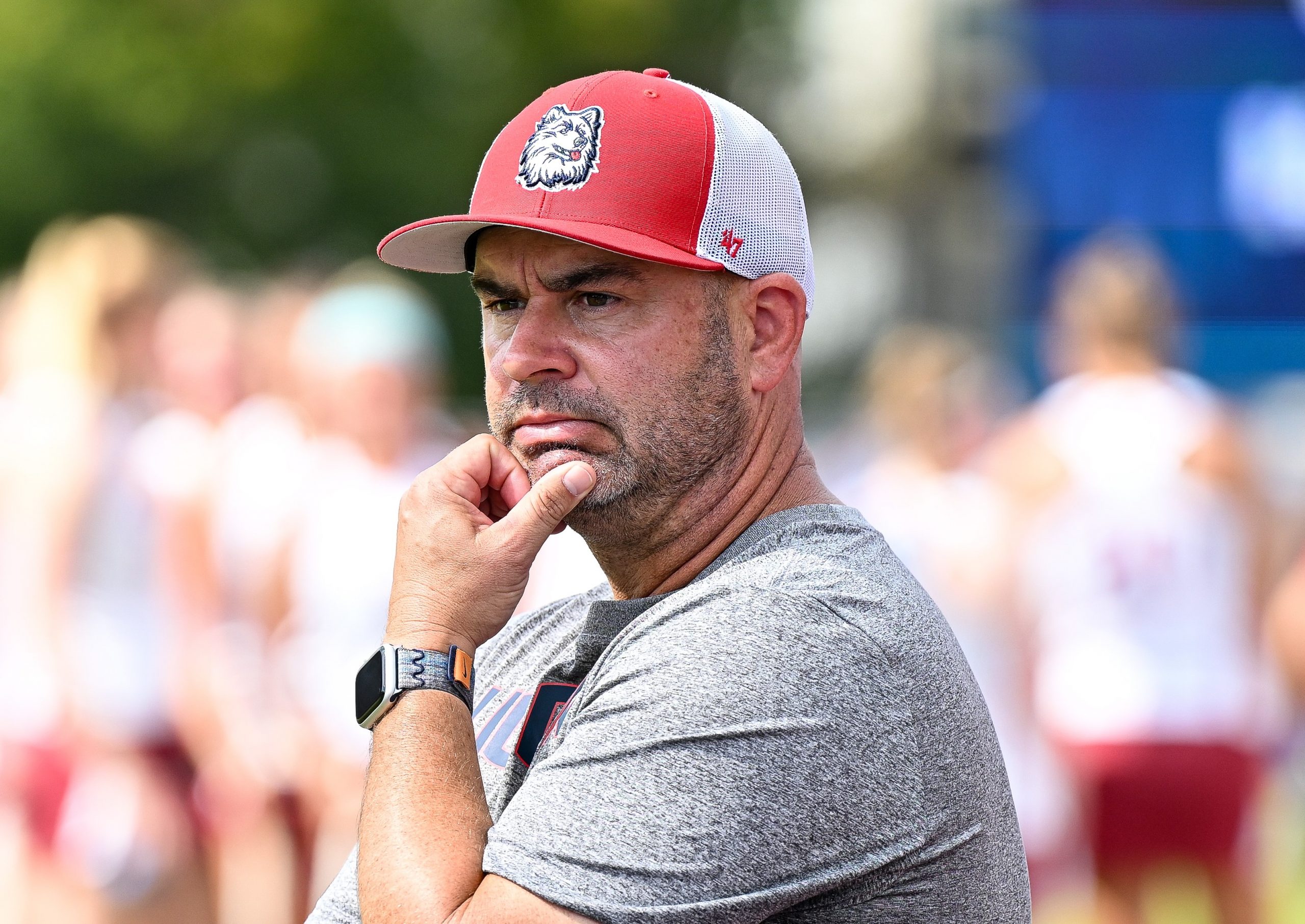
Field hockey is one of the most tradition-filled sports here at UConn as the program has won five national championships. Paul Caddy joins us on this episode of the podcast and is entering his seventh season as the head coach of the program. He was an assistant coach for 19 seasons prior to becoming the head coach and was part of three national championship staffs. Paul has led UConn to the NCAA tournament in each of the past two years, including a trip to the Elite Eight in 2024. He has been part of dozens of Big East championships and helped mentor over 30 All-American at UConn. Paul is a native of England and graduated in 1999 from the University of Wales Swansea. He played field hockey in college and earned a silver medal at the European Club Championships as a senior.
Listen to Episode 169 on Podbean
Mike: Hello, everybody. Welcome to another episode of the UConn 360 Podcast. It’s Mike Enright from University Communications, and I’ve got Jacie Severance from University Communications as my co-host today. Jacie, thanks for sitting in, as always.
Jacie: Thanks for having me again, Mike.
Mike: Well, it’s hard to believe the summer is moving along, and one of the first signs that the fall semester is beginning is when the athletic teams appear on campus. And one of the first teams to get going every year is our nationally prominent field hockey team.
And we are lucky enough to have the field hockey team’s head coach joining us on the podcast today, Paul Caddy. Paul is entering his seventh season as head coach of the Huskies and was an assistant coach for 19 seasons prior to that. He has been part of three national championship staffs here at UConn, and UConn has advanced to the NCAA Tournament in each of the last two years under his tutelage, including a trip to the Elite Eight in 2024.
He has won dozens of BIG EAST championships. He has helped mentor over 30 All-Americans here at UConn. He has got extensive experience on the national level with USA Field Hockey. You will be able to tell he’s got a little bit of an accent. He’s a native of England and graduated in 1999 from the University of Wales Swansea.
He played field hockey in college and earned a silver medal at the European Club Championships. So, Paul, thanks for joining us, and welcome to the UConn 360 Podcast.
Paul: Thanks for having me, Mike.
Mike: I can’t believe you’ve been the head coach here for seven years already. Time goes by so quickly. But tell us a little bit, UConn’s got a great tradition of field hockey, national championships, and it’s one of our most prominent sports.
Can you kind of take us back to the roots of the program, you know, well before you got here, and try to explain why field hockey is so important at UConn?
Paul: Well, you said seven years. I can’t believe I just turned 50, and I can’t believe I spent over half my life here. It’s a lifelong thing, my attachment to UConn, so it’s a wonderful place, and…
Mike: You’re very youthful-looking. I would have never guessed you’re 50 years old.
Paul: Well, you know, you need to get your eyes checked, Mike. I mean, field hockey, it’s a world sport. A lot of Americans don’t realize that it’s the fourth most popular sport in the world. Also, the fourth most popular sport for men.
So currently going on are the World Championships, which are going on in Belgium and Holland, and we actually have two of our former players who are playing in it. So, we have Róisín Upton playing for Ireland, and Sophie Hamilton playing for England, and she scored a goal yesterday for England against South Africa.
So, it’s a world game, and it’s obviously becoming more of a world game in college as well.
Mike: Yeah, your rosters lately have been full of international players.
Paul: Yeah, I mean, I think we’ve heavily influenced Geno, because his rosters were fully American, and now they’re kind of blended.
Jacie: There’s field hockey touching all parts of UConn sports.
Paul: Exactly.
Jacie: So, you’re only the fourth coach in our program’s history and the third since 1975. Can you tell us a little bit about your predecessors, Diane Wright and Nancy Stevens?
Paul: Yeah. I mean, I haven’t spent too much time with Diane. You know, she came back when they honored her by opening Diane Wright Way.
And obviously, her former players are so fond of her. As most coaches do, she impacted their lives heavily. They’re very fond of her, and obviously, two national championships. A vast coaching tree, of which Tracey Fuchs is the prominent one right now.
She’s just won her second national championship with Northwestern, and they’re very fond of Diane. And I think the players will tell you they had a fantastic time socially, hockey-wise, and academically.
And the same goes with Nancy. You know, the players had a wonderful time at the university as far as the hockey goes, but also holistically. You know, meeting friends, having a great social time, coming out with great degrees, great careers.
Because, you know, hockey ultimately is not like basketball or football, where it pays the bills. Our university gives a great athletic experience. In the field hockey realm of things, we provide championships, national championships. But also, we churn out doctors, nurses, teachers, with many great careers.
Mike: Paul, for those of us, not, I have, but a lot of people haven’t seen probably field hockey or field hockey lately. They might remember playing it in elementary school or high school on a natural grass field where the grass is three or four inches, and it’s not a speed game at all.
But in fact, the surface you play on isn’t even a football or soccer artificial turf. Tell us a little bit about the game in 2026. And I kind of compare it to playing, it’s like playing on asphalt. I don’t know if you would agree, but it’s a different game than maybe people knew from high school or early on.
Paul: Yeah. I mean, if you think about ice hockey, if you were to say to Cav or Mac, “We’re not going to use the Zamboni for a couple weeks, and you’re going to have to play on it,” you know, the friction would be so much that the puck would be jumping around everywhere, and it’d be a lot slower.
So, the more friction you have on a surface, the less you can do with the ball or the puck. With our turf, which is the same turf as they used to use with American football, the skill level is just higher, the speed is quicker. And it’s just, you know, to be honest, it’s a much better game on the eye.
So, for those people listening, if you came to watch a collegiate field hockey game, you would see a completely different sport than you would at the high school game. So, I would really recommend coming to watch one of our games because you would see a fast sport with tremendously amazing athletes and some exciting moments.
Warde Manuel, actually famously, for me, said to me one day, “Paul, there are so many whistles in the sport of field hockey.” And I said, “Warde, in your favorite sport, football, there’s a whistle every seven seconds and a commercial every 30 seconds.”
And he looked at me, and he’s like, “Yeah.” And I said, “In field hockey, we have what we call a self-start. So, there are quite a few whistles, but as soon as the whistle goes, as long as the ball’s stopped dead, you can continue and take the free hit yourself. So, although there are whistles, it’s continuous. So, it, you know, is a very, very fast-paced sport. There are no real stoppages. It just keeps going and going and going, so it’s very exciting.”
Jacie: Tell us a little bit about your own background. What was it like growing up in England, and what sports did you play?
Paul: So, growing up in England, I played a lot of sports, but probably a lot of sports that aren’t terribly familiar. Some of them will be, but I played a lot of football, soccer, you know, real football, as I would say.
Rugby, you know, grew up playing quite a bit of rugby. Squash, which, for those people that’ll be watching the Olympics in LA, will be an Olympic sport for the first time, I believe. So, it’s a very exciting sport. A little bit like racquetball, but a little bit faster.
But my two main sports were cricket and hockey, which we, again, we call field hockey hockey, because for the rest of the world, we call what you call hockey ice hockey, because only North America really plays it, and a couple of countries in Europe. Which is really ball-striking sports, so I’m good at hitting things.
I hit around the golf course a little bit, but I do lose quite a few golf balls as I do it. But yeah, cricket and field hockey were my main sports. And, you know, they got me a long way, to be honest.
Paul: My degree was American studies, so as part of my degree, I got a, really why I did it was I got to go to America, and I’d never been, as a gap year in a sandwich course, I guess.
So, I went to the University of Massachusetts, and I got to help out with the hockey team there and help coach. And I’m like, “This is a really, they pay people to do this? It’s a job.”
Because in the U.K., in most places at that point, it was, you know, teachers basically were the coaches. So, their full-time job was teaching, and they did coaching on the side, and they might have gotten 50 pounds, a small little bit of money, to help coach a team.
So, I decided to come back to do my master’s degree at Quinnipiac for a small stipend and help coach the Quinnipiac team.
So, I did my master’s in journalism because, much like both of you, I wanted to be involved in sports, and journalism and writing were my passion. But by the time I’d coached the Quinnipiac field hockey and actually women’s lacrosse teams, I decided that coaching was my passion.
So, then I went to Ohio State University to coach for a year. But I also realized that New England was more like England than the Midwest. And I don’t want it to sound bad, but, like, the people in the Midwest were wonderful people. But the pace of life there was a little slower than I was used to.
And that sounds funny because I’m in Storrs, which is very rural, and I’m from a rural area in England. But New England is a little bit more like England than it was in the Midwest, so I was more comfortable. So, when the opportunity came to come back to UConn and New England, I jumped at it. And it’s really felt like home ever since.
Mike: So, tell us a little bit about the 2026 Huskies, and, you know, we’ve mentioned you’ve been to the NCAA Tournament each of the past two years. You got to a final eight. Who are the best players on the team, and how are you feeling about the squad so far?
Paul: I mean, I think that the exciting piece is I don’t think you can really put your finger on a best player or players. I think that we’re very, very deep and very talented.
So, I could definitely pick out some players that would be exciting and goal scorers. I think Abby Davidson is going to score some goals for us. We’re very lucky that Natalie McKenna is a very gifted U.S. Under-21 goalkeeper that’s going to come back, and goalkeeping’s so important in all field sports.
We have got some exciting freshmen coming from Germany. Some other players that are returning. Some exciting transfers from Maryland. Maya Everett, AJ Eyre, Emma Larit is a sophomore now from Connecticut. So, we’ve got a lot of really good, Olivia McKenna, the twin sister of Natalie McKenna.
And I could go on. Milou Heuker is a junior from Holland. But we’re just deep and talented, and I wouldn’t say that we have a team of stars. We just got a team of very good players.
At some point, maybe someone will show themselves to be the star. But I just think that we’re going to be a really talented group, and we’re going to do it together.
Mike: You mentioned transfers, and of course, you know, when we’ve had other coaches in for the podcast, and you read about college sports, the transfer portal, NIL, you hear about it in football and basketball and ice hockey. How have the changes in college sports affected your sport of field hockey?
Paul: So, we haven’t had too many people transfer out. For us, it’s more like we’ve brought in some tremendously good players from overseas that have left to go back and play for top clubs overseas, or actually go to medical school. Mm-hmm.
So, if you’re not familiar with the academic track in Europe, if you go to medical school in Europe, you just go to medical school. You don’t go to undergrad first. So, we’ve had kids come over and then go back to medical school.
So, one of our top freshmen two years ago went back to medical school, but she also just scored the winning goal for the Dutch Under-21 National Team in the Euros. And the Dutch are the best program in the world for women’s field hockey.
So, you know, if we could’ve kept ahold of her, she would’ve definitely been a star for us. For us, it’s been keeping ahold of the international kids that we’ve brought in that had an impact on our program, rather than the Americans transferring out.
We’ve been more fortunate with the transfers in. And we had four tremendously good transfers come in from Maryland that we’re really excited about.
Jacie: So, coaches, you guys don’t get a lot of free time, but what do you enjoy doing when you do get some?
Paul: I mean, spending time with my family. My wife, Kate, my two children. Isabelle’s 16. She just started learning to drive. My son, Miles, just loves to play sports. My daughter’s doing a lot of theater. She swims. She’s just, you know, the driving, now she’s got to do 100 hours, I think. Learning to drive is a bit white-knucklish at times, but she’s getting better and better every time she gets in the car.
I play a little bit of golf from time to time when I can. But yeah, just, you know, as most coaches probably can tell you, spending time with your family when you can is the most important. If I can, it’ll be on the golf course, I guess, outside of that.
Mike: Are you a fan of American sports? Have you picked up on American sports? Do you have a favorite NFL team, a favorite baseball team? Or do you still follow sports back home more?
Paul: Well, my wife, Kate, will hate this, but I landed in Boston when I first got here, and this is when Drew Bledsoe was the quarterback for the Patriots. And so, the uptick of Boston sports was me.
Mike: That’s right.
Paul: So, Tom Brady took over shortly after I arrived, and the Red Sox then shortly after won the World Series. The Bruins won the Stanley Cup, and so you’re welcome. So, I follow all the Boston teams, particularly the Red Sox. I really love baseball.
Jacie: I have one more question.
Mike: Okay.
Jacie: Because I know that even for people who don’t follow sports, which everyone knows I famously don’t sport, so it’s always wonderful for me to get to learn about sports that I know nothing about. But for people who don’t follow sports and might not be from Connecticut or even from the USA, you’ve been in Connecticut for a long time. What’s the one thing in Connecticut that you think everyone needs to check out?
Paul: UConn.
Jacie: Good answer.
Paul: When the students are on campus, particularly in March, I mean, the vibe around campus, there’s just nothing quite like it. You know, the buzz around UConn Athletics, particularly basketball; you just can’t describe it. If you could bottle it up and sell it, it would be worth, you couldn’t put a price on it.
Mike: That’s great. And do you try to, when you do recruiting weekends for field hockey, do you try to tie it into basketball weekends? Is it…
Paul: Oh, absolutely. You know, the culture of our team is really important to us. I think it’s culture first. Our team is a great group of young women. So, they sell our program first and foremost, but then they get to experience a basketball game. It’s hard to say no to our university.
Mike: That’s great. That’s great. Well, Paul, your team opens up August 29 at the University of New Hampshire. You’ve had some exhibition games. The home opener, Friday, September 18, BIG EAST, Villanova, 3:00 p.m. That’s… One other thing I was going to… You’re a BIG EAST sport, but maybe explain to the fans, it’s a little mix of some BIG EAST teams and some nontraditional BIG EAST teams, right?
Paul: Yeah.
Mike: Because there are fewer schools that play field hockey?
Paul: Yeah. So, we don’t have enough teams that sponsor field hockey in the BIG EAST, so we have affiliate members. So, we have Temple, obviously, who used to be in the BIG EAST. And we have Old Dominion, who was a powerhouse back in the day. So, they used to have the most national championships of any sport.
So, Beth Anders was the head coach there, who, previously, before Nancy, was the all-time winningest coach in NCAA history, and she had nine national championships. So Old Dominion has nine national championships as a university for field hockey. They’re in our conference. And then we have Liberty.
And Liberty made the, they’ve only been a program, I think, for, like, 15 years. And in their 11th year, they made the national championship game, which is remarkable. And then now they’re perennially in the top 10 of the NCAA. So, we have a pretty powerful conference.
The Big Ten and the ACC are very, very strong. The Ivy League is also strong. But then we’re right there as well, with Temple, Old Dominion, UConn, and Liberty being very, very strong.
Mike: Well, Paul, like we said, you open up at home September 18, Friday, against Villanova at 3:00 p.m.
Other home games this year are against Princeton, Liberty, Northeastern, and UMass. And it’s a great opportunity to bring some people, come out to a game, see a sport maybe you haven’t seen. Very family-friendly. I know your student athletes are always signing autographs after the game and greeting fans.
So, thanks for joining us here today on the podcast, and good luck this year.
Paul: Thank you so much. Really appreciate you having me.
Mike: Jacie, thanks, as always.
Jacie: Always a pleasure, Mike. Thanks.
Mike: And we’ll catch you next time on the podcast.
Paul: Go Huskies.