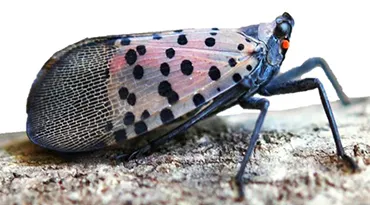
This summer there has been a lot of buzz about the spotted lantern fly – they seem to be everywhere in Connecticut, from big cities to farms and gardens. Our guest on this episode of the podcast is Evan Lentz, an assistant educator at the UConn Extension. He gives us an explanation of how the spotted lantern fly became so prevalent in the state and the biggest dangers they present, hint: it has to do with wine. Evan was the co-author of this extension website about the spotted lantern fly. We also talk about Evan’s work with the fruit farmers in Connecticut, what the fruit industry is like in the state, and the work is he doing to bring back UConn’s historic orchards and what the future might hold for them.
Listen to Episode 170 on Podbean
Mike: Hello, everybody. Welcome to another episode of the UConn 360 Podcast. It’s Mike Enright from University Communications, along with Izzy Harris from University Communications. Izzy, happy September.
Izzy: Thank you. I feel like it’s been a while since we did an episode.
Mike: Well, you missed the last one. You were out on assignment, and, yeah, it has been a while, so…
Izzy: Well, I’m happy to be back.
Mike: Well, we’re happy to have you, as always.
Izzy: Oh, thank you.
Mike: This place wouldn’t run without you.
Izzy: I mean, I could say the same thing about you, Mike.
Mike: Well, I’m not sure about that. Anyway, it’s September. School’s back. Kids are in classes. Storrs is buzzing. The regional campuses are buzzing, so it’s always a fun time to be on a college campus.
Izzy: It sure is. It feels like the spark is back at UConn.
Mike: So, every summer, there seems to be a thing or several things going on. There’s always, like, a fad or something’s in the news that you normally didn’t hear about, whether it’s music or something. Something’s always going on. And this year, it seemed like Connecticut’s summer was dominated by lanternflies.
Izzy: I know.
Mike: I still don’t know if I’ve seen one.
Izzy: Oh my gosh, really? I see them everywhere.
Mike: Maybe I haven’t been paying attention.
Izzy: Yeah, I don’t think you have.
Mike: But our guest today knows everything about lanternflies.
Izzy: I know. I’m super excited. I have so many questions.
Mike: Well, we will let you take the lead on asking questions. But our guest is Evan Lentz. He’s a UConn Extension assistant educator who deals with commercial fruit crops and integrated pest management. He does a lot of research about fruit production, and we’re going to ask him a little bit at the end about bringing fruit orchards back to UConn.
We’ve done some videos and some stories on that. We want to get a quick update on that before we let him go. But his research combines traditional production, integrated pest management, and precision agriculture technology. Three degrees from UConn. Evan, welcome to the podcast.
Evan: Hey, thanks. Good morning.
Mike: I should note that Evan was a co-author of a fact sheet about the spotted lanternfly, and we’ll put a link to that in our description of the podcast.
So, Evan, it seems like everywhere you go, everybody’s talking about and seeing the spotted lanternfly lately. It’s on TV. You hear about it on the radio. You hear about it on podcasts. Obviously, these things did not just fall out of the sky. They weren’t just created. So why are they around so much this year?
Evan: Well, you guys are just starting to hear about the spotted lanternfly, but I’ve been hearing about it for the past five years or so. It’s kind of how these invasive pests occur and creep up on us. You know, we are notified originally when they show up, and it’s just like, “Hey, be on the lookout for this.”
And then, as they get established and move throughout the state, that’s when you start to see the general public start to notice these things. So, it was probably last year or the year before when these things were observed in each county. But now, this past year, we’re seeing really large populations, so people are starting to ask some questions.
Izzy: So, what are the dangers of the spotted lanternfly? I’ve heard that they can secrete black mold when they land in places. Is that true? Are they harmful to my garden and things like that? I just, like I said, I have so many questions. Every time I see one, I’m scared. What’s the deal with all that?
Evan: Well, I don’t think you have to be scared, certainly not just yet. As far as the concerns for humans, there pretty much are none. It’s just a nuisance. They don’t bite. They don’t sting. I think they’re fairly large for an insect, so they kind of freak people out, and then they can jump and pop.
So, I think that’s kind of the main concern with homeowners. And then you mentioned the sooty mold. So, they don’t actually secrete the sooty mold. They secrete the substance that the sooty mold will grow on. So, the substance is a result of their feeding on the sap of different plants. So that’s where the sooty mold comes from.
Izzy: So then, does the mold hurt the plants?
Evan: Generally, the sooty mold isn’t the issue. So, the issue for farmers and grape producers in particular is that this insect will feed on the grapevines. It’s one of its preferred hosts. It has very few of those, so that’s why they kind of congregate in vineyards and at wineries.
So, you know, we still have to do a lot of work and research to see kind of, like, the full impact of these insects and then also kind of what the threshold is for tolerating these. But any insect that sucks the sap kind of out of plants, you know, slowly it’s going to cause it to decline.
You might get, you know, less yield. It might get predisposed to other issues, too. So that’s kind of the main concern right now for farmers, the impact to grapes alone.
Mike: So, if I’m at home and I see a spotted lanternfly in my garden or in my lawn or on my sidewalk or driveway, what should I do with it?
Evan: Some people might tell you to go ahead and squish it, and that’s perfectly fine. You know, that’s kind of just the scientists and the agencies trying to enlist the general public to get them to help out a bit. Now, what are going to be the benefits overall to you squishing one, two, 10, 20 a year?
Probably not going to be that impactful. So, you could just leave it. You could squish it. It’s kind of, it’s up to you.
Izzy: Where do they come from? I know you said that you’ve been learning about them since 2020.
Evan: Mm-hmm.
Izzy: And when I did my little research on it, I saw that, you know, 2020 is kind of when it started to evolve. But yeah, like, where are they coming from? How are they getting here?
Evan: Yeah. So, this pest is from Asia, so different parts of Asia. I think it showed up in, like, Pennsylvania around 2014. So well before even I was hearing about it, it was identified. And then this kind of slow creep, spreading around to different areas.
So how it got here, it could’ve been on a shipment of something. There could’ve been eggs on something else that got shipped here. Hopefully not, you know, these things are never really intentionally introduced. So, you know, it probably just hitched a ride here some way, somehow, and now it’s just spreading all over and enjoying itself.
Mike: Are there products people can get or buy to do something with them if they happen to appear, or to prevent them from appearing?
Evan: Yeah. So, I guess we’re talking about pesticides, right? So, I mean, as an IPM specialist, I like to advocate for everything before spraying pesticides.
But sometimes, you know, you have to rely on them. Certainly, I think it’s appropriate for our producers to be using the pesticides. And just now, this pest is kind of getting added to different labels. So, there are some materials that fruit growers are using to control this pest, insecticides.
Do I like the idea of homeowners spraying, you know, copious amounts of pesticides to deal with their large spotted lanternfly populations? Probably not. It’s probably not providing enough of a benefit, in my opinion. So yeah, I would say if you wanted to do something about them, go, you know, kind of the more brutal route and squish them yourselves.
Kind of hold off on just applying pesticides for now.
Izzy: So, what’s the biggest danger of the spotted lanternflies? You told me I don’t need to be afraid, but I kind of am because I hear everyone talking about it. What are the main concerns?
Evan: Yeah, I mean, the main concern is its potential damage to our wine industry and our grape industry, and, you know, our fruit growers, the impact to them.
They’ve done a lot of research trying to see what it will and will not feed on, and although it has been observed to feed on, you know, a larger number of plants, it’s really only these two plants that it is hosting on. So that’s tree of heaven, which is another invasive plant, and then grapevines.
So, the main problem is that, you know, when we have these really large populations, they’re slowly sucking the sap out of the plants, and basically what it’s doing is stealing the energy that the plant’s capturing from the sun, weakening it slowly over time. So, like I mentioned before, it could result in less of a yield for the farmers.
It could predispose the plant to different issues. And then, you know, there have been some cases of vine collapse, where they’ve taken too much energy from the plant year after year, and then you have the whole plant that dies. So really, we’re only kind of concerned about the impact to grape growers and wineries, and we have a pretty decent wine trail here in Connecticut, a lot of people growing grapes.
So, if we think about that industry, not just the grapes themselves, but, like, the value added and the impact to agriculture as a whole, I mean, that’s really the main issue. I don’t think people need to be too concerned about any harm to them or, kind of, you know, their yards or their plants themselves, unless they’re growing grapes.
Mike: So, I would say that UConn Extension’s one of the great things we have here that exposes people in the state to the good work that goes on at UConn. Do you work with the vineries, the wineries, the vineyards? Do they…
Izzy: I like that combo word, though.
Mike: Yeah, that was bad.
Izzy: No, no, it wasn’t bad. I like it.
Mike: Maybe it’s a new thing.
Izzy: I think it should be.
Mike: I’m not even sure what I said. Vineries. Vi, wine, yeah. Do they come to you? Do they come to Extension for help, or do you seek them out? How does that work?
Evan: Yeah. So, Extension’s unique. It’s kind of a two-way street. A lot of people will explain it as, like, outreach, right? So, it’s just, like, us putting things out there. But really, what we’re doing is we’re engaging the farmers the whole time, like getting their input. They’re basically telling us what we should be doing, what we should be looking at.
So, although I do reach out to certain people, say I want to set up a trap or two at their farm and see how things are going, a lot of times they’ll reach out to me. And, you know, I’ve had a handful of farmers over the last five years, they’ll say, “Hey, should I be worried about spotted lanternfly yet? Should I be worried about it this year?”
And it’s kind of been, you know, maybe not yet. So, this is, again, the first year we’re seeing, like, really large populations established all over, and even creeping into the winery. So, I spoke with a grower last week who was out there applying pesticide for the spotted lanternfly in particular.
Izzy: So, another question. I told you, Mike, I’m full of so many questions today.
Mike: Bring them on. Bring them on.
Izzy: I saw that you are supposed to report a spotted lanternfly if you see them in certain counties, but Hartford County, you no longer have to report them, I believe. And, you know, when you’re talking to me about the wineries and them feeding on grape plants, grapevines, not grape plants. See, like, we got to get this together with our winery, vinery situation. Any who, why do you think there are so many spotted lanternflies in cities like Hartford that maybe don’t necessarily have a lot of wineries or something like that?
Evan: Yeah. So that’s a really good question. You know, it could be that there are other host plants in the area. So, we mentioned tree of heaven. So, this is, you know, another invasive, like I mentioned before. So basically, if there are places for these insects to host, to feed and complete their life cycle, lay their eggs, then they will do so.
I’ve had a number of pictures and instances where you see these kind of, their egg masses laid even on, like, the sides of buildings and on rocks, and, you know, they kind of blend in really easily. Also, you think about the population in Hartford. You know, it’s probably much more dense than other rural areas, so whether there are actually higher populations of them in that area or we’re just getting more reports because more people are seeing them, that could be another explanation.
Izzy: So, should you still report them?
Evan: So, the reporting, I believe it’s the Connecticut Agricultural Experiment Station that’s been collecting this data for quite a long time now. They’re the ones who have been kind of informing us how it’s moving and where it’s moving throughout the counties and the region.
You know, is it just one or two reports, or, you know, are we having, like, these overwintering populations develop? So, you know, they’ve been collecting that basically to track the movement of this, and, you know, maybe now that it’s everywhere already, the tracking might not be as important.
So now we’re shifting to looking at questions like, what is the actual impact? Like, we know that it’s here. We know that they’re in large numbers. What does that mean?
Mike: So, we know your work with the fruit industry here in Connecticut. Just changing topics slightly as we start to wrap up, tell us, how robust is the fruit industry in Connecticut?
Evan: You know, for a small state, it is very robust. We have a fair amount of large, multigenerational farms that have been around for quite a long time. We have even more midsize and, particularly, small farms. So, the industry itself is pretty robust. If you check the last ag census, it was upwards, I think, of, like, 500 tree fruit and berry farms in the state.
And then, just based on the engagement that the fruit program has had with its growers, you know, we do a certain number of events per year, and we always get good attendance. Not every grower engages with Extension, but we like to think that enough of them do.
We have anywhere from, like, 100 to 200 fruit farmers in particular come out to these events. So, it’s robust. I think for a small state, apples are our number one fruit commodity. So quite a lot of apples out there.
Mike: And you’re bringing back the UConn orchards, is that correct?
Evan: Yeah, yeah. So, I mean, they went away kind of around 2000. We’ve had a long history of, you know, fruit research and Extension, and when I got hired here, I kind of was handed this torch and told, “Hey, you know, kind of bring things back. Maybe you should replant the orchards.” We used to have, like, four different ones over the years.
So yeah, at the Plant Science Research Farm, now we have apples, grapes, blueberries, blackberries, raspberries, and strawberries, all in the ground, all growing, all set up, planted, and being cared for by students here during the summer.
Yeah, it’s a slow burn with fruit production. You really don’t get fruit for the first couple of years, and they’re perennial plants, but it’s going pretty well.
Mike: And will those be for research, or will there be a commercial sale at some point, do you envision?
Evan: Ooh, so that’s a tough question. So, they are right now open and being used for, you know, research, teaching, and Extension work.
But there are some limitations around, like, food and research. And I know in the past, the old orchards used to have a stand or a store here, kind of right in the center of campus, where they would sell it, sell the fruit and the apples. And they made decent money. It went back to the department.
Still trying to figure out how to do that. I’ve had, like, some small talks with people who work with Dining Services, and they would love to get the fruit, and students would love to produce it and eat it. Just trying to figure out kind of the logistics of it. There’s a little bit of red tape, so we’ll see what happens.
Mike: What’s your favorite fruit, Izzy? Like an orchard fruit.
Izzy: Oh. I mean, probably apples.
Mike: Apples?
Izzy: I have apple trees in my yard, so, like, it’s always so much fun to harvest them and bake with them and just, you know, have that as an option when they’re so fresh. Another question for you, are tomatoes a fruit or a vegetable?
Evan: Yeah. So, botanically speaking, it is a fruit. It’s a berry.
Izzy: A berry? I don’t think I knew that.
Evan: Yeah, so basically, it’s like a soft, fleshy fruit with multiple seeds inside. But when you’re talking about, like, agriculture and, you know, consumers and marketing and stuff like that, fruit is fruit and vegetables are vegetables.
But again, like, what is the definition of a vegetable? You could have a leaf, like lettuce, that’s a vegetable. And then a tomato, that’s actually a fruit, that’s a vegetable. Or something like asparagus, which is like a stem, and it’s a vegetable. Or…
Izzy: Oh my gosh, it’s so complicated.
Evan: A root vegetable. It’s just, yeah. But yes, it’s a fruit technically. But it’s a vegetable.
Izzy: So, for people like myself who are growing apple trees or tomatoes or whatever types of fruit in our yard, do you have any advice for the amateur fruit planter who might have some trees or plants in their yard?
Evan: Yeah. So, you can, I think, first engage with UConn Extension. We have a lot of great resources. Although I primarily work with commercial producers, we do have the UConn Home and Garden Education Center, which does outreach with homeowners. And if they can’t figure something out, they’ll kind of give me a call, and I can help out.
There’s also the Master Gardener Program that UConn Extension runs, where you can get kind of educated in all things plants.
And then beyond that, I would say, test your soil, pick a good site. All right? So, a lot of this fruit needs full sun. Pick good varieties. There are a lot of varieties out there. Just because there’s one that’s being sold at, you know, the big-box store doesn’t mean that it might be the one for you.
There are a lot of disease-resistant varieties. And then grow something that you absolutely love. Because if you’re kind of meh about it, you’re not going to give it as much attention. If you know that you love apples or you just want some really sweet June strawberries, you know, you’re going to give it more attention.
You’re going to love it. And fruit production is a labor of love because it is a little bit more sophisticated and requires a little bit more from the home gardener than, you know, maybe a vegetable garden or ornamentals.
Izzy: What’s your favorite fruit that you’ve grown?
Evan: Oh, gosh. That I’ve grown. So, yeah, I mean, I love blackberries. I think for, you know, flavor, probably blackberry. But I think I did research in my graduate studies on a plant called aronia, aronia berry. It’s not really made for fresh-market consumption, but it’s a very, very healthy fruit, and it’s kind of unique.
And I think I just spent so much time studying it, I feel like I have to love that one.
Mike: We’ve covered a lot of topics today.
Izzy: I know. I still have more questions, but I’ll have to save those for another day.
Mike: We’ll have to have him back. We’ll have to have Evan back.
Evan: Yeah, yeah, anytime.
Mike: Well, thank you all for joining us today on the podcast. Evan, thanks for joining us today.
Evan: Yeah, thank you.
Mike: Great guest. Izzy, enjoy the beginning of school here.
Izzy: I’ll try my best.
Mike: All right, and we’ll talk to everybody next time on the podcast.