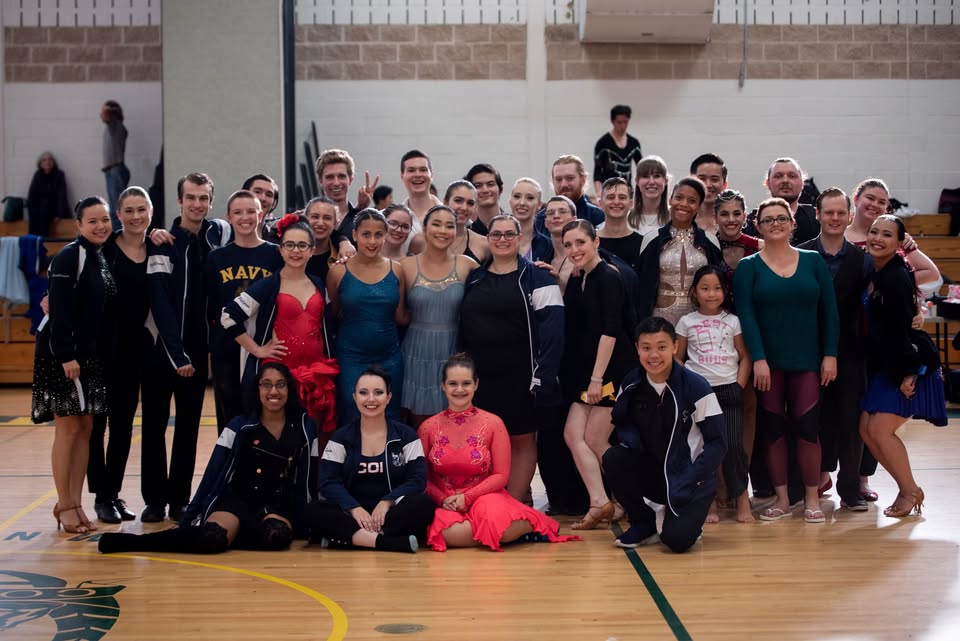
Ben Spaeth is the vice president of the UConn Ballroom Dance Club and joins us on this episode of the UConn 360 podcast. The club welcomes dancers of all experience levels and teaches a variety of ballroom dance styles through lessons, social dances, and competitions. Ballroom dance refers to a variety of partner dances across several different styles and speeds. Each dance has its own unique mood, style, appearance, and dance moves. The club regularly participates in collegiate ballroom competitions and helps introduce students to ballroom dancing in a fun and supportive environment. In the podcast, we talk to Ben about how students get involved in ballroom dance, what it’s like to compete, and whether Dancing with the Stars gets ballroom dancing right.
Listen to Episode 172 on Podbean
Mike: Hello, everybody. Welcome to another episode of the UConn 360 Podcast. It’s Mike Enright from University Communications, along with Izzy Harris from University Communications. Hi, Izzy.
Izzy: Good morning.
Mike: Our guest today is very interesting, somebody that you booked, and it’s a subject that is of great interest to you.
Izzy: Oh, yes. Oh, yes.
Mike: So, you’re excited.
Izzy: I’m super excited, and I know that you have a lot of excitement this week around other topics as well.
Mike: I know. It’s big, big baseball. I’m a big baseball fan.
Izzy: Right.
Mike: And I’m a big Red Sox fan, so Red Sox, Yankees, two out of three.
Izzy: I know we had just talked about this before the podcast, but I’m going to see Harry Styles on Wednesday, so I’m going to be in New York City on Thursday for potentially game three. Oh, will we ever be able to move past this in our friendship if I’m in attendance?
Mike: Well, as long as the Red Sox win, we’ll be able to move past it.
Izzy: Okay, okay. That’s fair enough.
Mike: Yeah. Hopefully, the Red Sox win the first two games, and there isn’t a game on Thursday.
Izzy: Right.
Mike: And you can just enjoy the concert on Wednesday.
Izzy: I hope so.
Mike: But speaking of concerts, it’s kind of a music-related topic we’re dealing with today. Our guest is Ben Spaeth. He’s the vice president of the UConn Ballroom Dance Club. So, Ben comes from West Hartford and, like I said, is with the Ballroom Dance Club, which welcomes dancers of all experience levels and teaches a variety of ballroom dance styles through lessons, social dances, and competitions.
They regularly participate in collegiate ballroom competitions. I never knew such a thing existed, to be honest with you.
Izzy: Well, Ben’s going to tell us all about it.
Mike: He is. I mean, I’m looking forward to it. So today, he’s going to tell us how students get involved in this, what it’s like to compete, and whether Dancing with the Stars gets ballroom dancing right.
Izzy: I’m really interested to hear that one.
Mike: I can tell. You’re very excited.
Izzy: I’m on the edge of my seat.
Mike: Well, Ben, thanks for joining us on the podcast.
Ben: Thanks for having me.
Mike: So, tell us a little bit about yourself and how you got involved in ballroom dancing. Have you always been a dancer, or is this something you discovered at UConn?
Ben: Well, I hadn’t originally planned to join the Ballroom Dance Club at all. I was more interested in the Swing Dance Club that met on Tuesdays, but it was my freshman year, and I was doing everything I could. I was also in a choir that met on Tuesday nights. So, I showed up to ballroom, and I was lucky enough to go there the week they were teaching East Coast swing, and I stuck around.
I’ve enjoyed it. I’ve been there ever since. Before that, I did musical theater mostly, so not, per se, a dancer, but close.
Mike: Did you do theater in high school?
Ben: Yes, I did.
Mike: What were some of your favorite roles?
Ben: Oh, for sure, the dentist in Little Shop of Horrors.
Mike: Oh, okay.
Izzy: Ooh, that’s cool. My cousin was in that one as well. So, can anyone join the UConn Ballroom Dance Club? Could Mike join it? Could I join it? Do you need any background experience in dance?
Ben: Both of you could join it. You do not need any background experience. I had basically none in ballroom, at the very least.
Mike: If you’re unfamiliar with ballroom dancing, which I am, tell us, what exactly is ballroom dancing, how is it different from other dance styles, and what constitutes ballroom dancing?
Ben: There are a few different ways to think about it. If you’ve seen Dancing with the Stars, that one is pretty clear-cut. That’s ballroom dancing. But if you’ve seen movies like, the one I always go to is Cinderella, just because it’s everywhere and everyone’s seen it. The scene where she’s dancing with the prince at the ball, in the ball gown with the shoes, that’s ballroom dancing.
We also have more modern styles. We do cha-cha, rumba, and mambo, which is salsa, let’s be real. It’s just on a slightly different beat.
A lot of ballroom is competitive, is the thing. There are social dances, to be sure, but most of what we do can be used in competition.
Izzy: So, I know you mentioned a couple of the different styles of ballroom dance. Which ones are easiest to learn, and which tend to be the most challenging? Like I said, I love Dancing with the Stars. It premiered two weeks ago, so we’ll be on week three this week.
Some of the dancers have done the jive. Is that a type of…
Ben: That is certainly a type.
Izzy: They said that was one of the harder ones.
Ben: Yes. Yes, it is. What I compare it to is jive is swing, but significantly faster, with more technique and less time to think. That’s one of the harder ones. If we teach that, it’ll be much later in the semester.
Izzy: And what are some of the easier ones?
Ben: Well, our first lessons usually include rumba, which is very simple. At least the basic for it is, and that’s the first thing we teach, of course. Gotta start with the basics. Its counterpart in the more traditional ballroom styles is waltz, which has the same steps for the basic in a different direction.
Mike: How many students are in the club?
Ben: Right now, we have about 20 showing up consistently.
Mike: Great. Great. And you talked about the competitions. Tell us about those. How are ballroom dancers graded against each other? Do you compete against other institutions? Do you travel?
Are there home competitions that people can come and watch? Tell us about the competitive aspect of it on the collegiate level.
Ben: I wish there were home competitions. We used to have one in, I think, around 2015. Certainly, after COVID hit, we haven’t had one since. A lot of schools in New England and New York, New Jersey, that area, Pennsylvania too, will host competitions in the fall or in the spring, usually once a year.
We’re looking at going to WPI or RPI this semester, as well as UMass, which is coming up, I think, relatively soon, on November 7th, I want to say.
Mike: Are you scored? Are you judged? Is it UConn versus UMass, like a game, or how does the competition work?
Ben: Dancers from all different schools will go to one competition at a time.
So, you’ll have dancers from MIT, UMass, RPI, WPI, RIT, sometimes UVM up in Vermont, going to UMass to have their competition there, and then all dancing at the same level, if not at the same time. You’ll have judges around the sidelines watching you dance and scoring you based on whatever they’re looking for.
Mike: So, is it, like, one through 10, like a typical scoring system, do you know?
Ben: For the finals, I think it’s ranked just what place they want you in.
Mike: I gotcha.
Ben: And then before that, at least at the level I’m at, it’s just they mark you down, maybe.
Mike: Gotcha. Gotcha. And if you get…
Izzy: So, you advance to the next level?
Ben: Yes.
Izzy: So, you have to have multiple dances prepared when you go into a competition like this, then.
Ben: Yes and no. If you really, really want to, you can specialize in doing just one dance and only dancing that for the entire day. But that’ll show up maybe four times if you get called back every round, and who wants to go somewhere for a full day to dance four times?
Mike: Do you pick your own music that you’re going to dance to, or is the music provided?
Ben: The music is provided by whoever organizes the competition, along with whoever they pay to make it for them. I’ve heard a version of the song the Monkey King sings in The Jungle Book used for a quickstep, which was wild to hear at the time.
Mike: So, you don’t know exactly what music you’re going to be dancing to, so it’s really the dance that you’re concentrating on and practicing?
Ben: Yes.
Izzy: I didn’t realize that the music was a surprise. That’s something new I learned today. I would have thought that you could rehearse to your own music and show up with your dance to the music. That’s extremely challenging, to not know what you’re dancing to ahead of time, I imagine.
Ben: A little bit, but in the beginning, it doesn’t really matter because, as a lead, I’m more focused on, “Don’t crash into somebody. Oh, I have to do a move.” And then that gets me through at least the earlier levels. At the higher levels, you have a routine, and it’s not going to be the same song you rehearsed to, usually. But since you have the routine and it’s about the right length, because rounds are only a minute and 30 seconds, you can usually get through the routine once.
Mike: In ballroom dancing, you have a lead and a follow, correct?
Ben: Correct.
Mike: Does it matter who leads and who follows?
Ben: No, not really. I prefer to lead. I’ve spent the past four years learning how to lead. So, if I had to change that now, I would not be very good. At competitions, usually the lead has to wear a number so the judges can tell who they’re judging.
Izzy: Do you have a regular dance partner?
Ben: I have one or two.
Izzy: One or two?
Ben: Yes.
Izzy: So, you can compete with different people at the same competition?
Ben: Yes. You can compete with multiple partners in different dances, but not with different partners in the same dance at the same level.
Izzy: Okay. So, your main dance partner is probably the one you practice with most often?
Ben: Yes.
Mike: Tell us a little bit about yourself academically. What year are you, what’s your major, and what are your future plans?
Ben: Well, my major is geographic information science. To make it as simple as possible, I make maps. I take data from several different sources.
Well, last year, I took some from the Census Bureau, and then other datasets, also from the Census Bureau, actually, and combined those two to make a map of Connecticut with population data for each census tract. Then I pulled a map of the railroad lines from the U.S. Geological Survey, that is the word, and overlaid the two. Then I figured out roughly how many people live close to railroad lines in Connecticut.
Mike: It’s interesting. Far different than ballroom dancing.
Izzy: Yeah. Very. So, the question that I have been most excited to ask you this whole time is, do you watch Dancing with the Stars?
Ben: Unfortunately, I do not. While I don’t watch it much at all, I have seen one episode, and I don’t think it’s a great representation of ballroom at the level I’m at, at the very least.
Izzy: Okay.
Ben: At the professional level, it might be a very different story. But one couple usually does not get the whole floor to themselves.
Mike: So, when you’re dancing at these competitions, you’re not the only couple on the floor at the time?
Ben: Oh, not even close.
Mike: Oh, interesting.
Ben: There can be, like, 24 couples on there in the biggest heats.
Mike: I didn’t know that.
Izzy: Me neither. Well, you answered a question saying that there are multiple people on the floor, but I guess it didn’t really click. On Dancing with the Stars, the attention is all on one couple, versus how you compete, where there are 24 couples.
Mike: How do the judges know who is who? Do you wear a number?
Ben: Yes, you do, actually.
Mike: Wow. How about that?
Ben: You get, like, a little nameplate.
Mike: Like a bib.
Ben: Or, yeah. Yeah, like a bib.
Mike: Yeah.
Ben: Get some safety pins. Pin it on your back.
Mike: This is from somebody who doesn’t know a lot about the competition. There are 24 couples out there. Do people ever bump into each other or knock each other over?
Ben: Yes. Yes, they do.
Izzy: That’s what Ben was saying earlier, that he was thinking in his head, “Oh, my gosh, please don’t bump into anyone.”
Mike: Wow.
Ben: Yep. Part of the, like, the classic ballroom styles, waltz, tango, foxtrot, all of those move. And you’re encouraged to take, like, larger steps as you get better, and honestly, just as you practice, which means at, like, the lower levels, and even well into silver and gold, you bump into people a decent amount.
Mike: So, this sounds like, I mean, it’s ballroom dancing, but it sounds like it’s a pretty athletic activity. Do you stretch? Do you work out? You need to be in shape to do this, right?
Ben: I certainly should stretch and work out. We usually do, like, a couple minutes of warm-ups before we get into lessons. While it helps to be in shape, it’s one of the things that helps keep you in shape as well.
Mike: That’s true.
Izzy: Fair enough.
Mike: Fair enough.
Izzy: Ben, is there anything else that you’d like our audience to know, whether they’re an aspiring ballroom dancer or a ballroom dancer who has been practicing for a few years?
Ben: I guess a good thing to tell you about would be when we meet. Usually, we meet up on Mondays in the Storrs Congregational Parish House.
Mike: Oh, which is right next door to where we tape the podcast.
Ben: Yes, it is.
Mike: Do you have a website?
Ben: Yes, we do.
Mike: Well, we’ll put the link to the website in the description, so if people want to learn more, they can learn more.
Ben: I guess I’m going to have to update it.
Izzy: Well, thanks for making the trek over here in the nor’easter today, Ben.
Ben: Thank you for having me.
Mike: Our guest today on the podcast was Ben Spaeth. He’s vice president of the UConn Ballroom Dance Club. And Izzy, thanks for coming up. Thanks for putting the show together.
Izzy: Yeah, no problem.
Mike: We’ll catch you next time on the podcast.