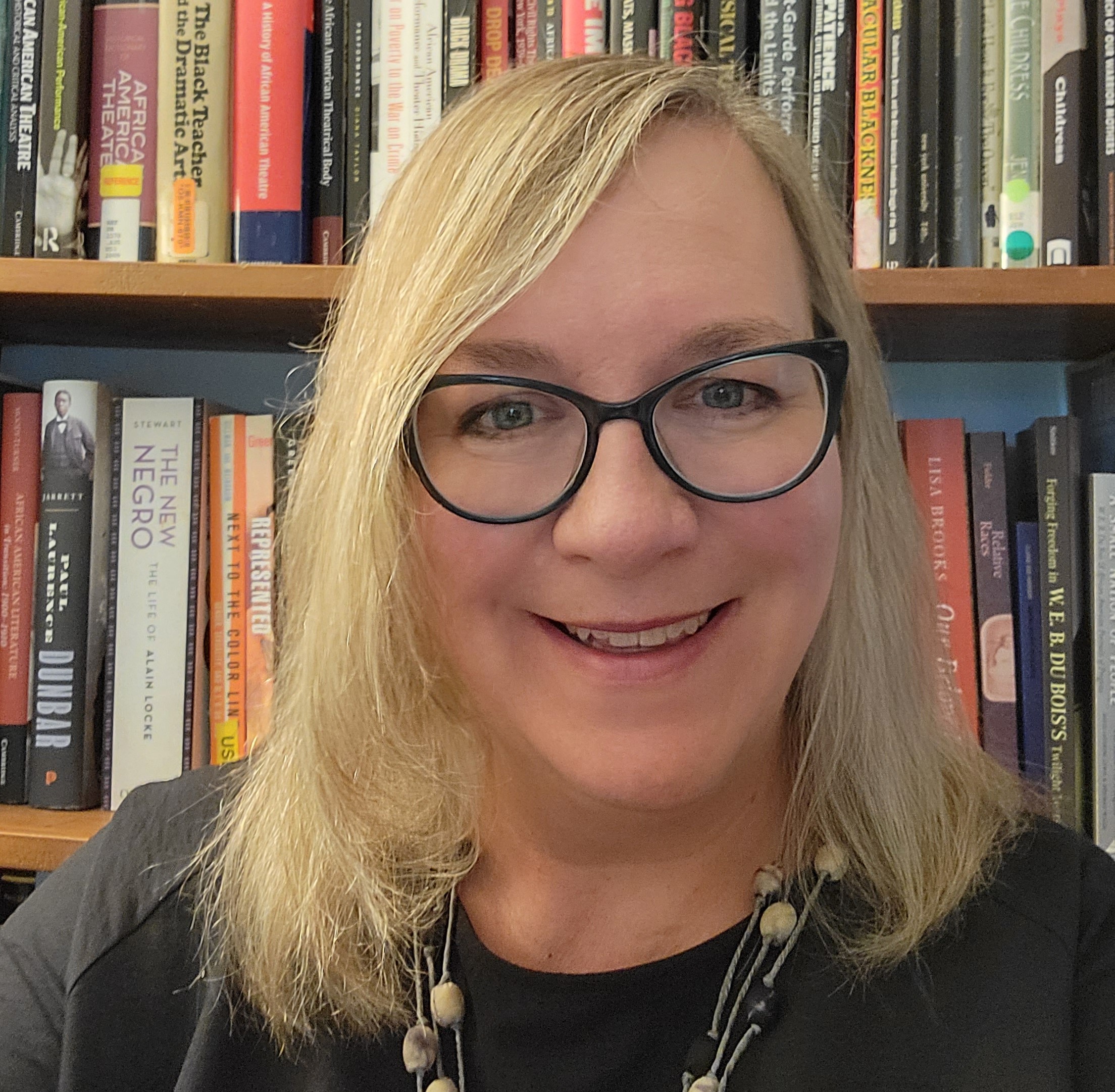
The first week of October is Banned Books Week in the United States and our guest on this episode of the podcast is Kate Capshaw, a professor of English and social and critical inquiry at UConn. The American Library Association tracks book banning and reports that 4,235 titles were challenged in 2025 and 92 percent of those challenges were initiated by pressure groups, government officials, and decision makers. Capshaw led a team for the past 18 months that surveyed teachers and librarians and how they navigate the subject of censorship and book banning. They then developed a toolkit for educators to use that includes sample policies and tips on how to talk to parents who voice concerns.
Listen to Episode 173 on Podbean
Mike: Okay. Hello, everybody. Welcome to another episode of the UConn 360 Podcast. It’s Mike Enright from University Communications, along with Izzy Harris from University Communications.
Izzy, it’s the best time of year in Connecticut.
Izzy: I know. It’s such a pretty drive into work every day.
Mike: People like the summer, people like the winter, but I think the fall in Connecticut is the best.
Izzy: I couldn’t agree more. And my birthday’s in October, so by default, best month.
Mike: It’s got to be the best month.
Izzy: Correct.
Mike: So, we are actually talking about a very important subject today. This first full week of October is Banned Books Week, and our guest is Professor Kate Capshaw of our Department of English, and she also studies social and critical inquiry. So, you might have read in UConn Today, by our colleague Kim Phillips, she did a great story about Professor Capshaw’s work.
She came up with the idea to survey K through 12 teachers, school librarians, and public librarians about how they navigate the subject of censorship and book banning, which is certainly in the news more than ever now. One of their graduate students developed a toolkit for educators to use that includes sample policies, tips on how to talk to parents who voice concerns, strategies on how to select less risky texts, and how to scaffold certain topics.
They did this work with colleagues from the University of Glasgow in Scotland, which is interesting. I think sometimes when we hear about banned books, we might think it’s a USA issue, but they went beyond our country. So, Professor Capshaw is a graduate of Manhattan College. She’s a Jasper.
She received her doctorate from UConn. So, Kate, welcome to the UConn 360 Podcast.
Kate: Thank you. I’m so excited to be here.
Mike: Well, we’re excited to have you and talk about this issue, which seemingly gets more and more attention and becomes more of an issue.
Izzy: Hey, Mike, would you mind if I mixed things up and started things off today?
Mike: Please do. Yeah, I always ask the first question, but there’s no reason that can’t happen.
Izzy: I know. This was kind of an off-script, last-minute question that came into my head while I was doing a little bit of research before our podcast today, and I was just wondering, can you please define what banned books are?
Tell me a couple of banned books, and why are they banned?
Kate: So, this is a great question. Censorship and a book being banned are different things. Censorship might involve a book in a library being challenged, or a book in a classroom being challenged, and individual teachers or staff members deciding to set the book aside, to not include the book in a curriculum, or to excerpt parts of a book in response.
But banning means the wholesale exclusion of that text from curricula and from libraries. Some of the most frequently challenged books have to do with Black history, ethnic history, and LGBTQ issues. So, for instance, The Bluest Eye is a frequently challenged text in high school because of its depiction of sexual violence.
And there are picture books, queer picture books, that are often challenged as well, among others.
Mike: So, tell us how this became an interest of yours, and tell us a little bit about who else was involved in the project. I think, actually, one of your coworkers on this was a former UConn 360 Podcast guest, but I’ll get to that in a second.
Kate: Sure. So, my collaborator in Scotland, our collaborator in Scotland, is Melanie Ramdarshan Bold, who’s at the University of Glasgow. And here at UConn, two professors in the Department of English, Anna Mae Duane, who is also the director of the Humanities Institute, a fantastic scholar and academic leader, and Victoria Ford Smith, who’s an expert in children’s literature and culture, and I think she’s been on this podcast.
Mike: She was actually the guest on one of our first podcasts when Izzy and I took it over.
Izzy: Yes, she was.
Mike: And she survived.
Izzy: And look at that, things are full circle now.
Mike: Absolutely.
Izzy: Love that.
Kate: And we have also our graduate assistant, I don’t want to not acknowledge her, Amber Weinstock, who was a team partner from the beginning.
Mike: Please.
Kate: So, I went to high school in the ’80s, and we read books like 1984 and Tom Sawyer and Huckleberry Finn and…
Izzy: Fahrenheit 451?
Mike: Fahrenheit, oh, we read all that stuff. And seemingly no one said anything. Has the tolerance of what a banned book is changed in the last 30 to 40 years?
Kate: Oh, so, so much. We are in an explosion of censorship and banning efforts right now. The American Library Association tracks the numbers, so if anyone wants to check that out. But most requests for book censorship come from political groups rather than from individuals, rather than from parents or from people in the community.
They come from political groups like Moms for Liberty, or they come from governmental kind of spaces. And since the pandemic, since 2020, the upswing has been profound. Last year, the ALA did a study of library censorship or attempts at censorship. It was more than 8,600, around 8,600 challenges last year.
Just as a point of comparison, between 2000 and 2020, the average each year was 46 books being challenged. So last year, there were 8,600 challenges. And so, post-pandemic has been an incredible upswing in this practice.
Izzy: What is the biggest problem with banned books?
Kate: The biggest problem with banned books is that banning books is fundamentally anti-democratic. It does not allow young people the ability to choose what they want to read and to advocate for themselves and their needs. It also fosters a climate of bigotry and is tremendously harmful to young people’s ability to develop empathy and compassion for others.
Mike: We hear this term, banned books, and we think about righteousness and whatnot, but I was thinking, are there, in your opinion, some books that should be banned?
Kate: I think that I trust teachers and librarians to introduce the texts that are appropriate for their audiences. They are the experts. They have dedicated years of their lives, both in terms of education and their professional organizations, to know what will work with their audience.
Izzy: I know you just mentioned 8,600 challenges, but is there a number published by the ALA about how many books are actually banned?
Kate: Yeah. So unfortunately, last year was the most successful year for these challenges. I think something like 77% of the challenges worked. And most of those challenges took place in states like Texas, Florida, et cetera. So unfortunately, not only is it on the upswing, but also its success is on the upswing.
Mike: You mentioned Texas and Florida. Does it happen less in Connecticut?
Kate: I think it does.
Mike: Right.
Kate: Yeah.
Mike: Yeah. So, tell us a little bit about this toolkit and study that you did, and how you came up with it, and who you worked with on it.
Kate: We’re a part of an international community as researchers, and we hear about what’s going on in other countries. And when our Global Affairs Office had a call for international collaborations, immediately I thought about conversations that I’d had with my colleague at conferences, my colleague in Scotland, about self-censorship and the changing political climate and how educators are responding.
And so, we decided to collaborate on this grant and to see, you know, if we could get teachers and librarians to talk about their experiences and also support them and provide kind of communities of practice, networks that can help them if they are facing censorship. And so that’s sort of the origin of the collaboration, and we’re super grateful to Global Affairs and to the Department of English, in particular, for supporting our work.
Mike: You know, like I said earlier, you worked with colleagues from Scotland on this, and I guess when you hear banned books, maybe you think it’s a uniquely American product, but it doesn’t sound like it is that way.
Kate: So, the pressure points are perhaps a little bit different over there. LGBTQ texts are definitely under scrutiny by political groups there.
But then also, some topics around migration also carry certain political kind of stakes, and there have been responses around that, whereas we don’t really have the same kind of issues around refugees, for example.
Izzy: Your project culminates in toolkits for teachers. What does it look like? Can you give us a little inside look?
Kate: Sure. So Amber, who’s a genius, she’s our graduate support, developed this toolkit for teachers and for librarians that not only sort of defines the terms, as we did in the beginning of this discussion, but offers practical examples of policy statements because we found that teachers and librarians feel supported when their administration supports them.
But some have not thought along this path because it’s a relatively recent phenomenon for teachers and librarians to have to experience. And so, she offers models for policy. She offers sort of scenarios, what happens if a book is challenged, how might you approach it?
I think that’s really, really helpful. We heard from teachers that they would like that kind of script, almost, and parameters around how to respond.
And she also links to resources that are already out there because the ALA and other groups have done a lot of research and have a lot of resources for people who are facing censorship.
Mike: In a state like Connecticut, are books reviewed for banning on a town-by-town basis? Is it statewide, or how does it work?
Kate: It’s typically school systems that might receive a complaint. But the thing is, every book in a curriculum has been hyper-scrutinized before it gets to the students. There are rationales and kind of explanations of process that can be offered to explain why a book is being extended to a student.
Mike: And what can parents do to support teachers to ensure that their children have a choice in what they want to read?
Kate: I think this is a really important question. From what I hear from parents right now, even the idea of not being able to read full books in the curriculum has come up.
So, some parents have found that their students are reading excerpts from books or short stories rather than whole books. And so, advocating for that kind of in-depth reading experience is really important. Communication is the key. Talking with the teacher and knowing what’s going on in the classroom can be really helpful, both to reassure the parent, but then also for the teacher to know that their work is valued and that parents care about what their students are experiencing.
Mike: How do you, as somebody who deals with banned books, I mentioned some, you mentioned some contemporary titles, but, you know, I mentioned some, whether it’s Tom Sawyer, Huckleberry Finn. How do you deal with the nomenclature used in these historical books that just isn’t, I think everybody would agree, probably appropriate right now?
How do you handle that, and how do you suggest people handle that?
Kate: So first of all, all the books you mentioned are on the ALA’s banned book list. Those are books that have been challenged, especially the ones that are dystopias, and then also ones that have this historical, antiquated, derogatory language.
I know that in my own classroom, we talk about how that is a historical term within a literary context, and that I will not say it out loud, and I ask the students not to read it out loud. So that’s one approach.
Mike: And is that, I know that works for college students, is there a certain age, do you think, that can be implemented fully, where a student understands what that means?
Kate: I think high schoolers are quite sophisticated and understand. I think they would participate in such a dialogue about why it’s not appropriate.
Mike: If a parent approached you in a very direct way and said, “How dare you tell me what my kid can read? How dare you tell my kid to read X book, Y book, Z book?” Besides being angry, how would you tell that parent, in kind of a concrete, professional way, that they’re making a mistake, and what would you tell that parent?
Kate: I think I would spend some time with the parent trying to understand what their concerns are. I think that’s important because sometimes it comes down to not understanding the context of the book. I mean, they may have read about the book online, or they may think about the book through something that they heard from a friend.
But do they actually know what they’re objecting to? That’s the first thing. And what are their concerns? And to take concerns seriously. However, students need representation, and they need connection, and they find that through books. So often the books that, as I said before, are challenged have to do with queer identity or experience, or the suppression of stories of people of color. Those are usually the topics that are most often challenged.
And so, getting into a conversation with a parent about, “Well, what are your concerns? Are you concerned about learning about history? Are you concerned about, I don’t know, the level of violence?” We found also through our studies, sometimes parents are concerned about exposure to discussions of death, for instance.
So, it can be more complex than, “I just don’t want this book to happen.” But to really hear what the concerns are so that you can address them and explain the significance of the text.
Izzy: All right. I’m going to do a 360 here. Get it?
Mike: Ah-ha-ha.
Izzy: UConn 360, that’s the name of our podcast.
Kate: Amazing.
Izzy: I know, I’m hilarious.
Mike: You’re actually doing a 180. If you do a 360, you go back to where we started.
Izzy: You know, I thought about that, and I was like, “Can you just, like, let me have it?”
Mike: No, I can’t.
Izzy: Okay.
Mike: You’re doing a 180.
Izzy: Okay. I’m going to do a 180 here, and we’re going to talk about very much not banned books. I’d love to hear some of the books that you like to read, what kind of genres you like, and, yeah, anything else you enjoy outside of reading.
Kate: Sure. I want to give a plug to this year’s Malka Penn Award winner. Our Human Rights Institute has a children’s book award, and it’s called the Malka Penn Award.
And this year, the winner is The Teacher of Nomad Land by Daniel Nayeri, which is a phenomenal book set in World War II in Iran, and has to do, it’s like an exciting adventure story, but it’s also about language and crossing cultures. It’s really wonderful. I believe in November the author is going to visit.
And so, I just wanted to mention that. It’s terrific. It’s really, really good. It won the National Book Award. It’s amazing. And then I’m really into graphic novels, and recently I read an interesting retelling, to Mike’s point earlier about Huckleberry Finn, of Huck Finn called Big Jim and the White Boy, which is about Jim and Huck growing into adulthood.
It’s a graphic novel. It’s for young people. And it imagines Jim as a kind of Harriet Tubman figure, as a revolutionary. It’s amazing.
Izzy: Interesting. Have you read Theo of Golden?
Kate: No.
Izzy: That’s, like, been on the number one New York Times Best Sellers list for a couple of weeks now. That was the book I most recently read, and boy, did it make me cry like a baby.
Kate: There you go.
Mike: I’m reading a book right now called The Greatest Game Ever Played. It’s taking me forever to get through it. It’s a golf book, and I’ve already seen the movie, which is a mistake to do it that way, but it’s pretty good.
But I’m in a little bit of a book slump right now, so if any of our 360 listeners have any suggestions, let me know.
Izzy: Yeah, let us know. Drop them in the comments.
Mike: In the meantime, this was a great podcast.
Izzy: Yeah, it was.
Mike: Thank you, Kate, for joining us.
Kate: Oh, thank you. I’m so happy to talk to you both.
Mike: And everybody, go out and enjoy some cider doughnuts and some apple cider, and watch the leaves.
Izzy: You don’t have to tell me twice.
Mike: We’re going to have two feet of snow before you know it.
Izzy: I already had about 12 fritters this week.
Mike: Twelve? That’s okay.
Izzy: I’m not joking.
Mike: That’s okay.
Izzy: I wish I was.
Mike: That’s okay. Thanks for listening, everybody, and we’ll catch you next time on the podcast.