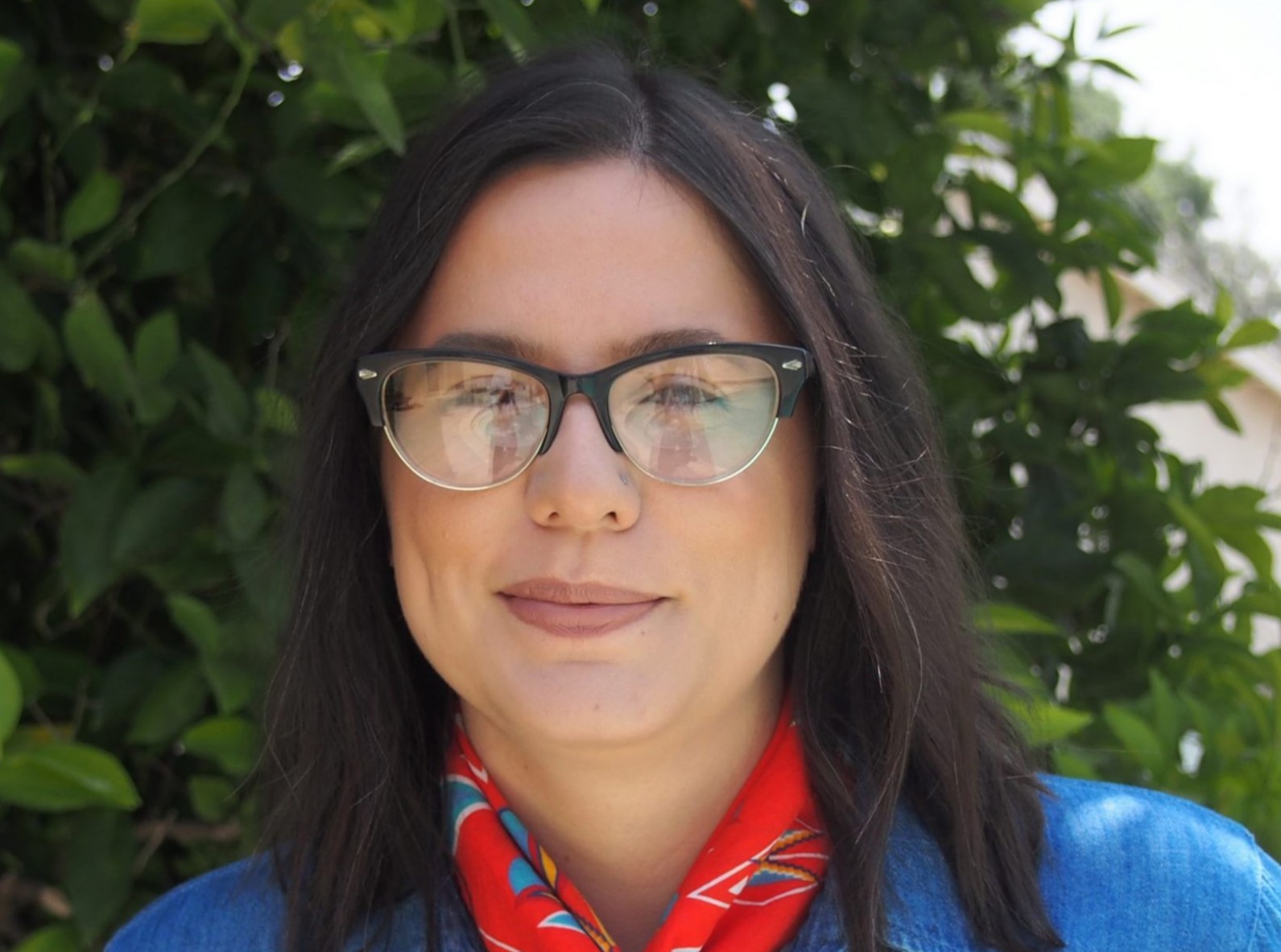
November is Native American Heritage Month and the current research of assistant professor Kali Simmons examines the representation of Indigenous Peoples in contemporary American horror cinema. She is an enrolled citizen of the Oglala Sioux Tribe and joined the English and social & critical inquiry faculty in 2024. Kali is a graduate of Portland State University and has advanced degrees from the University of Oregon and the University of California-Riverside. This academic year with a fellowship from the UConn Humanities Institute, Kali is working on her latest book, “Savage Screen,” that aims to study how Indigenous people have been represented in U.S. horror through things like ghosts and possession films, where someone is taken over by an evil spirit which prompts them to embark on a killing rampage.
Listen to Episode 175 on Podbean
Mike: Hi, everyone. Welcome to another episode of the UConn 360 Podcast. It’s Mike Enright from University Communications, along with Izzy Harris from University Communications. Hello, Izzy.
Izzy: Good morning, Mike.
Mike: Izzy, today our guest is Kali Simmons. She’s an assistant professor of English and Social and Critical Inquiry here at UConn.
Our subject is that November is Native American Heritage Month. Kali’s current research project examines the representation of Indigenous people in contemporary American horror cinema. She’s an enrolled citizen of the Oglala Sioux Tribe and joined the UConn faculty back in 2024. She’s a graduate of Portland State University, grew up out in Oregon, and has advanced degrees from the University of Oregon and the University of California, Riverside.
This academic year, she’s on a fellowship with the UConn Humanities Institute, and she’s working on her latest book, The Savage Screen, which examines how Indigenous people have been represented in U.S. horror through things like ghost and possession films, where someone is taken over by an evil spirit, which prompts them to embark on a killing rampage.
Wow.
Izzy: I didn’t realize we were in for such a spooky episode this time.
Mike: I didn’t either.
Kali: Yeah.
Mike: This is interesting stuff. So, Kali, thanks for joining us today.
Kali: Thank you. Taŋyáŋ wačhíya. Oyáte mitáwa Oglála Lakȟóta. Kali Simmons emáčiyapi. Háŋ, mitákuyepi. So, hi, everybody. I’m Kali Simmons. I’m Lakota, enrolled Oglala Sioux Tribe, and it’s nice to see everybody.
Mike: It’s good to have you here and thank you for that interesting start. What language was that that you used?
Kali: So, it’s Lakota. That’s my tribal language.
Mike: We could go on a tangent here and ask a thousand questions just about your opening statement. But, so tell us, when people think of scary movies and zombies, what part do Native people play in them?
Kali: It’s interesting because, in early American literature, you wouldn’t necessarily immediately go to, like, vampires and ghosts. You would immediately go to Native Americans.
So, in a lot of, like, early bestselling American texts, really famous pieces of poetry, the archetype that you’re probably, or trope that you’re probably most familiar with is the Indigenous ghost, right?
So, Native people coming back to kind of haunt and take revenge on settler society. There’s also the kind of very well-known trope of, like, the Native American burial ground, right? The idea that Native people, even when we pass away, like, it kind of marks the territory where we’re buried. But as we move forward in time, there’s actually a lot of, like, plasticity to Native representation in horror, and that’s what I’m thinking about in my book.
So, in the ’70s, as we get, like, a kind of advocacy for ecology, people, you know, trying to defend the environment, we get all of these stories about, like, animals that are taking revenge on society. And often, those animals are kind of linked to or placed in a kind of relationship with Native people.
There are a couple of Native-authored zombie films and zombie texts. There’s a weird run of, like, slashers in the ’80s that have Native characters. So, there’s actually, like, a rather diverse sort of representation of Native people in horror, especially over the past 50 years or so.
Izzy: What sparked your interest in horror, and how did you eventually come to specialize in Indigenous horror?
Kali: So, back before podcasts, there was this thing called radio. And my dad is, and was, a really prolific kind of outdoorsman, so we would go on, like, hunting and fishing trips all the time, and we would drive home late at night.
And we would listen to this radio show called Art Bell, which was this, like, call-in show that had interviews, and it often had, like, a kind of paranormal spin. So, they’d talk about, like, aliens and ghost stories and all kinds of weird stuff. Bigfoot. We were really into Bigfoot because when you’re driving around rural Oregon at night, you’re, like, looking for Bigfoot.
Really early on in my youth, I was introduced to, like, all of these stories about cryptids and weird critters and ghost stories. And growing up, I was also really into, like, punk rock music. And so, there are a couple of bands, like The Cramps and The Misfits, that write songs that are, like, super kind of horror-inspired, and they make references to old horror movies.
And so that’s kind of what sparked my interest and got me into looking at obscure horror movies. I’ve always been a fan of horror movies. As I was going to graduate school, I wanted to do some kind of work with the genre of horror. And then I started taking Native studies classes at the University of Oregon, and there I was really supported by two faculty members, Kirby Brown and Lani Teves.
Kirby’s still there. Lani’s now at the University of Hawaiʻi at Mānoa. And they were actually the ones who introduced me to Native film, to Native horror films, and really supported me writing about those works in their seminars. So, once I sort of geared up to go to grad school to get my Ph.D., I was like, “I guess I’m going to talk about Native horror.”
And it was a good choice because in the past, like, five years, there’s just been this huge explosion of Native films, anthologies, you know, novels. So now I have a lot more to write about, which is really cool.
Mike: So, we want to ask you why it’s important to talk about Indigenous representation in horror. And I guess, maybe a little more specifically, you know, are Indigenous people portrayed inaccurately in horror, or is it a mixed bag? What’s your take on how they’re represented?
Kali: So, the short answer is yes, Native people are portrayed inaccurately. And I think the portrayals often teach us less about, like, the truth about Native people and more about the conditions of U.S. society at the time that these representations are produced.
Like, what people are worried about, how Native people are being figured within the national imaginary. And one of the main things I’m thinking about in the book is that these very contemporary representations that we see in genre pictures actually have, like, a really long history.
And so, while we may look at a horror movie and come to expect certain tropes or certain characters, certain kinds of settings, right, those conventions actually come from, like, really, really old rhetoric. And so, if you’re making a film or if you’re consuming a film and you’re expecting those things, you might want to question where those expectations are coming from, particularly because these really old historic tropes come from really harmful rhetoric around Native people.
So that’s one thing. And then the other thing, too, is just that, like I said, there’s been this explosion of Indigenous-authored horror, and that stuff is really awesome. So, if you’re wanting to get a better sense of, you know, from a Native perspective, what is horrifying about our contemporary moment? What is horrifying, say, about zombies and ghosts and vampires from an Indigenous perspective? Then turning to those texts is really important and just really fun.
Izzy: So, word on the street is that you created a class here at UConn, Indigenous Horror. What do students do in it, and what do you hope they take away from it?
Kali: Yeah. So Indigenous Horror is a class that I’ve taught at a couple of institutions, the University of Redlands, Portland State University[HI1] , and now here.
I’ve kind of been thinking about setting up these franchises of the class. And as far as I understand it, I think I’m the first one to offer it at a university in the U.S. I know there are some folks up in Canada who have been teaching Native horror. So, it’s a one-of-a-kind thing. You know, sign up for it next year.
And so, how I’ve kind of come to run the class is that, in the first half, we look at historic representations of Native people from a kind of settler, white, European, mainstream U.S. perspective. So, we’ll start off by reading captivity narratives from the 1600s, which, now that I live in the Northeast, I kind of understand why people thought the woods were scary, because the woods out here are kind of scary.
And we’ll, you know, look at Algernon Blackwood and H.P. Lovecraft, who were both kind of interested in writing about Native people, especially because they were situated in areas where there was a very visible Native presence. So, we kind of start to understand, right, how have Native people been represented historically?
Where do these tropes come from? And then, in the second half of the class, we flip, and we look at all Native-authored horror texts. So, things I’ve taught in the past are Jessica Johns’ book Bad Cree. Usually, we teach something by Stephen Graham Jones, who’s a Blackfeet writer.
He seems to put out, like, two books every year, so every year I teach the class, I have something new to teach from him. And then we also look at a selection of Indigenous horror films as well, and the students can sort of start to understand, okay, how is horror different from Indigenous perspectives?
How is Indigenous-authored horror sort of responding to these historical tropes? But how is it also sort of challenging us to think about our world and what we think about as fearsome in really radically different ways? And I usually get some students who are not super big horror fans, and I think, by the end, many of them are converted, which I feel very proud of.
And also, a sort of funny story is that, teaching the class in the past, I’ve made posters and put them up, and students will come to the first day and say, “Hey, I saw the poster, and I want to come to the class,” which feels like a very horror movie thing where you make a cool poster and then get people to come see your movie.
So yeah, it’s super fun.
Mike: So, speaking of movies, you’re working with a director and a team of others to produce a film called Hannah. What’s the movie about, and what’s been your role in producing the movie?
Kali: Yeah. So, about three years ago, the director, Siobhan Landry, who works at Boston University now, approached me because she had been working on this film about Hannah Duston, who folks in the Northeast might be familiar with.
She was taken captive in the 1600s by Abenaki and then taken from the Boston area up north toward New Hampshire. And in order to escape captivity, she and another one of the young men who had been taken captive murdered and scalped 10 Native people, primarily women and children.
And we have a record of this because she presented the scalps to the Massachusetts government in order to get a bounty on them, and they actually paid out that bounty. So, we have these historical documents about her. About 150 years after she committed these horrific acts, the state of Massachusetts decided to dedicate a statue to her.
It’s, like, the first statue dedicated to a woman in the United States, and it’s a really scary statue. She’s holding a hatchet, and there’s another one in New Hampshire where she’s holding a hatchet and pointing at you. She looks like a really, she’s not a very approachable character.
And so, Siobhan had been examining this mythos around Hannah Duston because there are these statues. Jim Beam, the whiskey company, had made these bottles of whiskey shaped like her and the statue. There are bobbleheads. There are all sorts of Americana now associated with Hannah Duston.
And in light of the 2020 protests around the removal of statues or the questioning of statues that are dedicated to really troubling figures, Siobhan was looking at Hannah and her story and thinking about, “Okay, why are people so fascinated with this?” So about three years ago, she approached me to be a traditional talking head in the documentary since I write about captivity narratives and horror movies.
And she had also been collaborating with another scholar, Angie Morrill, who’s Klamath, whose work I super admire and has been really foundational to my own writing. And we just meshed really well and decided, what if we do something really weird with this movie?
It starts out as a traditional documentary and then turns into this horror film that is about Siobhan slowly becoming possessed by the ghost of Hannah Duston and then trying to trick me and Angie into participating in some weird rituals and potentially trying to come after us.
And it’s very silly, but also a really, I think, profound meditation on motherhood and grief and historical memory, and also the dangers of encountering stories that can take over you or move people to act without thinking. And in terms of my role, I’ve been a producer. I’ve written some stuff. I’ve storyboarded large sections of it.
I’ve helped with the cinematography, and then I am both a talking head in the traditional documentary sense and have now had to become a kind of ad hoc actor. So, this summer, we went up to Maine and were shooting some of it. We shot a scene where Siobhan and I have a fight in what should be the Merrimack River.
We actually shot it in the ocean off the coast of Maine, and I was dressed as Cotton Mather, who’s this historical Puritan figure. It was kind of the climax of the film, where we have this showdown. So, it’s very silly, but also, I think, very, there’s layers to it.
Mike: And do we know when it’s going to be coming out and where it’s going to be available?
Kali: That we are still working on.
Mike: Sure.
Kali: We are currently in the process of starting the primary edit, so we’re working with a couple of different editors to narrow down the style and pacing, and who we want to work with primarily. We still have a little bit to shoot, so we’re looking at either a year out or maybe two years out.
And in the spring, we will be having an event somewhere in Massachusetts since we received some grant funding to work on the film. And I’m sure I will do a screening here as soon as it is all done, and that will be weird.
Izzy: Well, it sounds like something that I’ve never seen before.
Mike: I’m not familiar with this at all.
Izzy: Yeah. So, super interesting to learn about, and super cool that you’ve played so many roles in the movie. Thanks for sharing a little bit about it.
Kali: Yeah. So, if you’ve seen, I guess the closest analog is if folks are familiar with that new Nathan Fielder documentary, You Can See Everything. I watched that movie and was like, “Okay, we’re doing some of this stuff in our movie,” so that’s neat.
Izzy: Well, I’m not familiar with that either, so it’ll be a total surprise to me when I see it, which I think I like better. So, we’re well into Native American Heritage Month and heading toward Thanksgiving. What should people keep in mind throughout the month of November, especially as we gather around the holiday dinner table?
Kali: I guess I’ll start by saying I’m very pro-feeding people. I’m very into, like, making a big, elaborate meal and hanging out with people, so I hope that folks do that.
I hope that the students, like, go home and rest and take a nap and get a break from all of their work. And I think it’s also a really good opportunity to do some self-education, particularly around Native people and particularly around Native people in the areas where you are living and working.
For a couple of recommendations, UConn’s own Chris Newell, who’s an instructor in SCAI and is also the director of Native American Cultural Programs, has a really approachable children’s book. So, if you want to, like, chat with your family, the book is called If You Lived During the Plimoth Thanksgiving, so I’ll plug that.
And Chris is just an awesome guy. He’ll also be teaching Intro to Native Studies next spring. If any of the students are interested, I think it would be a really cool opportunity to take the course with him.
I also want to specifically recommend Wunneanatsu Lamb-Cason, who is Schaghticoke, which is a tribe whose traditional territories we’re currently on. She’s also Ho-Chunk, and she also has another children’s book called Grandmother Moon. And she works for Native student programs over at Brown, so she comes and hangs out with us a bunch.
So, taking the opportunity to, you know, engage with Native voices directly and to sort of familiarize yourself with the communities whose traditional territories you are living and working on is really awesome.
I think also, you know, taking this moment to understand that Native thought is really profound and dense. And so, I think a really beautiful thing that I love about Native thought and Native stories is that they really portray a profoundly challenging understanding of the world.
And so, I think taking some time to engage with that can be really transformative for folks. So, you know, go read Layli Long Soldier’s poetry. Go watch a Jeff Barnaby movie. You know, go to the beautiful Mashantucket Pequot Museum. Go to the beautiful Tantaquidgeon Museum and really engage with community members.
Because I think, having now worked in this community for a couple of years, the Native communities here are just so wonderful and really kind and generous with their time. And so, I would, you know, take the opportunity to engage with them because I think everyone’s really super lovely.
Mike: Well, Kali, thank you very much for joining us today on the podcast. Thank you for your work here at UConn. This is an interesting topic, and it’s, I think, something everybody can take a little something from.
Kali: Thank you.
Mike: Izzy, thank you, as always, and we’ll talk to you on the next podcast.
[HI1]not sure what she says here