It’s one of America’s most iconic events – the Macy’s Thanksgiving Day Parade – and the UConn Marching Band is headed to New York to be part of this historic day for the first time in school history. It’s a great honor and even more so that the parade is celebrating is 100th anniversary. Our guest on this episode of the podcast is Jessica Dickerson, the director of athletics bands here at UConn. She is in her first year in that role, but has been part of the band faculty since 2014 and has both an undergraduate and graduate degree from UConn. Jessica was a member of the Marching Band as a student. It’s a busy time for the band with the parade, the end of the football season and men’s and women’s basketball and hockey seasons in full swing with pep bands.
Listen to Episode 176 on Podbean
Mike: Hello, everybody. Welcome to another episode of the UConn 360 Podcast. It’s Mike Enright from University Communications, along with Izzy Harris from University Communications. Hello, Izzy.
Izzy: Good morning, Mike.
Mike: Izzy, when you think about iconic American events, what do you think of?
Izzy: That’s a tough one, but maybe the Macy’s Thanksgiving Day Parade.
Mike: That would be right up there, I think, and that’s why we’re here today. We are talking to Jess Dickerson, who is the director of athletic bands here at UConn, who’s in a very, very busy time of the year. But the exciting news, and preparations have been going on, I think, for almost over a year, is that for the first time ever, the University of Connecticut Marching Band, the Pride of Connecticut, as they’re known, is appearing in this year’s Macy’s Thanksgiving Day Parade in New York City.
It’s, I believe, the 100th version of the parade, so it’s an exciting time. Jess was named director of athletic bands here at UConn earlier in the year, but she’s a longtime member of the university’s band faculty. She’s got her bachelor’s and master’s degrees from UConn and, as I said, joined the faculty in 2014 as a graduate assistant.
It is a crazy time with the bands because we have football season still going on. We have men’s and women’s basketball and hockey seasons going on, and we’re getting ready to participate in, like I said, an iconic American event. So, Jess, thanks for joining us here today and taking some time for the podcast.
Jess: Thanks for making some time for us. Happy to be here.
Mike: So, tell us, first, before we get going, a little bit about yourself, your background, where you grew up, and you were the first female director in UConn Marching Band history.
Jess: It’s true.
Mike: Which dates back to 1896. So, first of all, congratulations.
Jess: Thank you.
Mike: And tell us a little bit about yourself.
Jess: Yeah. Thanks so much. You know, it is really awesome to be in this role, and when I look back at what the last 20 years of my life around bands has really included, the marching band activity has been at the core of it. So, to be sitting here today as director of athletic bands, really just full circle for me.
I was born and raised in Tiverton, Rhode Island, Newport County. Beautiful coastal community. I was so blessed as a kid, but like many young people, you think that the grass is greener on the other side. So, when I went to school, I was always dreaming about getting out of Rhode Island, the smallest state in the country.
You know, I want to have these other opportunities. I want to get out of my hometown and see what else is out there.
I was a two-sport athlete. I really loved it. When I got into high school, I, you know, I had been doing the music thing. You know, concert band was fun in middle school. A family friend was my band director there, and I really loved challenging myself through music. But I also loved sports.
So, I got into high school, and like a lot of our students do, I was just kind of forced to choose a lane. And I had a band director, Mike Alves, out at Tiverton High, who was just so invested in me, more than I felt in the athletic space, in my team spaces. And he poured into me really early on in my career.
He made me a drum major really early in my high school path, and that changed the trajectory of my life. He told my mom when I was applying for schools, I was thinking about Plymouth State University. It had a great music therapy program. I thought, “I’m going to go do this. I’m going to ski on my breaks. I’m going to enjoy the mountains and get out.”
And Mike said, “No way. She needs to go to a big state school with a great marching band, opportunities to really just continue to expand her leadership skills, and to have lived experiences outside of her town that felt as big as the ones I told Mike I was trying to chase.” And so, he pointed me in the direction of UConn, and, you know, that was just an incredible moment in my life.
My parents were all in. I came, I auditioned, I met a few faculty members here. I saw the campus, and it was over as soon as I finished that visit. I knew that if I got accepted to UConn, I was going to come. And, you know, I think in the years that have followed, I’ve seen a lot of the same.
I’ve seen great mentorship here in former Director of Bands David Mills, former Associate Director Marvin McNeill, and many of the faculty in the Department of Music who have just continuously encouraged me, shouted out the things I’m excelling at, and given me space to try new things. And that path somehow has led to me leading this program, and I really just feel so prepared for the moment because of the great mentorship I’ve had all the way back to Tiverton, Rhode Island.
But UConn was the right place because it had so much of that same investment and mentorship. That’s really at the root of what we’re trying to do in athletic bands now.
I think it’s great for our students to see a woman in this role. I’m a mom of young kids. My kids are six, four, and two, and so they often see me, like I am now, exhausted, totally overextended, and struggling to balance all of the priorities.
And it’s good for our students to see us and the reality of our lived experience. And so, you know, being the first female director is certainly great for my students to see that this is possible for a person who is chasing a whole other dream, which is building a beautiful family and having a life outside of work.
But I really think that the reason that I’m the first is because we have had great directors before who have, you know, David Mills was here 32 years and invested a great deal in this program. And before him, David Maker, Gillespie, Gary Green, just incredible people who have invested long stays in our institution and in building the band program.
So, you know, I look back on when they started, and I think it probably wasn’t necessary for a mom of three children to be working at that time, right? And to be needing to have a full-time job. It certainly is for me now to have a full-time job. And I think if I were in the ’70s or the ’80s, I would be like, “No, husband, go do your thing.”
But, you know, happy to be the first in any case. But I really just think that is all because we have had great investment in the program over the last three decades. And that, you know, can’t say enough about David Mills and what he’s built here, and the gentlemen who have come before him, pouring into UConn’s pride and tradition.
Izzy: It’s an exciting time for UConn Marching Band, which dates back to 1896, with football season, new uniforms for the first time in 20 years, and, of course, getting ready to perform in the Macy’s Thanksgiving Day Parade. Tell us about balancing your time and getting everything accomplished. There are only so many hours in the day. How do you do it?
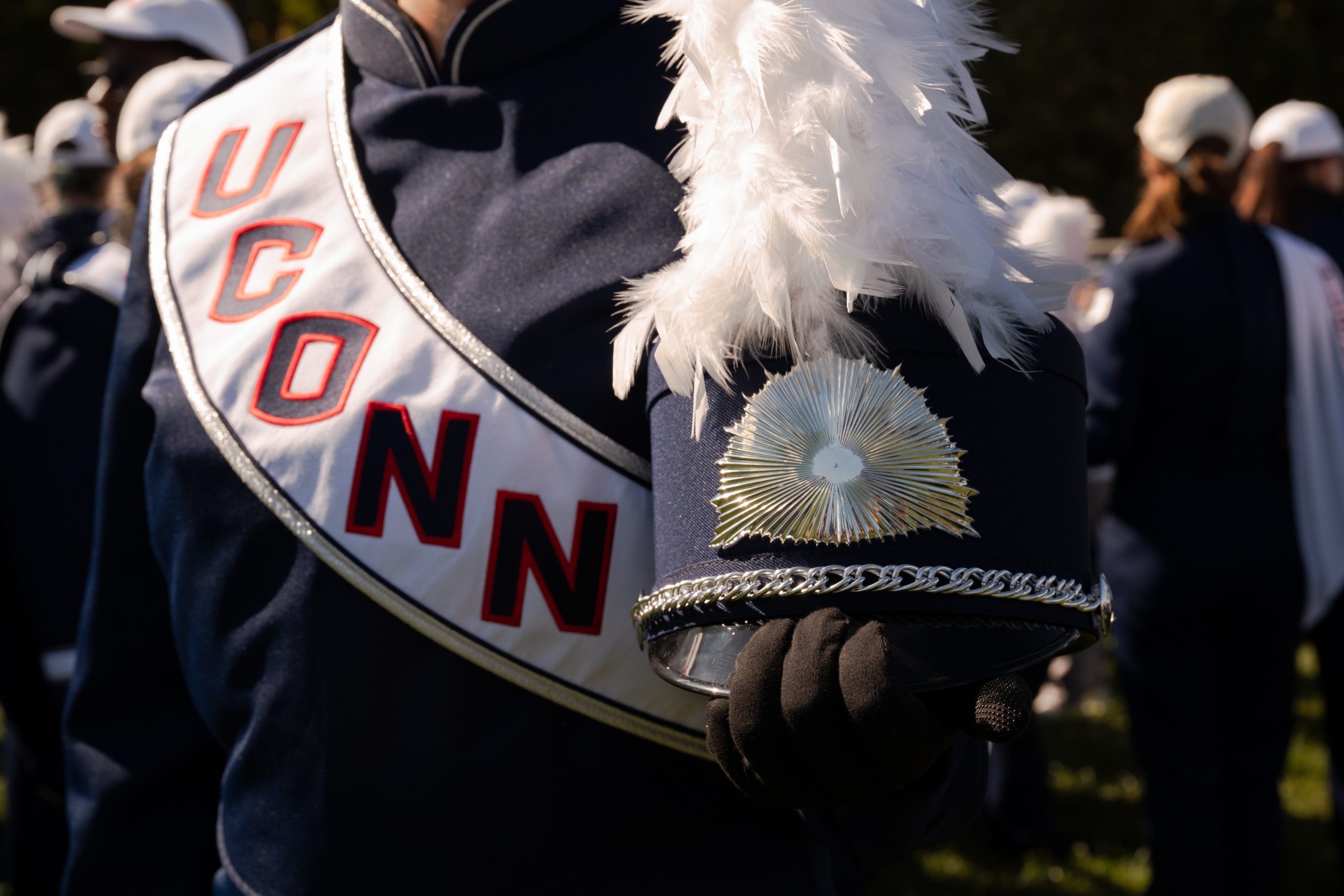
Jess: You’re not kidding. The list is long, and as was said earlier, we’re doing so many things right now. This is such a busy time for us every fall semester, and so this has been a unique challenge this year. We really dove into this uniform project last year and have been working with DeMoulin on designing this new look for UConn bands. So, we were so excited, before we even knew that we were headed to Macy’s, that we were going to have these new uniforms.
We were going to be able to do something and create a connection between our alumni and our current students and honor tradition. So, to come out of the gate celebrating new uniforms for the first time in 20 years, so awesome. We are excited about this new look, and I’m really happy to be wearing a beautiful design by DeMoulin and for our alumni to feel so much pride and identify with these uniforms.
They’re a nod to two former uniforms, and so that’s super exciting. The energy right there would’ve been enough alone to carry us through a great season. But then, in the spring, we heard that we were headed to this historic 100th Macy’s Thanksgiving Day Parade, and that call was a shock. Honestly, you know, we’ve never applied to this parade before.
This is our first time going. We applied for a range of several years, and when we found that we were selected for the 100th, sharing the street with the Marching Illini from the University of Illinois and the Million-Dollar Band from Alabama, I think we all took a deep breath and realized very, very early on just kind of the significance of the opportunity, right?
These are fantastic college band programs that have visited this parade several times and have institutions with great tradition. And so, the bar has been really high. And I think when we think about what we do great at UConn, obviously, its athletics, it’s our sports, it’s basketball. And so, our pep band program has been, for a long time, really excellent.
My colleague, Associate Director Ricardo Brown, is a tremendous, I mean, world-class college band arranger. He’s built a book that really has put us out there as unique and out in front of a lot of our colleagues in Division I sports. We’re super proud of that. And so, when we knew the gravity of the stage that we were going to, right, the significance, we said, “We got to take what we’re doing on the pep band stage and just transfer it to the marching band.”
That’s the mentality, that’s the writing, that’s the creative vision. And so, we jumped into the summer really thinking, “What are we going to do that is so visibly and audibly UConn? How do we make what we do in our basketball, and our hockey spaces come alive on the street in front of, you know, more viewers than the Super Bowl?” Right?
We have a minute and 15 seconds to get it done, and I think our priorities were all framed in that conversation right there. We knew we needed to sound good. We knew we needed to do something that really created an energy that mirrored what happens when we step into Gampel Pavilion and it’s packed.
And so, the priorities have been a little different this year than they normally are. I think when we think about marching band, you think, you know, field movement, lots of forms. The band is constantly moving. This year, we’ve made some sacrifices. You know, we have reduced the amount of movement that we’re doing on the field so that we can spend the limited hours that we have, which is about six hours a week with our students, really focused on how we sound and the quality of the movement and how that impacts the sound.
And so, we have really thought about the moment, what it’s going to take to build a foundation that’s going to guarantee that when we step out there on Thanksgiving morning, we are executing at a level that we feel reflects the excellence of our institution. And so, I would say balance isn’t really a word that we’re using.
It’s more like shifting priorities, right? At all times, we’re thinking about what is the next immediate thing, and the undertone of that all year in all of our spaces, be it hockey, be it basketball, be it football, or in preparation for the parade, the name of the game is quality. The standard is high, and our students are working really hard to meet those expectations, both musically and visually, but also in our culture.
We’re just so proud of the community we’re building.
Mike: So, tell us a little bit more about the trip to New York and the Macy’s parade. Like you mentioned, obviously, the entire world will see the UConn Marching Band. What, a minute and 15 seconds?
Jess: Yeah.
Mike: Is that what it is? But I’m sure there’s much more to the trip. I’m sure there are tons of logistics. When do you head down? Are there other events you’re involved with? When do you come back? What will the experience be like for you and the band members?
Jess: You know, we’re lucky that this is a close trip for us. Some of our peers are coming in on Monday, and they’re flying. I mean, the bill on this thing is massive for some of these bands.
We’re going to go on Tuesday. So, our students, we perform on Saturday for Senior Day at Rentschler Stadium. We’re so excited to honor our seniors and the rest of the Husky senior class. We’ll finish that game. Sunday, we’ll have a band meeting. Monday, we got a rehearsal. Tuesday, we got a rehearsal. We get on a bus, and we go.
Tuesday afternoon, we’ll be in New York City. We’re staying at The New Yorker, a historic hotel right on Eighth Avenue, across from Madison Square Garden.
The students are going to have an opportunity to explore the city on Tuesday night and kind of just, you know, celebrate the moment together as a community. And then on Wednesday, we’re doing something really cool. We’re headed to Central Park, and we’ll be joined there by the only remaining marching band in all five boroughs, and that’s the Long Island City High School Marching Band. We’re so excited to partner with them and to do a clinic in Central Park with their marching band students.
We’ve been coordinating with them. We’ve sent them some merch. We’re excited to gather with them there at the Bandshell and to teach them a little bit about UConn pride, about what the opportunities are for them beyond high school, and to hopefully inspire some students to stay engaged in music.
And then we’re going to do a side-by-side concert. You know, the mayor’s office has been contacted. That’s, like, all the hype. The students were freaking out when they heard that the mayor’s office had gotten an invitation to Central Park. So, we’re hoping that the public shows up and that that’s a great opportunity for people to see the culture of our band in action, the spirit of our band in action.
I think we see so much of our values reflected in community outreach and engagement, and in working with young students in music to try to inspire them to continue to build programs like the great one we have at UConn, which is entirely dependent on a student’s investment in the activity.
These kids get no scholarships here at UConn, right? They’re here because they love it, and they know that if they pour into it, they’re going to get something that they can carry beyond their time at the institution. So, it’s great to have an opportunity to work with some high school kids. And then Thursday morning, we’re out on the street at, like, 1:00 a.m.
We’ve got a rehearsal in the morning. All the college bands are out there on Thursday morning. We will do our run for the NBC broadcast team in Times Square. We’ll go eat a quick breakfast and get right back out on the street for the parade itself. So, it’s going to be a really long stretch for us.
We’re probably all going to have an all-nighter because the men’s basketball team is playing Duke in Las Vegas on Wednesday night.
Mike: That’s right. The week before Thanksgiving.
Jess: We’re having a watch party. I guarantee you every person in the band will be watching that game and then maybe getting, like, two or three hours of sleep before our rehearsal on the iconic Macy’s star.
But totally worth it. We’re going to stay up and cheer for the Huskies and then go be the Pride of Connecticut on the street on Thursday morning.
Izzy: As if you’re not busy enough with the parade.
Jess: Right.
Izzy: On top of all of that, basketball and hockey seasons are gearing up, and you have varsity pep bands for those sports. So, are those bands made up of marching band members, or are they different students? And what’s it like in March when you have bands traveling around the country with all of our teams?
Jess: It’s wild, and, you know, I think we’re one of the few schools in the country that’s faced with these challenges because so many of our teams are doing so great.
We’ve got to produce these pep bands that travel, you know, this year, potentially with four teams. Women’s hockey is really doing fantastic, and we’re looking forward to an opportunity to support them on the road, as well as men’s hockey and men’s and women’s basketball, if all goes well for our Huskies this year.
There is a lot of crossover in the personnel. For a long time, you had to be in the marching band to be in the pep band. It was a prerequisite. We’ve kind of let that go because we need to grow the number of students in the pep band program to support our athletic activities.
So right now, our pep band program is just shy of 200 kids, about 196 kids, who serve in two travel bands, two high-quality travel bands, which are our NCAA bands. NCAA regulations allow 28 students, plus what we use as a full-time staff member and a graduate director.
So, we have two of those bands, and then we have a whole cohort of Husky Band kids who are a mix of students. Some of these students auditioned and didn’t quite make the cut, but a lot of them are advanced-degree students, some graduate students.
We have a really, I think, diverse set of majors reflected in the pep band population. And, you know, kids are committing a lot of their time, and not all of them can afford to take two weeks off from labs and research and, you know, student-teaching placements in March. So yeah, we do see a lot of crossover between the two activities.
When we get into the postseason, things kind of feel like they slow down. These guys are used to three nights a week, plus their Saturdays, right now through the months of October and November. And then we kind of hit January, February, and the break, and all of a sudden, it’s like, “You only have two games this week, guys, and then we’re going to pack our bags, and we’re going to take a nice flight, and we’re going to get these great snack bags.”
You know, our teams are so awesome about really making the environment welcoming and fun for our band. And so, we get these amazing opportunities to travel, and it feels slow-paced, but academically, we do not let off the gas. I probably proctored 25 quizzes and exams on the women’s run last year between Dallas and Phoenix.
And our students are working hard when they’re on the road. They’re really engaged in their academics all the time. So, the demand is high, but I think the quality of the work that we’re doing, again, is really just the foundation. That’s student first, quality of education and academic performance, and then really just leaning into going out game after game and being the best.
You know, excellence is what we’re all about here at UConn. That absolutely extends to athletic bands.
Mike: You talked about it quite a bit. I mean, we hear the term student-athletes and athletes balancing the rigors of the classroom and athletic performance. But very similarly, the band members have to do the same thing in terms of being musician-students, if you will.
Jess: Definitely. I mean, certainly in the marching band space, there is, you know, a direct line to athleticism. They’re conditioning their bodies. You got them out there sweating. They’re working hard. They are having to move their feet in time. It might as well be running.
And I think that a lot of these kids, we say it all the time, the best and the brightest in UConn bands, a lot of these kids are, you know, 4.0, 3.8, really high GPAs, invested leaders in other places around our campus, engaged in other activities.
And I think that speaks to the same sort of culture and character values that we see in our student-athletes. They’re leaders in their space. They’re community leaders. They’re engaged and invested in giving back to the community, and I definitely see all of those things in the student body in UConn bands, marching band, and the pep band.
We’re so proud of our students. They really just are such great ambassadors for our university.
Izzy: You mentioned values, and some of those in the UConn Marching Band are talent, unity, and pride. Can you talk to me a little bit about each one and what they mean to you?
Jess: Oh, you know, that’s a longstanding tradition in UConn Band. We’ve been saying talent, unity, pride, we call it TUP, for decades in the UConn Band. Generations of students have said, “What does TUP stand for? Talent, unity, pride,” at the end of every rehearsal.
And I think, for me as a student, it was like, we’re a great band, and we do it together, and, you know, we’re proud of being a flagship organization out in front of our flagship institution.
But I really have challenged myself in stepping into this role to think about what those things mean for us now, and they mean something different. I think where we are as an institution, what we’re trying to do as a band program, the national visibility that has come since the early 2000s from athletics really just blowing up on a national stage and having so much success, is really demanding us to reframe what those things mean and to have some accountability, right, as a program, to upholding those values and to maintaining a culture that we think reflects them.
So, for us this year, talent really is connected to excellence, and excellence requires consistency of effort. You know, we show up every day, we work hard, we’re consistent in the way that we produce our product and our process. That’s going to turn into talent that shows up for us week after week when we step out on the field or when we show up on game day.
Unity, we can do a lot of things together, and in a marching band, of course, unified movement, coordinated movement, and uniformity are a definition of the activity. So, unity means a lot of things, but I think right now, because our students are such academic leaders and are so committed to their academic performance, we’re expecting that same commitment to the activity.
So, unity for us this year is a commitment from everybody to show up and pour in, to be present, and to hold ourselves accountable, right? Be self-aware.
And then pride, you know, for a long time, we’re the Pride of Connecticut. What does that mean? Pride is a feeling, and for us this year, it’s really defined by a feeling we get when we give back. And that’s why I’m so excited to do this thing in Central Park, I think.
You know, when we show up on game day and we pour it out in the stands, and we’ve got hundreds of people to our left and our right and above us just engaged and feeling UConn pride, that is the feeling we get when we give back, right?
So, the Pride of Connecticut, really, for us, the culture, talent, unity, and pride, is all about consistency of effort, a commitment from everybody, and an investment in giving back so that we get the feeling of pride when we pour it out for people around us.
We’re excited about what those things are doing for our culture and how we represent the university through them.
Mike: You know, you mentioned something earlier, that there’s only one high school marching band left in New York City. I mean, that’s sad. It’s expensive to put on these bands. What’s the state of the union, if you will, for marching bands around the country, especially at the high school level?
Jess: You know, the Northeast is a unique place for band programs. And I think, you know, when you look in the Midwest, you look at Texas, Florida, even out on the West Coast, marching bands are alive.
Competitive marching band is alive. There is a lot of investment and engagement in many parts of our country, and it’s certainly true here in the Northeast. There are lots of students who are engaged in the marching band activity. I think that, like anything else around education, budgets have been impacted, right?
And we know that resources are more and more finite as the years go on. Certainly, the pandemic impacted enrollment in a lot of music activities. It’s very hard to learn an instrument over Zoom, right? And to have a connection with a mentor or a teacher. So, I think the state of engagement and investment in marching bands, particularly in the Northeast, is recovering, right?
We’re seeing our numbers increase, and I’m excited about it. I think marching band here at UConn is healthy. Why? Because we’re a great institution. A lot of kids want to come to school here because we have great athletics programs. But also, I think it says a lot about the students we put out front, the culture, and the way that we invite people into our community.
I think the state of the union is, marching band is an awesome activity for students. That’s still true across our country, and certainly true here in the Northeast. The challenges remain, and I think, as we all do in the arts, we persevere through adversity. We see ourselves as really leaders in that practice of persevering through adversity, of naming challenges and facing them.
And I think, you know, it’s cool to be a part of the School of Fine Arts as a marching band program. A lot of our colleagues in Division I sports are in athletics or student activities. We have a real tie to the arts community here at UConn, and it’s informing how we move through some of the challenges that we’re facing.
So, you know, it’s a great thing to be a part of an athletic band program anywhere in the country. I would say it’s a unique experience here in the Northeast, for sure.
Izzy: Speaking of unique, I’m going to wrap things up here with a fun question. When you get the chance to listen to music, what kind do you enjoy? Who are some of your favorite artists? Or are you just listening to the UConn alma mater on repeat all the time?
Jess: Oh, no. No, no, no, no, no. I, you know, I grew up, my dad is, like, a huge music junkie, like a huge music junkie. And I listened to just all kinds of mixes and CDs when I was a kid. I didn’t really understand that there was just, like, one lane of music.
My mom was a country music person. I cannot listen to country music. I find myself all over the place. And because music is my work, frankly, I listen for work a lot. So, I’ll get on Spotify or Apple Music, and I’ll just shuffle top playlists. I’m into just all kinds of stuff.
But when I’m home alone by myself with my kids, singing in the house, often it’s my dad’s favorites, which is about 2,500 songs shuffled on a playlist, and just a really fantastic way to stay connected to him.
And I, you know, music is just always in the background of my life. I don’t feel like I’ve ever landed on one artist, one genre, one bucket. Sound informs everything I do, so I try to stay open.
Mike: Well, Jess, thanks for joining us here today. We all look forward to spending part of our Thanksgiving morning watching the parade and watching the Pride of Connecticut on the streets of New York City. So, thanks for stopping by today.
Jess: Yeah. Thanks for having me, and thanks to everyone for watching. We’re so excited to be a part of this historic 100th Macy’s Thanksgiving Day Parade, to represent Connecticut, the University of Connecticut, the School of Fine Arts, and all of the Huskies out there who will be watching.
Mike: Well, thank you again. And Izzy, another podcast.
Izzy: Another podcast in the books.
Mike: We’ll catch you next time on the next episode.