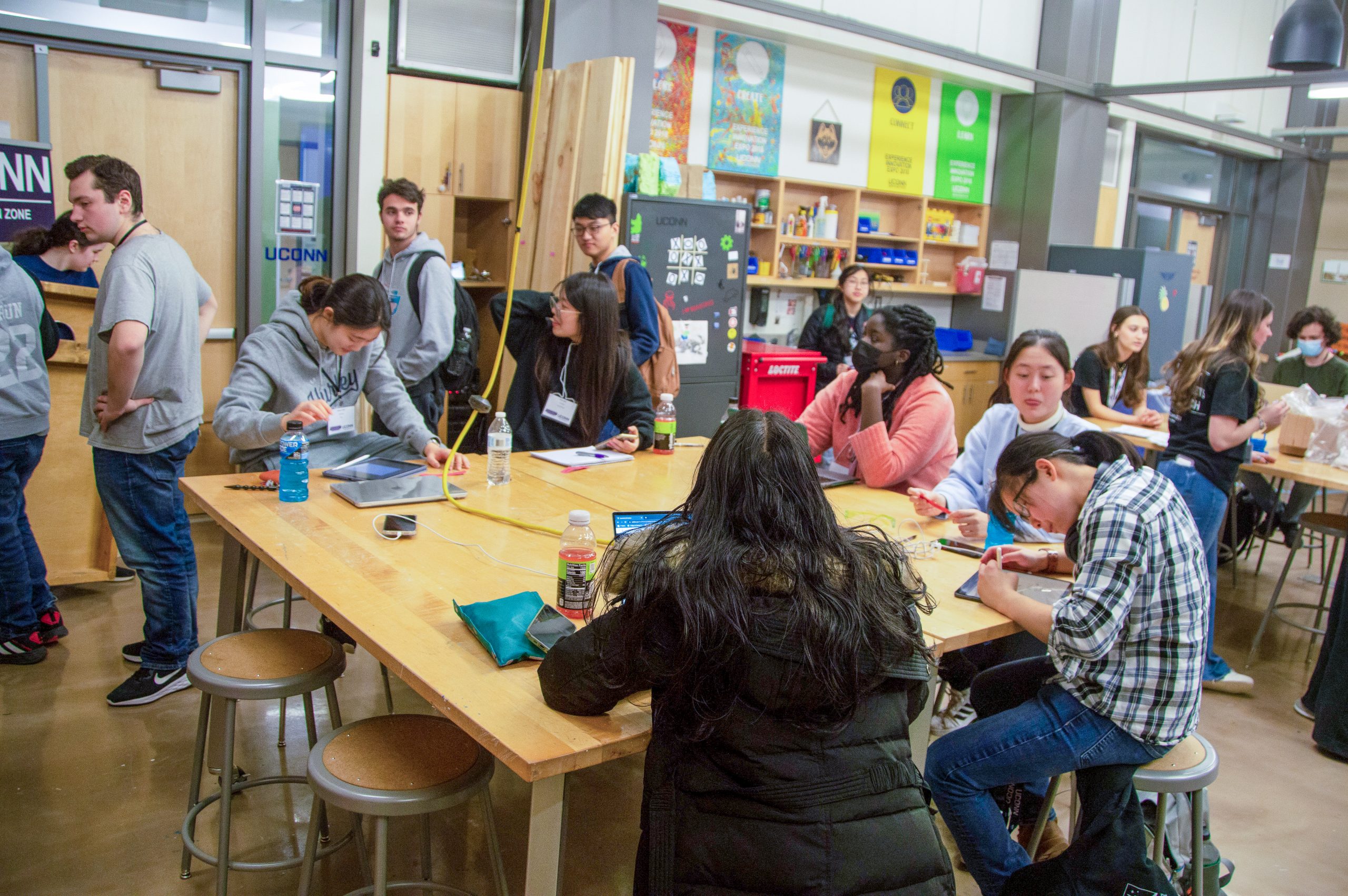
The Peter J. Werth Institute for Entrepreneurship and Innovation will be hosting its “Day of Discovery” on this week, which is an opportunity for UConn students to find out and explore what is available to them through Werth as part of their academic experience. Aaron Rosman is a program manager at Werth Institute Aaron and is a long-time member of the UConn community. He joins us on this episode of the podcast to talk about the “Day of Discovery.” Rosman also helps lead the institute’s Innovation House, which is their direct connection to first- and second-year students who were drawn to innovation as an identity. Innovation House is reinforced by experiential learning through the lens of community building. Plus, we celebrate Izzy’s birthday!
Listen to Episode 174 on Podbean
Mike: Hello, everybody. Welcome to another episode of the UConn 360 Podcast. It’s Mike Enright from University Communications, along with Izzy Harris from University Communications. Hello, Izzy.
Izzy: Good morning.
Mike: We have somebody joining us today who loves being at UConn.
Izzy: That’s amazing.
Mike: We need people like that.
Izzy: Oh, absolutely. I mean, I love being at UConn.
Mike: Well, as do I. But we got, so we have three people who love being at UConn.
Izzy: Okay, now we’re talking.
Mike: So, our guest is Aaron Rosman. He’s the program manager at the Werth Institute. We’ll get into that. He’s, like we said, a longtime member of the UConn community. He earned both his undergraduate and graduate degrees from UConn.
He’s worked at the school here for over 10 years. He’s currently the program manager for the Peter J. Werth Institute for Entrepreneurship and Innovation, which dates back to 2017. The institute links academic courses, funding, mentorship, and activities to help students, faculty, and alumni develop entrepreneurial skills and create new companies.
So, as the podcast drops today, the Werth Institute is hosting its Day of Discovery, which is an opportunity for UConn students to find out and explore what is available to them through Werth. So, Aaron, thanks very much for joining us today here on the podcast.
Aaron: Yeah, thanks for having me, Mike and Izzy. I appreciate it.
Mike: So, tell us a little bit about yourself, your UConn journey, and the work that you do at the Werth Institute.
Aaron: Yeah, absolutely. So, my roots with UConn go very deep. It took me, I had a story in my head going up to 2016, just when I started here at UConn. And from working my first job at the Center for Judaic Studies, that story actually changed.
So, you know, the story as it was, was that my folks had both worked at UConn for a very long time, most of my life, really. My father was a professor of accounting. One of my very first memories is going to one of the exams in Schenker that he was delivering. He had to babysit me, and it was exam night, so I remember saying hi to the crowd.
The crowd liked that. I hope they liked the grades that they got, too. Yeah, my mother also worked as staff in the Gifted Education Department, so with Joe Renzulli and Sally Reis. So, I’ve seen many at Confratute. I’ve got to experience UConn from an academic and business side early on.
That really was my formative years. I grew up in Storrs, so UConn was always in the backdrop. You know, it was always a second place for me to go, to hang out, to be. And ultimately, I became a Husky in 2012. You know, I got accepted into UConn. So, I did my undergraduate in forestry, which I love, and I still practice in ways to this day.
But when I graduated, I started working at the Center for Judaic Studies, and then the story changed a little bit. My great-grandfather, Nathan Solomon, was an immigrant to the United States. He came through Ellis Island. He left Poland for the United States. We don’t know why.
There are mysterious circumstances around it. All we know is that he was the only person in his family to leave. So, he came to Ellis Island. That was fraught. He had a really difficult time with the immigration process. He got held up because he had ringworm, so he had to quarantine.
During that time, his acceptance was rocky. It wasn’t clear if he was going to be accepted or not into the United States. He might have been turned around. From that experience, I think it really shaped him. And later in life, he lived to be 99, he would take to poetry to tell his story. And what’s interesting is that I had known that he had written, but I had never really read any of the work that he actually got published.
So, I’m in the Center for Judaic Studies. It’s 2016. It’s my first job. I’m working, and we have this bookshelf of famous literature from Jewish authors. And I see one day the face of my great-grandfather looking at me from the bookshelf, and I said, “What the heck?” And it’s just sticking out. So, I go and I look at it.
I pull it off the counter, or I mean, the cabinet there, and it’s a copy of his poetry book called My Odyssey. And in it, there’s a note, and it’s a note from my grandmother. And that note says, you know, something along the lines of, “Dear Center for Judaic Studies, you know, we’re sending these books out to try to get Nathan’s story known. We’re sending it to a lot of institutions across the United States, and we’d love for you to retain a copy of it. Sincerely, Elaine Rosman.” And I don’t think anybody ever wrote back, but the book’s on the shelf. So, I took a moment and I wrote back to her 10, maybe 20 years later, after she wrote the letter.
And I said, “Hey, I want you to know that the Center for Judaic Studies has received your book.” And yeah, so my history, or our history, with UConn goes back way earlier. So, it’s really unique.
Izzy: Yeah, that was a…
Mike: Fascinating story.
Izzy: Yeah, I didn’t expect that.
Mike: I know, me neither.
Aaron: I didn’t either. I just thought I was working my first job. I wasn’t expecting to get a history lesson.
Izzy: Wow. Yeah, I know. I feel like I got a little bit of a history lesson today, too. That’s super cool how deeply rooted you are in UConn. So, coming full circle a little bit, can you tell us about the work that you do at the Werth Institute?
I know October is a really busy month. You’re all getting ready for the Day of Discovery, which is today, October 21st.
Aaron: Yeah.
Izzy: Also, my birthday.
Aaron: Oh, congratulations.
Izzy: Thank you. Can you tell us a little bit more about the Day of Discovery?
Aaron: Absolutely. So, the Day of Discovery, it’s an evolution of an event that we’ve been holding for a couple of years now called the Month of Discovery.
We’ve actually truncated it to meet our students where they’re at, but it’s a really great partnership among a lot of offices. So it’s the Werth Institute, the Office of Undergraduate Research, First Year Programs and Learning Communities, Innovate Labs, and the Center for Career Readiness and Life Skills coming together to put on some of the best programming that we can for our students, so they know about all the amazing opportunities that are available to them in creativity, innovation, entrepreneurship, and research that’s going on here at the university.
So, the Experience Innovation Expo is one of several events. We are also having Research Connections, which will be over in Werth Tower. That’s a great place for students to meet undergraduates, graduate students, and faculty who have either partaken in research or have research opportunities available for students to join.
So, it’s a really great place to get connected. And then also, Fall Frontiers, which is the research event where all the research that’s happened in the last academic year is being showcased by students. So, there are over 100 student presenters who are just ready to show you what they’ve worked on, get you excited about research at UConn, and also help you learn about a new subject.
Every year, I walk out knowing about four new subjects I had no idea existed, which is great. But, you know, that’s the work that we’re doing right now. We’re trying to get all that prepared so that you guys can come and see what’s available. What we’re doing at the Werth Institute right now with the Experience Innovation Expo is getting all of the partners and members of the Werth Institute together to come and show you guys the opportunities that are available within creativity, innovation, and entrepreneurship.
So that’s what we’ve been stringing together right now, and that doesn’t happen without the help of some really amazing, talented students. We can get into that a little bit when we talk about our programming, but I just want to give them all a shout-out, the student planning team. They’re doing an incredible job this year, and I think they’re going to be excited to see their work come together today.
So, I hope you guys can join us in enjoying it.
Mike: So just taking a quick step back, a lot of people may not be familiar with the Peter J. Werth Institute. Tell us a little bit about it and what it does exactly, from kind of a broad view.
Aaron: Absolutely. So, what we do is we meet students that…
Well, we see students as innovators. There’s a lot of creativity and talent here at UConn, and sometimes students don’t know how to tap into that or recognize themselves as creative or innovative. So, our goal is to show students that they’re innovators, and we help them in one of two ways.
Aaron: The first way is to help them get connected. So, there’s a really big ecosystem of creativity, innovation, and entrepreneurship here at UConn. It can be a little overwhelming, right? I think we’ve all kind of stared at the website and said, “Where do I start if I have a question on X or Y?” So, our goal is to have any student who’s, you know, curious and wants to learn more come by, and we help connect them.
We learn about them, right? So, we want to get to know them, who they are, what their challenges are, what their story is. And from there, we try to see what programming makes sense for them, right? So, we look at what’s happening at UConn and say, “Okay, you know, maybe it would make sense for you to go to CCEI and get a seat at Pitch Night,” right?
Or, you know, “Hey, we heard this opportunity’s happening over there, like maybe going to IdeaCon this Saturday. We’re going to BU. We’re going to be presenting, so, you know, maybe it would be a great opportunity for you to come on the bus with us and meet other people.” So, we really try to give students that care through connection.
And the other way that we do it, too, is through our programming, right? So, we have a lot of great programming. The people in the office really care tremendously. Michelle Cote, our interim director, Kathy Rocha, Katie Britt, Julie Garing, and myself, we all oversee different aspects of the Werth Institute.
So, our programming, we start with Werth Innovators. Werth Innovators are a bunch of curious, interested, and eager students who want to learn and be a part of a community of learning and growth. And they come together, and they’ll work on a project, either individually or sometimes in a group.
And they’ll use that opportunity provided by Werth Innovators. It provides mentorship, financial support, and networking opportunities, and it really helps them grow their ideas into becoming, you know, even more curious students. And they’ll either have a product or a business at the end of it, or they’ll be part of that learning process.
But we really try to cultivate that through that program. And the cool thing is that once a Werth Innovator, always a Werth Innovator. So, there’s no program end date. They’re part of a community for all the years that they’re here at UConn and beyond. So, it’s led to some really great mentorship interactions between alumni and students, and then just current students with students.
It’s a real joy to see. Along with that, we have NetWerx. You know, it tackles, I think, one of the hardest aspects of being a student and trying to really integrate, get to know people, and get your name out there. So, collaboration through networking is a really big key skill. And what the NetWerx program does is bring together interested students with UConn alumni.
And those UConn alumni have been in your shoes, and they’re ready to mentor you. And what’s really great about that program is that it happens virtually. So, it can happen, you know, it works with your schedule. It’s really easy to get into, and the NetWerx team is always there, ready to help get you connected.
So, if you’re interested, please stop by and see our NetWerx team. They would do a really good job of getting you connected with an alum. It’s gonna make a really big difference in your life. You don’t have to stop it there. You can continue to meet with more alumni after the first set of initial meetings.
You can continue to meet with that specific alum. But you’ll see the impacts, right? You know, having these people who are looking to mentor you, know your story, and are willing to advocate for you, it’s a big game changer.
We obviously know about the Experience Innovation Expo. So that’s gonna be on the 21st. It’s a really great way, I almost liken it to the Involvement Fair, right? We’re the Involvement Fair of creativity and innovation at UConn. So, if you’re looking for an opportunity to get involved in that space, we have, I think, currently 18 programs that are being represented. Sorry, 18 partners, and then, on top of that, so many more programs that they run that have opportunities ready for you.
They want you to join them, and it’s a really low-stakes, low-key environment. You get to talk to students who are in that program, so you can see yourself in their shoes. And, you know, I like to say within 10 minutes, you could walk out with three new connections, three new opportunities. So, it’s a really fast and quick way to get involved here at UConn in ways that you see as meaningful.
And then, on top of that, too, the last event that I oversee is called HackUConn. It’s a really fun one. It’s our 24-hour problem-solving competition. Our student planning team picks the theme for each year. It’s relevant to what they believe students are interested in here at UConn, and they create tracks for students to compete in.
Aaron: So last year, we did Living with AI. AI was growing and growing and becoming more and more interesting, so we focused on that as our theme. But we’ve tackled sustainability, sports, well-being, and public safety, which is, I’m wearing the shirt for today. It gets students thinking, and it’s open to all majors.
There’s scholarship involved with that for winners. But at that event, too, you’re gonna be getting problem-solving and hands-on experiences. You’re going to be able to use the Innovation Zone in Werth Tower to create solutions. You’re going to receive mentorship from people, faculty, you know, staff here at UConn who are relevant to the topic.
They’re experts in the field. And you’re going to put yourself out there by competing, right? So, you’re gonna challenge yourself, but you’re gonna grow because of it. So that’s really our programming. Just the last quick tidbit I want to throw in there is that for the expo and HackUConn, I alluded to the fact that there’s a student planning team behind it.
These are students who volunteer their time to learn project management skills, from marketing to communications to logistics and more. These are students who are volunteering their time because they really want that experiential learning component outside of the classroom. And that’s really what the Werth Institute is all about, getting you that hands-on experience outside of the classroom that’s gonna really say, “Hey, I actually learned skills because of this.”
“I didn’t learn about a, you know, a date in history. You know, I actually learned the skills. I feel like I did something, and I feel like I grew because of it.” So that’s where our programming shines, I think. So yeah.
Izzy: It sounds like you work very hands-on with students, and if you’re not able to help them directly, it sounds like you know exactly where to steer them.
Aaron: Yeah.
Izzy: You’re a great citizen of UConn. Thank you for all that you do for the students here.
Aaron: Of course.
Izzy: And to kind of wrap things up here, can you give us an overall view of where entrepreneurship stands in the state, or even in the country or the world, for that matter? What do you think is the biggest challenge that entrepreneurs face today? And maybe it’s something that they might not have faced five or 10 years ago.
Aaron: Absolutely. So, I think, like I said, we chose HackUConn’s theme based on AI because it was so prevalent, and AI is definitely changing the landscape of entrepreneurship. I think we’ve all seen how many businesses have been started because of this, how many things have been disrupted, for better or for worse, right, because of it, and it’s really shaken up the playing field.
And so, what we see with our entrepreneurs right now here at UConn, the ones who work in our programming, is that AI has now become a really big tool in helping students achieve their goals. So, we’ve had a lot of students create apps that help solve a problem. And AI can help them reach heights that they’ve never reached before because of how quickly it can get things done or how it can build things out that you might not have been able to.
So, for a lot of people, it’s for apps, right? You know, you had no app development skills whatsoever, but a lot of students use Claude, and Claude can help build these apps, so that’s really important. But the thing that doesn’t change is empathy. Empathy’s never going away. You need to be empathetic to want to solve a problem.
You need to have empathy in order to understand the people who are suffering from your problem, right? Or the problem at hand. And that’s a critical part of the design thinking process. Artificial intelligence will never replace thinking. Artificial intelligence will never be able to capture empathy.
Our Werth students, our students at UConn, have empathy, and because of that, they’re gonna be able to understand the market. They’re gonna be able to make change and impact. So yes, AI is the new vehicle that we’re all trying to figure out, you know, over the last five to 10 years, but empathy’s not changing.
Mike: That’s a good lesson to wrap things up with.
Izzy: Oh, yeah, it certainly is.
Mike: Empathy.
Izzy: Empathy. Everyone could use it.
Mike: Aaron, thank you very much for joining us on the podcast today. Good lessons all around, and certainly the Werth Institute is just another thing that makes UConn a great place. And Izzy, happy birthday.
Izzy: Thanks, Mike.
Mike: You doing anything special?
Izzy: Yes, I am going to Nashville tomorrow.
Mike: You’re going to Nashville tomorrow?
Izzy: Yeah. Have you ever been?
Mike: I’ve been to Nashville several times.
Izzy: Really? Have you, Aaron?
Aaron: No, not yet.
Izzy: Me neither.
Aaron: I need to go.
Izzy: This is my first time, and coincidentally, I’m going with our former, I don’t know if I’d call her a co-host, because is “co” two? But I’m going with Kelsie.
Mike: Oh, Kelsie.
Izzy: Yeah.
Mike: From when we first took this thing over.
Izzy: Yep, absolutely.
Mike: Is she the co-host? I think if you have three, it’s still co-host.
Izzy: Okay. Yeah, I wasn’t sure.
Mike: I don’t think tri-host is a term.
Izzy: Yeah, yeah. That doesn’t sound right.
Mike: Well, tell her all the listeners say hello.
Izzy: I will.
Mike: All right. Sounds good. Aaron, again, thank you, and we’ll catch you all next time on the podcast.
Aaron: Thanks for having me.